

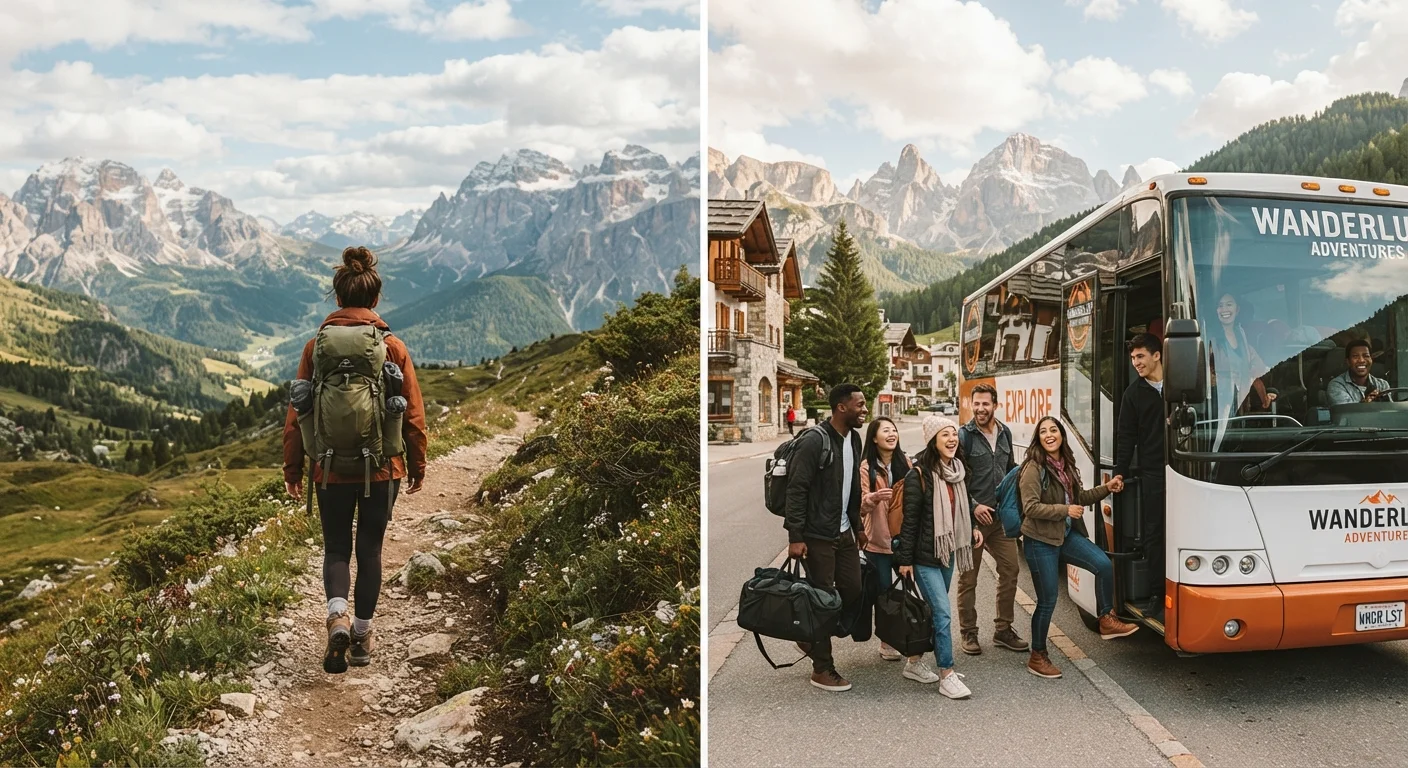
Option A
Solo Travel
The independent, self-directed approach to exploring the world.
Best for: Travelers who value flexibility, personal pace, and immersive, unscripted experiences.
Option B
Group Tours
The structured, community-driven way to see more with less planning.
Best for: Travelers who prefer built-in logistics, social connection, and guided expertise.
What Each Travel Style Actually Means
Solo travel means planning, booking, and navigating entirely on your own terms. You decide the destination, the pace, the accommodation, and how each day unfolds. There's no predetermined schedule and no one else's preferences to factor in. This approach suits people who are comfortable making decisions independently and who find spontaneity energizing rather than stressful.
Group tours, by contrast, bundle transportation, accommodation, meals, and guided experiences into a single organized package. A tour operator handles the heavy lifting — permits, reservations, local expertise — while participants follow a shared itinerary. The experience is social by design: you travel alongside a fixed group, which can feel either reassuring or constraining depending on your personality.
For a deeper look at the trade-offs between these two models in international contexts, see our detailed comparison of solo and group travel covering safety, cost, and flexibility in more depth. These styles also connect to broader decisions about pacing — our guide to slow travel versus fast-paced itineraries explores how speed of travel interacts with either style.
Planning, Cost, and Logistics
Solo travel requires you to manage every logistical layer. Booking accommodation, researching transport connections, obtaining necessary permits, and understanding local entry requirements all fall to you. The upside is that you can often find arrangements that match your preferences precisely. Evaluating accommodation beyond the star rating becomes a skill that pays off significantly when you're solely responsible for your comfort.
Group tours simplify all of this considerably. The per-person cost of a tour can appear high upfront, but it frequently bundles services that would cost more if sourced individually — particularly for remote or logistically complex destinations. Solo travelers, meanwhile, may spend less per day in budget-friendly regions but more when they require private rooms, private transport, or last-minute bookings.
| Criterion | Solo Travel | Group Tours |
|---|---|---|
| Itinerary flexibility | Complete — change plans anytime | Fixed schedule set in advance |
| Upfront planning required | High — all logistics self-managed | Low — operator handles logistics |
| Social environment | Self-created, often spontaneous | Built-in group dynamic |
| Cost structure | Variable; budget or premium | Bundled; predictable upfront cost |
| Safety support | Self-reliant; requires preparation | Guide and group provide backup |
| Depth of local interaction | Often higher — more open time | Guided; varies by tour design |
| Best destination fit | Familiar regions or well-trodden routes | Complex, remote, or unfamiliar regions |
Timing also matters. Traveling off-peak can reduce costs and crowds regardless of which style you choose. Our piece on the case for and against off-season travel walks through how seasonal timing affects both approaches differently.
Safety, Freedom, and the Social Dimension
Safety is one of the most discussed differences between these styles. Solo travelers carry full personal responsibility for their security, which means researching local conditions, sharing itineraries with trusted contacts, and making real-time judgments about unfamiliar situations. This isn't a reason to avoid solo travel — millions do it safely each year — but it demands a realistic self-assessment of your comfort with uncertainty.
Group tours offer a support network by default. Guides are typically trained to handle emergencies, navigate local regulations, and advocate for group members. For travelers entering regions with significant language differences or complex infrastructure, this can meaningfully reduce risk and stress.
Always Verify Entry and Safety Requirements
Regardless of whether you travel solo or with a group, entry requirements, visa rules, vaccination recommendations, and travel advisories can change. Always consult official government travel advisory sources and your destination country's embassy or consulate before departure. Tour operators may assist with some logistics, but verifying requirements remains your personal responsibility.
The social element shapes the experience as profoundly as safety does. Solo travelers often report richer spontaneous interactions with locals precisely because they're more approachable and have more unstructured time. Group travelers, however, benefit from the immediate community of fellow participants — a factor that matters greatly to travelers who find solo dining or exploring uncomfortable. Neither experience is inherently superior; the question is which social context feels right for you.
For inspiration on US destinations where both styles work well, our guide to off-season US city visits highlights how timing can transform domestic trips for any traveler. And if you're weighing a California itinerary, our comparison of San Francisco and Los Angeles examines how destination character shapes the travel style that fits best.
The content on this site is for informational purposes only and is not a substitute for professional advice. Always consult a qualified professional for guidance specific to your situation.