

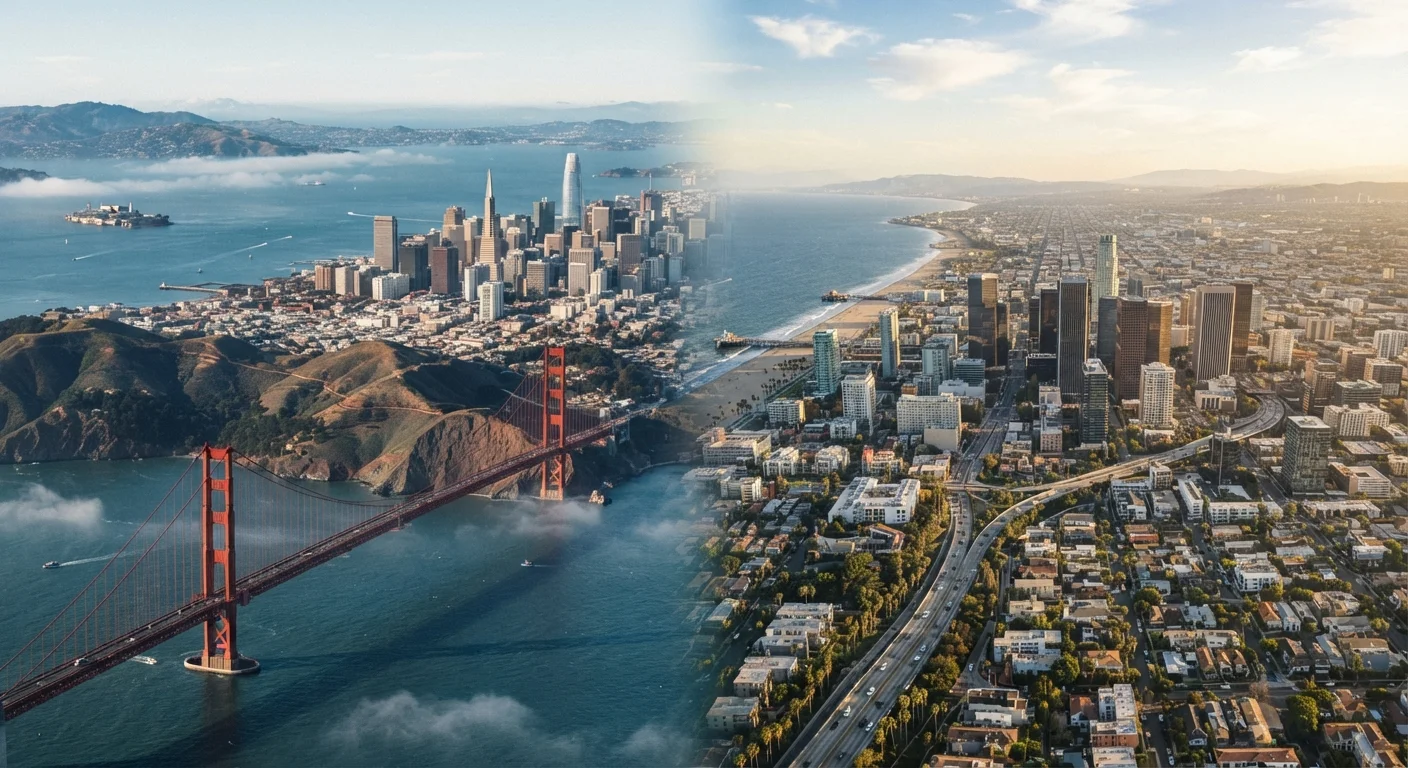
Option A
San Francisco
The compact, walkable city of neighborhoods and fog.
Best for: Travelers who want dense culture, diverse architecture, and a cooler, year-round Pacific climate packed into a navigable urban grid.
Option B
Los Angeles
The sprawling, sun-soaked entertainment capital.
Best for: Travelers seeking warm weather, iconic pop-culture landmarks, beaches, and the latitude to design a highly personalized itinerary across a vast metro area.
Scale and Navigation: The Biggest Practical Difference
The single most consequential difference between San Francisco and Los Angeles isn't culture or climate — it's scale. San Francisco covers roughly 49 square miles and holds about 870,000 residents. Los Angeles proper spans over 500 square miles with a population exceeding 3.8 million, and the broader metro area is orders of magnitude larger still.
That gap shapes everything about how a trip unfolds. In SF, a visitor staying near Union Square can reach Fisherman's Wharf, the Mission District, the Haight, or Chinatown by foot, cable car, or a short Muni ride. In LA, driving from Santa Monica to Griffith Park, then down to the Arts District, is a multi-hour commitment depending on traffic — and LA traffic is notoriously unpredictable.
Travelers who prefer not to rent a car, or who dislike driving in unfamiliar cities, tend to find San Francisco significantly easier to navigate. Those who enjoy the freedom of a car and want to cover a lot of geographic ground often thrive in LA's sprawl.
| Criterion | San Francisco | Los Angeles |
|---|---|---|
| City size | ~49 square miles | 500+ square miles |
| Best transport | Walking, Muni, BART | Car or rideshare |
| Summer climate | Cool, often foggy (60s°F) | Warm and sunny (mid-70s–80s°F) |
| Beach access | Cold, windswept shores | Wide, swimmable coastline |
| Neighborhood density | Compact, distinct neighborhoods | Spread across vast metro |
| Cultural identity | Tech, counterculture, history | Entertainment, diversity, industry |
| Food scene character | Farm-to-table, Bay Area produce | Global, highly diverse cuisines |
Climate: Don't Assume It's Always Sunny
California carries a reputation for sunshine, but that narrative fits Los Angeles far better than San Francisco. SF's proximity to the Pacific and its relationship with the marine layer produces a famously cool, often foggy climate — even in summer. July and August can be among the foggier months in parts of the city, with afternoon highs in the low-to-mid 60s°F common near the coast.
Los Angeles, by contrast, delivers warm, dry summers with temperatures regularly climbing into the mid-70s to high 80s°F, and mild winters that rarely dip below 50°F. The trade-off is wildfire smoke risk in late summer and fall, and occasional heat events inland.
If your trip centers on beach days and outdoor dining in shirtsleeves, LA is the more reliable choice. If you prefer cooler, layer-friendly weather and don't mind mist, SF's climate has its own appeal — and the fog is genuinely part of the city's character. Considering shoulder seasons? Our guide on visiting US cities off-season explores how timing affects crowds and cost in destinations like these.
SF's Microclimates Vary Block by Block
San Francisco is famous for its microclimates — conditions can shift dramatically between neighborhoods within the same hour. The Mission District often stays several degrees warmer and sunnier than Ocean Beach or the Richmond District just miles away. Packing layers and checking neighborhood-specific forecasts before heading out each day makes a real difference to comfort.
Culture, Food, and What Each City Does Best
Both cities punch well above their weight culturally, but in different registers. San Francisco's identity is shaped by its Gold Rush origins, its role in the counterculture movements of the 1960s, and its current position as a global technology hub. The result is a city with a strong sense of neighborhood identity — the Mission's Latino heritage, the Castro's LGBTQ+ history, North Beach's Beat Generation legacy — all compressed into a navigable space.
Los Angeles is a city of industries: film, music, fashion, and tech all intersect here, producing a culture that is simultaneously global and hyperlocal. It's also one of the most ethnically diverse cities in the US, reflected in a food scene that ranges from Koreatown's late-night BBQ to Oaxacan tasting menus in the Arts District.
SF's food culture leans toward farm-to-table, sourdough, and California cuisine rooted in the local agricultural abundance of the Bay Area. Both cities reward curious eaters, but the experiences are distinct enough that food alone can justify choosing one over the other depending on your preferences.
500+
Square miles in the city of Los Angeles
Los Angeles covers more than ten times the land area of San Francisco, according to US Census geographic data.
Top 5
US cities by international visitor volume
Both San Francisco and Los Angeles consistently rank among the most visited US cities by international travelers, per the US Travel Association.
~200
Foggy days per year in San Francisco
SF's marine layer produces frequent fog, particularly in summer months — a climate pattern that surprises many first-time visitors expecting California sun.
Planning Your Trip: Which City Fits Your Travel Style
The right choice often comes down to pace and priority. San Francisco rewards travelers who like to walk, linger in neighborhoods, and discover texture within a contained area. It suits a slower travel approach, where depth matters more than coverage.
Los Angeles rewards those who are comfortable behind the wheel, enjoy variety across large distances, and want to mix entertainment, outdoor recreation, and cultural exploration. A well-planned LA itinerary might include the Getty Center, a morning in Venice Beach, and an evening in Koreatown — but only if you're prepared for the driving those combinations require.
Neither city is objectively better. They serve different travel personalities and different trip goals. The clearest mistake travelers make is arriving in LA expecting San Francisco's walkability, or arriving in SF expecting year-round beach weather. Match the city to the trip you actually want to take, and both will deliver.
The content on this site is for informational purposes only and is not a substitute for professional advice. Always consult a qualified professional for guidance specific to your situation.