

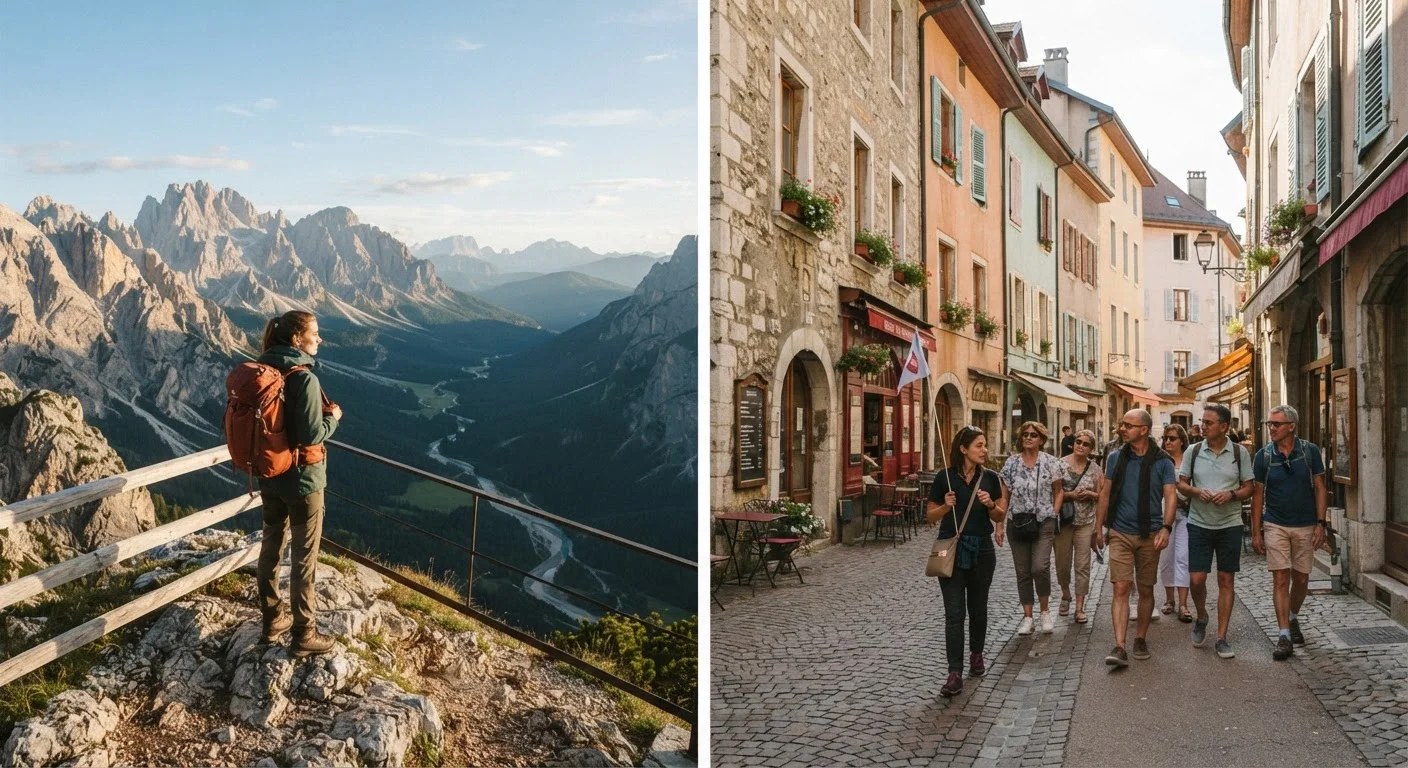
Option A
Solo Travel
The independent, fully self-directed approach.
Best for: Travellers who want complete control over their schedule, pace, and destination choices.
Option B
Group Tours
The structured, socially supported travel format.
Best for: Travellers who value built-in logistics, local expertise, and ready-made companionship.
Flexibility vs. Structure: The Core Trade-Off
The most fundamental difference between solo travel and group tours is the degree of control you hold over your own itinerary. When you travel alone, every decision — which neighbourhood to explore, how long to linger at a site, whether to skip a planned stop entirely — rests with you. That freedom is genuinely powerful, but it comes with a cost: every decision also requires your time, research, and energy.
Group tours invert this equation. The itinerary, transport, accommodation, and often meals are arranged in advance. You trade autonomy for ease, and for many travellers in many contexts, that trade is entirely rational. A packed two-week itinerary through multiple countries, for instance, is significantly less exhausting when someone else handles the logistics between stops.
The right framing is not which style is inherently better, but which fits the specific trip you're planning. For more on how pace and structure intersect with travel satisfaction, see our comparison of slow travel and fast-paced itineraries.
| Criterion | Solo Travel | Group Tours |
|---|---|---|
| Itinerary flexibility | Fully self-directed | Fixed or semi-fixed schedule |
| Logistical effort | High — traveller arranges everything | Low — operator handles logistics |
| Per-person accommodation cost | Often higher (single supplement) | Shared rates, potentially lower |
| Social connection | Organic, unpredictable | Built-in group dynamic |
| Local cultural immersion | Generally deeper, more spontaneous | Guided and curated |
| Safety support structure | Dependent on personal planning | Guide and group provide backup |
| Pace control | Entirely your own | Group pace applies |
| Suitable for first-time international travel | Possible with thorough research | Generally more accessible |
Cost, Safety, and Practical Realities
Cost comparisons between solo travel and group tours are more nuanced than they first appear. Solo travellers pay single-occupancy rates on accommodation, which are frequently higher per person than shared or twin rates. They also absorb all transport costs alone. Group tours spread many fixed costs across participants, which can make guided excursions, airport transfers, and regional travel surprisingly competitive.
That said, solo travellers gain the ability to make cost-conscious decisions in real time — choosing a locally run guesthouse over a centrally booked hotel, or eating where locals eat rather than at tour-approved restaurants. Over a longer trip, these micro-decisions can add up meaningfully in either direction.
~70%
Solo travellers who are women
Multiple travel industry surveys consistently indicate that women represent the majority of solo travellers globally, reflecting growing confidence in independent travel.
15–20%
Typical single supplement surcharge
Solo travellers booking accommodation or cruises commonly face a single-supplement surcharge in this range compared to per-person twin-share rates.
Safety is another dimension where the comparison depends heavily on context. Group tours provide an inherent social safety net: someone notices if you don't appear at breakfast, guides often carry emergency contacts and local knowledge, and the group itself deters certain risks. For solo travellers — particularly in unfamiliar regions or those with language barriers — the absence of that support structure is worth planning around carefully.
Importantly, risk is not binary. A solo traveller in a well-documented, traveller-friendly destination faces very different conditions than one navigating a region with limited infrastructure or active travel advisories. Always consult your government's official travel advisory service before finalising plans. The Travel Tips hub has further guidance on planning and preparation across trip types.
Cultural Depth and Social Experience
One consistent observation among experienced travellers is that solo travel tends to generate richer, more spontaneous interactions with local people. Without the gravitational pull of a group, solo travellers are more likely to ask locals for directions, accept an unexpected invitation, or spend an afternoon in a neighbourhood that wasn't in any guidebook. This kind of encounter is harder to replicate when you're moving with fifteen others on a fixed schedule.
Group tours, however, offer something distinct: a ready community of fellow travellers who share your interests and are experiencing the same moments alongside you. For travellers who find solo dining uncomfortable, or who are visiting a destination where cultural context genuinely benefits from expert interpretation, a guided format can deepen rather than limit the experience.
Verify Entry and Safety Requirements Independently
Whether you travel solo or with a tour operator, visa requirements, vaccination recommendations, and local safety conditions can change without notice. Always consult your government's official travel advisory and the destination country's embassy or consulate before travelling. Tour operators may provide general guidance, but they cannot substitute for official, up-to-date government advice.
A practical middle ground that many experienced travellers use is the hybrid approach: joining a group tour for a specific segment — an overland section in a remote region, a language-intensive destination, or a culturally complex site — while travelling independently before and after. This preserves flexibility where it matters most while borrowing the tour's efficiency where it genuinely helps. For perspective on how timing affects both formats, our piece on the case for and against off-season travel is worth reading before you book.
The content on this site is for informational purposes only and is not a substitute for professional advice. Always consult a qualified professional for guidance specific to your situation.