

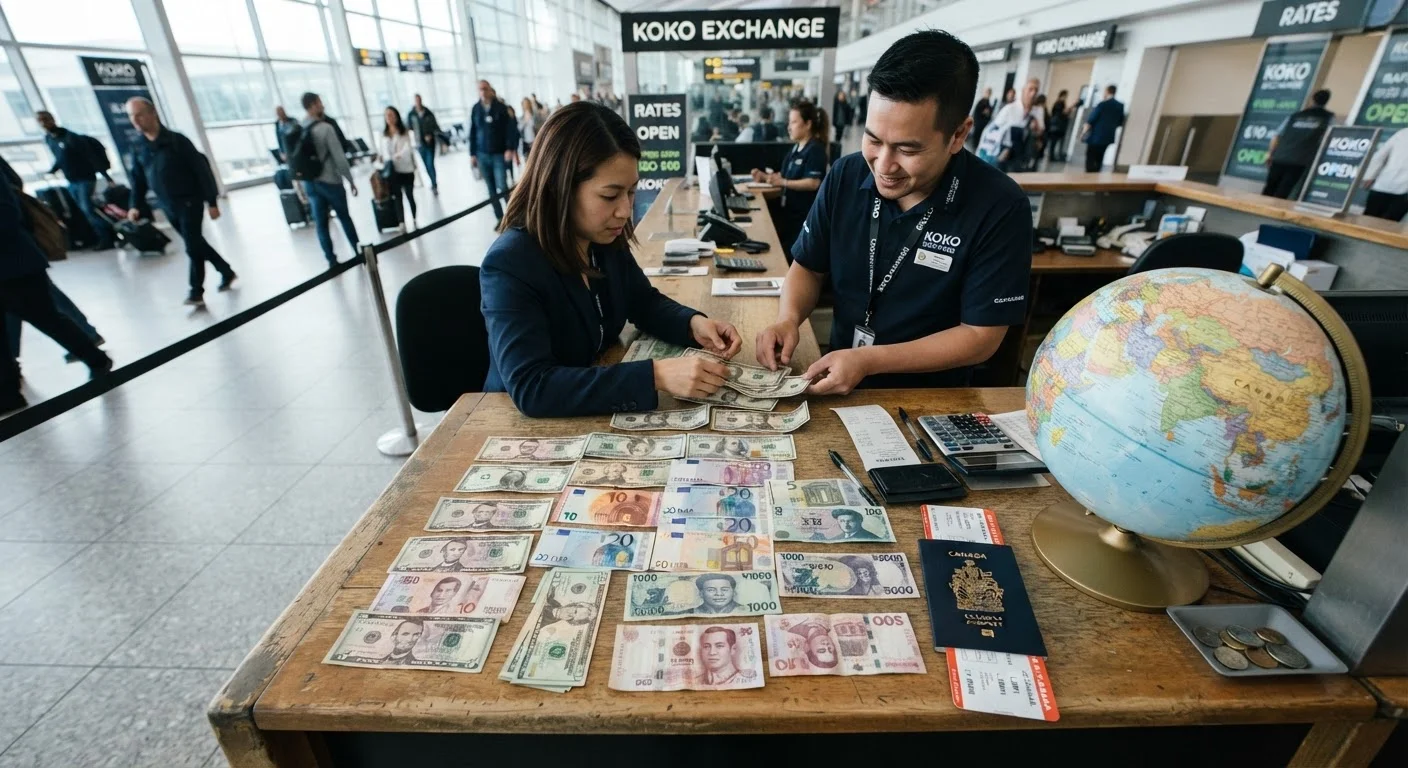
How Currency Exchange Actually Works
At its core, currency exchange is a transaction: you give up one currency and receive another at an agreed-upon rate. The rate itself is not arbitrary — it emerges from the global foreign exchange market, the largest financial market in the world by daily trading volume, where currencies are bought and sold continuously by banks, governments, corporations, and investors.
The rate consumers see posted at a bank branch or exchange kiosk is derived from this interbank market but is not identical to it. Providers add a spread — a margin between the rate they acquire currency at and the rate they offer to the public. Some providers also charge an explicit flat or percentage fee on top of the spread. Understanding both components helps you read an exchange offer accurately.
For first-time international travellers, the entire system can feel opaque. Our introduction to international travel covers the broader landscape of cross-border logistics, including currency basics, for those just getting started.
$7.5 trillion
Average daily forex market trading volume
According to the Bank for International Settlements' 2022 Triennial Central Bank Survey, the global foreign exchange market processes approximately $7.5 trillion in transactions each day.
180+
Currencies recognised by the United Nations
The United Nations recognises more than 180 official currencies in circulation worldwide, each with its own exchange dynamics relative to other currencies.
What Causes Exchange Rates to Move
Exchange rates are not fixed — they fluctuate in response to a range of economic, political, and market forces. Some of the most significant drivers include:
- Interest rates: Central banks set benchmark interest rates that influence how attractive a country's currency is to investors. Higher rates can draw foreign capital, strengthening a currency.
- Inflation: Countries with lower inflation rates tend to see their currencies appreciate over time relative to higher-inflation economies.
- Trade balances: A country that exports more than it imports may see stronger demand for its currency.
- Political stability and economic confidence: Uncertainty — elections, conflicts, policy shifts — can prompt rapid swings in currency values.
For travellers, this means the rate you see when you begin planning a trip may be meaningfully different from the rate available when you actually exchange money. Understanding what drives market volatility offers useful context for anyone curious about how financial markets respond to these forces more broadly.
“The foreign exchange market is unique in its trading volume, the liquidity of the market, its geographical dispersion, its long trading hours, and the variety of factors that affect exchange rates.”
— Bank for International Settlements, International financial institution and central bank authority on global monetary matters
Common Exchange Options Travellers Encounter
Travellers generally encounter several types of currency exchange channels, each with distinct characteristics:
- Bank branches
- Many banks offer currency exchange to account holders, sometimes at more competitive rates than other retail channels. Availability and fees vary by institution and destination currency.
- Airport and hotel kiosks
- Convenient but frequently carry wider spreads. Useful for obtaining a small amount of local currency quickly upon arrival.
- ATMs abroad
- Withdrawing local currency directly from a reputable ATM can provide rates close to the interbank rate, though your home bank may charge foreign withdrawal fees. Always opt to be charged in the local currency rather than your home currency when given the choice — a practice known as avoiding dynamic currency conversion.
- Prepaid travel cards
- Some travellers use dedicated travel-oriented prepaid cards that allow loading of multiple currencies. Fee structures and exchange terms vary widely by card and should be reviewed carefully.
Beliefs about which option is always superior are often oversimplified. Common misconceptions about exchanging money abroad examines what the evidence actually shows about these choices.
Decline Dynamic Currency Conversion
When paying by card abroad or withdrawing from an ATM, you may be offered the option to complete the transaction in your home currency. This is called dynamic currency conversion, and it typically results in a less favorable rate because the conversion is handled by the merchant or ATM operator rather than your bank. Selecting the local currency option is generally the more straightforward choice, though confirming your own bank's foreign transaction fees is also worthwhile.
Practical Considerations Before You Travel
A few steps taken before departure can reduce friction and cost when exchanging currency abroad:
- Check the mid-market rate from a neutral financial data source so you have a baseline before comparing provider offers.
- Contact your bank or credit union to understand their foreign transaction fees, ATM withdrawal policies, and whether they offer fee-free international withdrawals.
- Notify your bank of travel dates to avoid having cards blocked for suspected fraud when used in unfamiliar locations.
- Carry a backup payment method — not every destination is uniformly card-friendly, and ATM access can be limited in rural or remote areas.
Entry logistics — including what documents and funds you may need at a border — are worth reviewing separately. Entry requirement mistakes that catch travellers off guard outlines common gaps in pre-travel preparation.
Currency exchange is one part of a broader set of logistical details to organise for international trips. For a consolidated reference on visas, plug adapters, time zones, and similar fast-lookup facts, see our international travel reference sheet.
Rates and Fees Change — Verify Before You Travel
Exchange rates and provider fee structures change frequently. Any specific rate or fee mentioned in general travel guidance may not reflect what is available at the time of your trip. Always verify current rates directly with your bank, card issuer, or chosen exchange provider before departing. For destination-specific advice — including whether cash is preferred locally — consulting official tourism resources or recent traveller guidance for that country is advisable.
Frequently Asked Questions
An exchange rate is the price of one currency expressed in terms of another. Rates are set continuously in global foreign exchange (forex) markets, driven by factors like interest rates, inflation, trade balances, and investor sentiment. Consumer-facing rates differ from interbank rates because providers add their own margin.
Common options include bank branches, airport exchange kiosks, hotel desks, and ATMs that dispense local currency. Each comes with different fees and rates. ATMs at local banks abroad often provide competitive rates, but your home bank may charge foreign transaction or withdrawal fees — check before you travel.
There is no universal answer, as rates and fees vary by provider and destination. Some travellers exchange a small amount before departure for immediate needs, then use local ATMs or banks for the remainder. Consulting your bank and checking independent rate comparisons before departing is advisable.
A spread is the difference between the rate at which a provider buys a currency and the rate at which it sells it. This margin is how exchange businesses generate revenue. A wide spread means the traveller receives a less favorable rate even if no explicit fee is charged.
Airport kiosks are convenient and generally reliable in terms of safety and legitimacy, but they often carry wider spreads than alternatives. Rates can vary significantly between locations. It is worth having a small amount of local currency ready for immediate needs and comparing other options once you arrive.
Verify the current mid-market rate from a neutral source, then compare the rate and any explicit fees offered by your chosen provider. Also confirm whether your debit or credit card charges foreign transaction fees, and check whether your bank reimburses ATM fees abroad.
The content on this site is for informational purposes only and is not a substitute for professional advice. Always consult a qualified professional for guidance specific to your situation.