

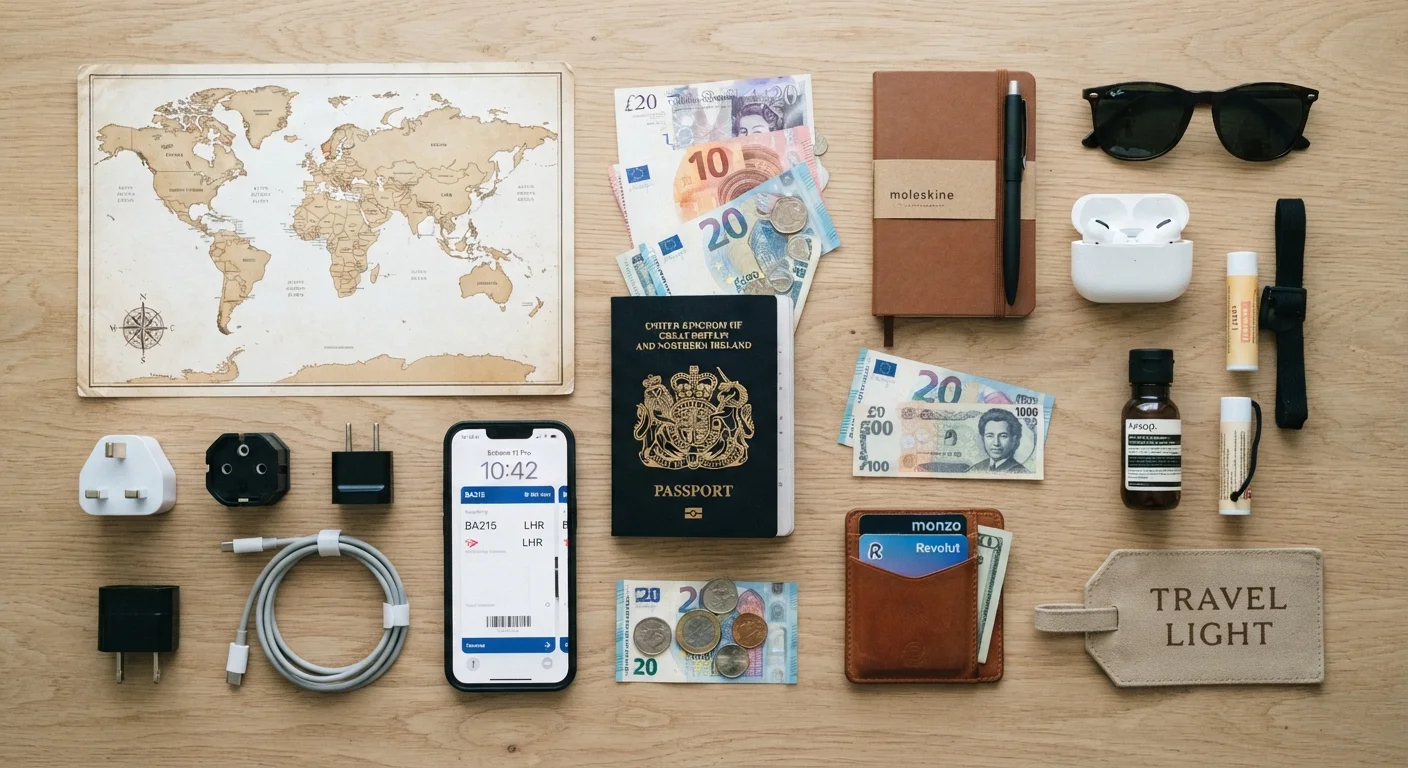
Electrical Voltage and Plug Types by Region
One of the most overlooked pre-departure tasks is confirming whether your devices will work at your destination. Two variables matter: voltage and plug type.
Most of North America operates on 110–120V at 60Hz, while the majority of the world — including Europe, Asia, Africa, and Australia — uses 220–240V at 50Hz. Plugging a 110V-only device into a 220V outlet without a voltage converter can permanently damage it. Many modern electronics (laptops, phone chargers, cameras) are dual-voltage and will indicate "100–240V" on the power brick — those need only a plug adapter, not a converter.
Plug shapes vary by country and fall into several internationally recognized types. Type A (two flat parallel pins) is standard in the US and Canada. Type C (two round pins) is the most widely used in Europe and South America. Type G (three rectangular pins in a triangle) is used in the UK, Ireland, and much of East Africa. Type I (two or three flat pins in a V shape) covers Australia and New Zealand. Type B (two flat pins plus a round ground pin) is found in Japan and Mexico alongside Type A.
Multi-port universal adapters cover the most common configurations but do not convert voltage — confirm your device's compatibility before relying on one. For extended trips to multiple regions, a universal adapter with built-in USB ports offers the most flexibility.
Visa Categories: What Each One Actually Means
A visa is official authorization — typically stamped or affixed to your passport, or issued electronically — that permits entry into a country for a specific purpose and duration. Categories vary by country, but the most common types travellers encounter are described below.
Visa on Arrival (VOA)
An entry permit issued at the port of entry rather than obtained in advance. Eligibility is determined by your passport nationality and the destination country's current immigration policy.
eVisa / Electronic Travel Authorization
A digitally issued travel permit linked to your passport, applied for online before departure. Processing time varies by country and application volume.
Voltage Converter
A device that changes the electrical voltage level so that appliances designed for one voltage standard (e.g., 110V) can safely operate on a different standard (e.g., 220V).
Plug Adapter
A physical connector that allows a plug from one country's socket standard to fit into another country's outlet. It does not convert voltage.
UTC (Coordinated Universal Time)
The global time standard against which all time zones are calculated. Offsets are expressed as UTC+ or UTC− followed by the number of hours (and sometimes minutes) of difference.
Visa Waiver Program (VWP)
A US government program that allows nationals of certain countries to travel to the United States for tourism or business for up to 90 days without obtaining a visa, subject to pre-travel ESTA authorization.
Visa on arrival (VOA) is granted at the port of entry rather than requiring advance application. Eligibility depends on your passport nationality and the destination country's current policy — always verify through the destination country's official immigration authority before travel, as rules change.
Electronic Travel Authorization (eTA) or Electronic Visa (eVisa) systems require online pre-registration before departure. Canada, Australia, Sri Lanka, and Kenya are among countries that use these systems. Processing is typically fast but is not always instant, so apply well in advance.
If you hold a passport from a country with a visa-waiver agreement with your destination, you may enter without any prior authorization for short stays — commonly 30 to 90 days. The US Visa Waiver Program (VWP) and the Schengen Area's forthcoming ETIAS system are prominent examples.
Always verify your specific visa requirements at least six to eight weeks before travel using your country's official foreign affairs website and the destination country's embassy or consulate site. See our complete pre-departure document checklist for additional guidance on what to prepare alongside your visa.
Navigating Time Zones
The world is divided into 24 primary time zones based on offsets from Coordinated Universal Time (UTC). New York (Eastern Standard Time) is UTC−5; London (GMT) is UTC+0; Tokyo is UTC+9; Dubai is UTC+4.
Daylight Saving Time Varies Widely
Not all countries observe Daylight Saving Time (DST), and those that do often change their clocks on different dates. The US and Europe, for example, shift clocks on different Sundays in spring and fall, creating a brief window each year when the usual offset between them is one hour off. Countries near the equator — and several others like Japan and India — do not observe DST at all. Always confirm the current offset, not just the standard one, when scheduling connections or calls abroad.
Crossing the International Date Line, located roughly along the 180° meridian in the Pacific, means the calendar date changes — westward crossings advance the date by one day, eastward crossings subtract one. This is relevant for flights between North America and Asia or Oceania. For a deeper look at how time zones and jet lag interact, see our guide to time zones and jet lag.
Practical tips for managing time zones: set your watch or phone to destination time as soon as you board your flight; plan sleep and meals around local time rather than home time; and if your trip spans multiple countries, use the World Clock function on your phone to track several zones simultaneously.
Some countries — including India (UTC+5:30), Iran (UTC+3:30), Nepal (UTC+5:45), and Australia's South Australia state (UTC+9:30) — use half-hour or quarter-hour offsets rather than full-hour increments, which can catch travellers off guard when scheduling calls or connections.
Other Fast-Reference Facts Before You Go
A few additional logistical details are worth confirming for any international trip:
- Emergency numbers: 112 works across most of Europe and many other countries as a universal emergency number. 999 is used in the UK and parts of the Commonwealth. Research the local number before you land.
- Currency: The euro (€) is used in 20 EU member states, making it the most widely applicable single currency for European travel. Understanding how exchange rates work helps you avoid unnecessary fees — our overview of currency exchange covers the essentials.
- Driving side: Roughly 35% of countries drive on the left, including the UK, Australia, Japan, India, and South Africa — important if you plan to rent a vehicle.
- Tap water safety: Tap water is generally safe to drink in North America, Western Europe, Australia, and Japan, but may not be in many parts of Asia, Africa, Latin America, and Eastern Europe. Check local advisories.
For a comprehensive planning foundation, our introduction to international travel walks through passports, customs, and cultural norms in a single reference. The essential pre-departure checklist is also a useful companion to this sheet.
195
Countries in the world, each with its own entry requirements
Entry rules, visa categories, and required documents vary significantly by destination and passport nationality.
15+
Distinct electrical plug types used globally
The IEC (International Electrotechnical Commission) recognizes more than 15 plug and socket types worldwide.
UTC+5:45
Nepal's unique time zone offset
Nepal Standard Time is one of fewer than 10 zones worldwide that uses a quarter-hour increment rather than a full-hour offset.
The content on this site is for informational purposes only and is not a substitute for professional advice. Always consult a qualified professional for guidance specific to your situation.