

Why Currency Exchange Trips Up Even Experienced Travellers
Currency exchange seems straightforward until you realise you've paid far more than expected for far less than advertised. Many of the beliefs travellers hold about exchanging money — when to do it, where, and how — are based on assumptions that don't hold up under scrutiny.
This article addresses the most persistent misconceptions, drawing on how exchange markets actually work. For a broader grounding in the mechanics of foreign exchange, see our guide to how currency exchange works. And if you're preparing for your first international trip, the first-timer's introduction to international travel covers the full logistics picture.
Myth
Exchanging currency at the airport before your flight is the safest and most convenient option.
Fact
Airport exchange bureaus are convenient but consistently offer some of the widest margins above the mid-market rate.
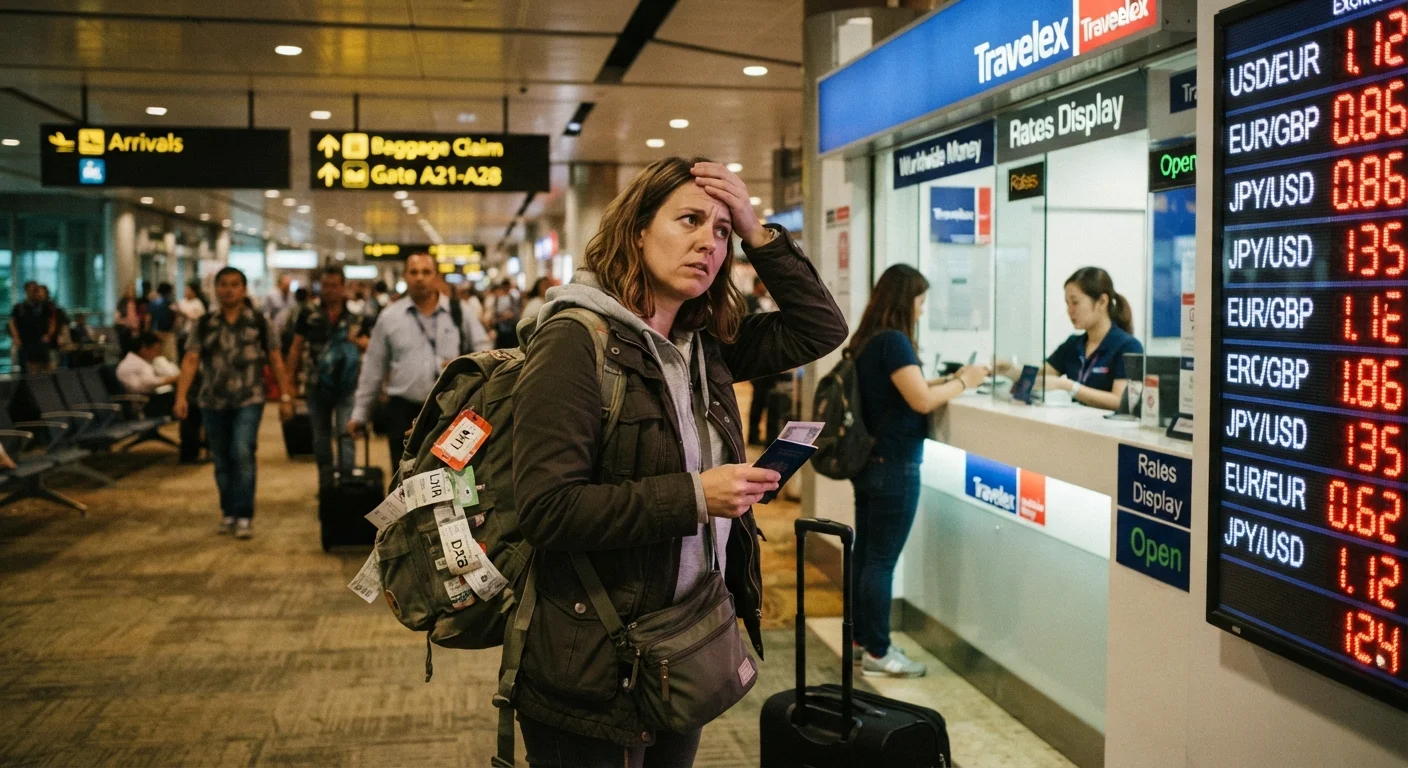
Airport kiosks occupy a captive market — travellers are time-pressed and have few alternatives. Providers take advantage of this. The spread between what you pay and the interbank (mid-market) rate at an airport counter can be significantly higher than what a bank branch, credit union, or ATM abroad might charge. Convenience is real, but it carries a measurable cost. If you need local currency immediately on arrival, withdrawing a modest amount from an ATM at the destination is generally more cost-effective than exchanging before departure at an airport counter.
Myth
The exchange rate shown on Google or XE.com is what you'll get when you exchange money.
Fact
That figure is the interbank mid-market rate — a wholesale benchmark that retail customers almost never receive directly.
The mid-market rate is the midpoint between global buying and selling prices for a currency pair. It is useful as a reference point for comparing what different providers charge, but no retail provider exchanges at exactly that rate. Every provider adds a margin — sometimes disclosed as a fee, sometimes baked invisibly into the rate itself. When comparing options, calculate what percentage above the mid-market rate you're being quoted, rather than just accepting the rate at face value.
Myth
Accepting dynamic currency conversion (DCC) at a card terminal is helpful because you can see the charge in your home currency.
Fact
Dynamic currency conversion almost always applies an unfavourable exchange rate set by the merchant's payment processor, not your bank.
When a card terminal abroad asks whether you want to pay in your home currency or the local currency, choosing your home currency activates DCC. While the transparency feels reassuring, the rate applied is typically set by the retailer's processor and is almost always less favourable than your card network's rate. The general guidance from consumer finance organisations is to always pay in the local currency and let your own bank or card network handle the conversion. Decline DCC wherever it's offered.
Myth
Using a travel money card always saves money compared to a regular debit or credit card.
Fact
Travel cards vary widely in their fee structures; some are competitive, others are not — and some charge for inactivity or loading.
Prepaid travel cards are marketed on the promise of locked-in rates and fee savings, but the actual value depends heavily on the specific card's terms. Some carry ATM withdrawal fees, currency conversion fees when topping up, and expiry or inactivity charges. A card with no foreign transaction fee and no ATM withdrawal fee can perform equally well or better in many scenarios. The key is reading the fee schedule, not the marketing headline.
Myth
You don't need any local cash if you have a contactless card — cards are accepted everywhere now.
Fact
Card acceptance varies dramatically by destination, region within a country, and type of vendor.
In major urban centres of high-income countries, card payments are widely accepted. But rural areas, smaller businesses, markets, transit systems, and some entire countries still operate predominantly in cash. Even in card-friendly destinations, a system outage, a minimum spend requirement, or a vendor preference for cash can leave a card-only traveller stranded. Carrying a moderate amount of local currency as a backup remains a sensible precaution regardless of destination.
Making Smarter Choices at the Point of Exchange
Understanding what to avoid is only half the equation. Applying that knowledge at the right moment — before you travel, at a payment terminal, or when withdrawing from an ATM abroad — is where it actually matters.
Always Verify Fees Before You Travel
ATM fees, foreign transaction charges, and currency conversion margins differ between card issuers, banks, and exchange providers. What applies to one traveller's account may not apply to yours. Contact your bank or card provider before departure to confirm exactly what fees apply to overseas withdrawals and purchases — and check whether your card charges a foreign transaction fee at all. Assumptions here are a common and avoidable source of unexpected costs.
A practical baseline: check the mid-market rate on a reliable financial data source before any exchange transaction, then assess what margin the provider is adding. That spread is your real cost. Providers rarely advertise it directly, which is why most travellers underestimate how much they're paying.
For context on how currency exchange decisions connect to broader financial habits, it's worth reading about common myths about credit card balances — particularly if you plan to carry travel spending on a card.
Up to 15%
Margin added at some airport exchange counters
Consumer finance research has documented spreads of up to 15% above mid-market rates at certain airport currency exchange providers, compared to 1–3% at more competitive alternatives.
3–7%
Typical DCC rate premium over card network rate
Financial regulators in several countries have noted that dynamic currency conversion markups commonly range from 3% to 7% above the rate your card issuer would otherwise apply.
The central takeaway: no single method is universally perfect, but being aware of the fee structure of whatever option you choose puts you firmly ahead of most travellers. Verify rates, decline dynamic currency conversion, and always confirm ATM and card fees with your bank before departure.
The content on this site is for informational purposes only and is not a substitute for professional advice. Always consult a qualified professional for guidance specific to your situation.