

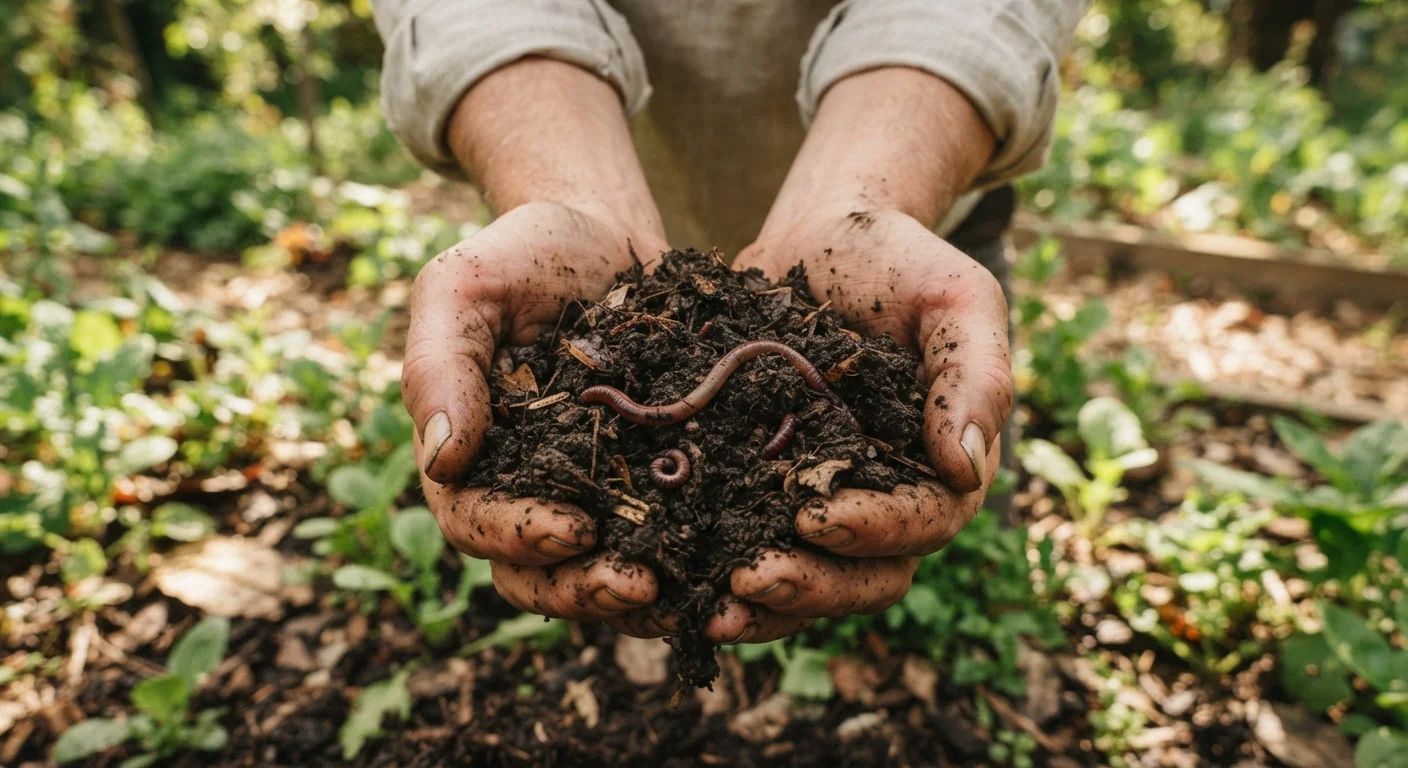
Why Soil Is More Than Just Dirt
Most gardening problems — yellowing leaves, poor harvests, plants that refuse to establish — trace back to the soil. Yet soil is the part of the garden most gardeners think about least. Understanding what's actually happening beneath the surface changes how you approach almost every growing decision.
Healthy soil has four main components in roughly the right proportions: mineral particles (sand, silt, and clay), organic matter (decomposed plant and animal material), water, and air. It also contains a staggering variety of living things — bacteria, fungi, protozoa, nematodes, and earthworms — that collectively drive nutrient cycling and make plant growth possible.
When any of these elements falls out of balance, plants feel it. Compacted soil blocks root expansion and suffocates microbial life. Soil low in organic matter drains too fast or holds too much water. Soil with poor biological activity forces plants to rely entirely on whatever nutrients you add, rather than drawing on the natural cycling the soil would otherwise provide.
Soil and the Gut Microbiome: A Surprising Parallel
Researchers have noted that soil biology and the human gut microbiome share structural similarities — both are complex microbial communities where diversity correlates with resilience and function. While the science operates at very different scales, the parallel is a useful reminder that feeding beneficial organisms (not just the host plant or body) is key to long-term health. For more on how microbiomes work in a human health context, see our overview of the gut microbiome.
pH: The Master Switch for Nutrient Availability
Soil pH is measured on a scale from 0 (highly acidic) to 14 (highly alkaline), with 7 being neutral. It matters because pH controls the solubility of soil nutrients — whether they're in a form roots can actually absorb. Even if iron, manganese, or phosphorus are physically present in your soil, the wrong pH locks them out chemically.
Most common vegetables, fruits, and ornamentals do best in a pH range of roughly 6.0–7.0. Blueberries and azaleas are notable exceptions, preferring more acidic conditions around 4.5–5.5. Lawns are generally more forgiving but still perform better closer to neutral.
To raise pH (make soil less acidic), garden lime — typically ground limestone — is the standard approach. To lower pH, elemental sulfur or acidifying compost can help, though changes happen slowly. Always test first: guessing at amendments can make things worse rather than better.
Test Before You Amend
Adding lime, sulfur, or fertilizer without testing first is a common and avoidable mistake. Over-liming, for instance, can push pH too high and create new nutrient deficiencies. A soil test — available through most cooperative extension services — gives you a precise starting point and prevents wasted effort and expense.
Organic Matter and the Life Within It
Organic matter — partially and fully decomposed plant material — is the engine of a healthy soil ecosystem. It feeds the microorganisms that break down nutrients into forms plants can use, improves soil structure so that it holds both air and water well, and helps buffer pH swings. Compost is the most accessible and reliable source for home gardeners.
Soil biology deserves more credit than it typically gets. Mycorrhizal fungi, for example, form symbiotic relationships with plant roots, extending their reach significantly and helping them access water and phosphorus. Bacteria fix atmospheric nitrogen and help decompose organic material. Earthworms physically aerate and enrich the soil as they move through it.
Practices that harm this biology — heavy pesticide use, chronic tilling, leaving soil bare and baking in summer sun — accumulate costs over seasons. Covering soil with mulch, adding compost regularly, and limiting unnecessary disruption are among the most effective ways to support it. For a closer look at mulch options and how they interact with soil health, see our comparison of organic vs. inorganic mulch.
Compaction, Structure, and the Physical Side of Soil
Soil structure describes how mineral particles clump together into aggregates, creating a network of pores that hold air and water. Good structure looks and feels crumbly — a handful breaks apart easily. Poor structure feels dense and sticky when wet, or brick-hard when dry.
Compaction — caused by foot traffic, heavy machinery, or working wet soil — collapses those pores. Roots struggle to penetrate compacted soil, water pools or runs off instead of infiltrating, and the microbial activity that depends on oxygen slows dramatically. This is why dedicated pathways and avoiding walking on planting beds matters more than many gardeners realize.
Clay-heavy soils are especially prone to compaction and poor drainage but are also naturally nutrient-rich. Sandy soils drain quickly but hold little water or nutrition. Both improve dramatically with regular additions of organic matter, which physically changes how particles bind together over time. Pairing good soil structure with smart watering habits makes a real difference — our article on garden watering myths explores how irrigation choices interact with soil conditions.
~1 billion
Bacteria per teaspoon of healthy garden soil
USDA Natural Resources Conservation Service estimates put microbial populations in productive soils at extraordinary densities, underlining that soil is a living system, not an inert medium.
5%
Organic matter content in high-quality topsoil
While averages vary widely by region, many soil scientists consider 3–5% organic matter a target for productive garden soil; much US agricultural topsoil falls below this threshold.
6.0–7.0
Optimal pH range for most vegetables
This range is widely cited by university extension programs as the window in which the broadest set of nutrients remain plant-available in typical garden soils.
Taking Stock: How to Actually Assess Your Soil
Before adding any amendment, it's worth knowing what you're starting with. The simplest and most informative step is a soil test. Many US cooperative extension services offer testing for a modest fee, with results that include pH, macronutrient levels, and often organic matter content, along with locally calibrated recommendations.
Beyond testing, a few field observations are telling. Does water pool and sit, or does it infiltrate quickly? Does a spade go in easily, or is the soil compacted? Dig down six inches — are there earthworms? Does the soil smell earthy and rich, or flat and lifeless?
Once you understand your baseline, targeted improvements become much more effective. Gardeners who also pay attention to what they grow — and how plants respond to each other in the soil — often find useful information in companion planting research, since some plant combinations actively support soil biology. Similarly, matching plants to your soil and site from the start — using resources like plant label information — reduces the work needed to compensate for soil limitations.
Frequently Asked Questions
Signs of healthy soil include a dark, crumbly texture, an earthy smell, visible earthworms, and plants that grow vigorously without constant feeding. A more reliable method is a soil test through your local cooperative extension service, which measures pH, nutrient levels, and organic matter content.
Most vegetables grow best in soil with a pH between 6.0 and 7.0, which is slightly acidic to neutral. Outside this range, nutrients become chemically locked and unavailable even when present. A soil test will tell you exactly where your soil stands and what amendments, if any, are needed.
Adding compost is the fastest and most broadly effective improvement you can make. A 2–3 inch layer worked into the top several inches of soil improves structure, feeds microbial life, and buffers pH. Avoiding compaction and reducing tilling are equally important complementary steps.
Frequent or deep tilling disrupts fungal networks and the habitat structure that soil organisms depend on, and it can accelerate the breakdown of organic matter. Reduced or no-till approaches — combined with regular compost additions — tend to support soil biology better over time.
Earthworms physically aerate soil as they tunnel, improve drainage, and leave behind nutrient-rich castings that feed plants. Their presence is generally a reliable indicator that soil organic matter and biology are in reasonably good shape.
Yes, though container soil has different dynamics than garden beds. Potting mixes deplete organic matter faster and may need refreshing each season. See our <a href="/home-garden/garden-outdoors/container-gardening-growing-vegetables-herbs-and-flowers-without-a-garden-bed">guide to container gardening</a> for practical advice on maintaining soil quality in pots.
The content on this site is for informational purposes only and is not a substitute for professional advice. Always consult a qualified professional for guidance specific to your situation.