

Why Tyre Pressure Affects How Much Fuel You Use
Most drivers think about fuel economy in terms of driving style or engine health. Tyre pressure rarely enters the conversation — yet it has a direct, measurable impact on how many miles you get per gallon.
The mechanism is straightforward. An under-inflated tyre deforms more as it rolls, increasing the area of rubber in contact with the road. This deformation requires energy to overcome on every rotation — energy that has to come from the engine, and therefore from the fuel tank. This phenomenon is called rolling resistance, and tyre pressure is one of its primary drivers.
According to the U.S. Department of Energy, tyres that are under-inflated by just 1 PSI across all four wheels can lower fuel economy by approximately 0.2%. That figure compounds quickly: a vehicle running 8 PSI low on all four tyres — a common real-world scenario — could be losing over 1.5% fuel efficiency purely from tyre pressure alone.
Up to 3%
Potential fuel economy gain from correct tyre inflation
According to the U.S. Department of Energy, properly inflated tyres can improve gas mileage by up to 3% compared to under-inflated tyres.
~1 PSI
Pressure lost per 10°F temperature drop
Tyre pressure decreases by roughly 1 PSI for every 10-degree Fahrenheit fall in ambient temperature, making seasonal checks essential.
25%
Pressure drop needed to trigger standard TPMS warning
Federal regulations require TPMS systems to alert drivers when pressure falls approximately 25% below the vehicle manufacturer's recommended level.
The connection to everyday costs is real. If you're filling up frequently and haven't checked your tyres recently, pressure is a logical first place to look. It's also one of the few maintenance tasks that costs nothing but a few minutes of your time.
How to Find the Right Pressure — and What to Do With It
A common misconception is that the number printed on the tyre sidewall is the pressure you should inflate to. It isn't. That figure is the maximum pressure the tyre is structurally rated to hold — not the pressure your vehicle is designed to run on.
The correct specification for your vehicle is found in two places: the sticker inside the driver's door jamb, or your owner's manual. These figures are set by the vehicle manufacturer based on the car's weight, suspension geometry, and intended load. They are the numbers you should follow.
Always Check Pressure on Cold Tyres
Heat generated during driving temporarily raises tyre pressure, which can make an under-inflated tyre appear acceptable on a gauge. Check your tyres first thing in the morning or after the vehicle has sat for at least three hours for the most accurate reading. If you must add air after driving, inflate to about 4 PSI above the recommended figure, then recheck when the tyres have cooled.
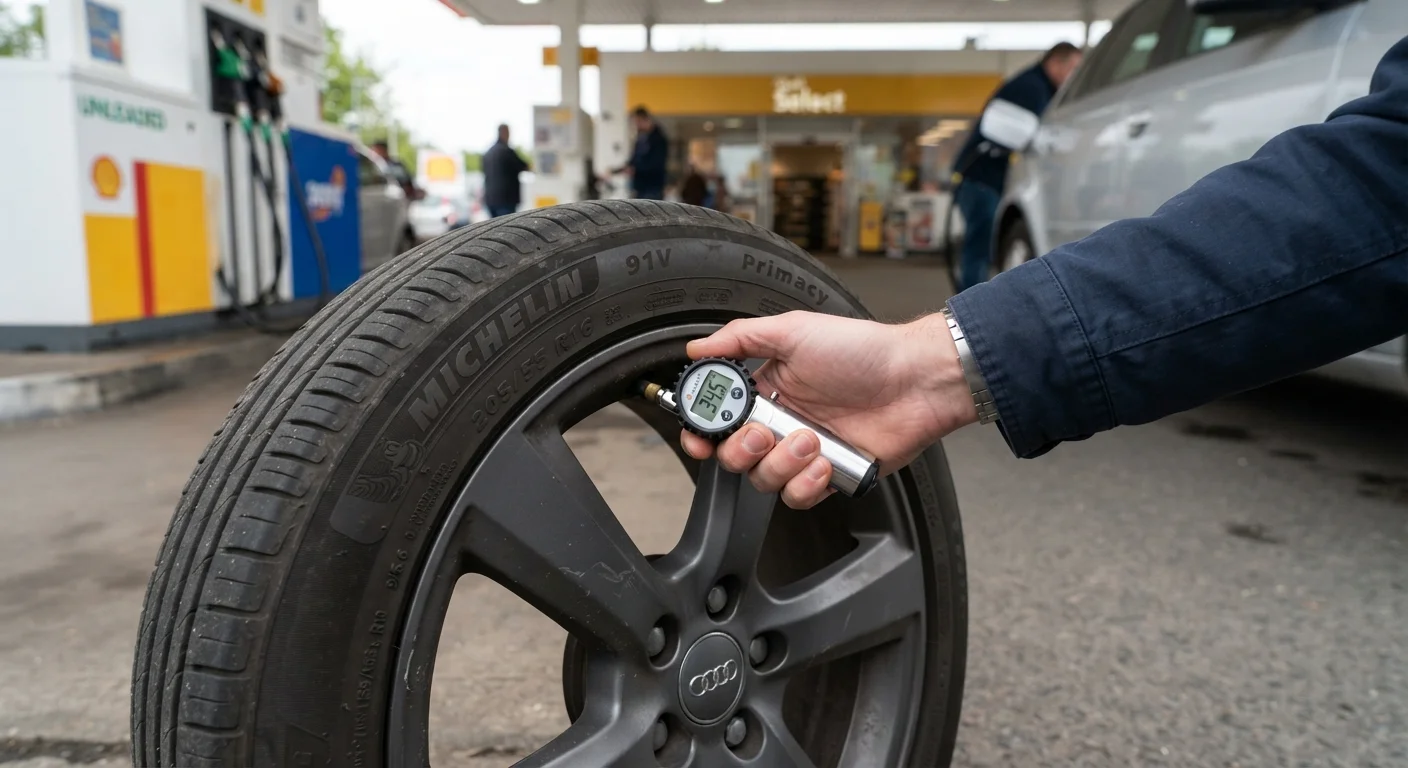
To check your pressure accurately, use a reliable tyre gauge — digital gauges are inexpensive and easy to read. Check tyres when they are cold (driven less than a mile), since heat from driving temporarily raises pressure and can give a misleading reading. Most gas stations have air compressors available, and many now offer free air.
For a broader look at what's written on your tyres and what it actually means, see our guide on tyre sidewalls, tread, and markings.
Beyond Fuel Economy: The Wider Cost of Neglected Pressure
The fuel efficiency argument is compelling on its own, but tyre pressure has several other consequences that drivers should understand.
Tyre Wear
Under-inflated tyres wear unevenly — typically faster on the outer edges of the tread — shortening the tyre's overall lifespan. Over-inflated tyres do the opposite, wearing the centre of the tread prematurely. Either pattern means earlier replacement costs that proper inflation could have deferred.
Handling and Safety
Tyre pressure directly influences how the vehicle responds to steering inputs and how quickly it stops. Under-inflated tyres are less responsive and can increase stopping distances — a serious concern at highway speeds. Severely low pressure also raises the risk of a blowout, particularly in hot conditions or under load. Our overview of tyre condition and road safety explores the safety dimensions in more depth.
Tyre Pressure Monitoring Systems (TPMS)
Vehicles sold in the U.S. after September 2007 are required to include a TPMS, which alerts the driver when pressure drops around 25% below the recommended level. This is a useful safety net — but it is not a substitute for regular checks. A tyre can be meaningfully under-inflated without triggering the warning light.
TPMS Is a Warning System, Not a Maintenance Tool
The tyre pressure monitoring system in your vehicle is designed to alert you to a potentially dangerous pressure drop — not to confirm your tyres are optimally inflated. A tyre running 10–15% below the recommended pressure may provide no dashboard warning at all, yet will still increase fuel consumption and wear unevenly. Regular manual checks remain necessary even on vehicles equipped with TPMS.
Maintaining tyre pressure sits naturally alongside other routine checks. If you're building your maintenance habits, the car maintenance guide for new drivers covers the full range of checks that keep a vehicle running well.
Temperature, Seasons, and Pressure Drift
Tyre pressure is not static — it changes with ambient temperature. As a general rule, tyres lose approximately 1 PSI for every 10°F drop in outside temperature. This means a tyre correctly inflated at 35 PSI on a warm autumn day may read closer to 30 PSI when a cold snap arrives — a meaningful difference in real-world terms.
For drivers in colder climates, this makes monthly pressure checks in autumn and winter especially important. It also applies when travelling between significantly different climates, such as from a warm lowland to a cold mountain pass.
Pressure management is just one piece of the broader vehicle ownership picture. A consistent approach to routine checks — tyres, fluids, and service intervals together — is what keeps long-term running costs down. The practices outlined in making your vehicle last longer reinforce why small habits matter more than expensive interventions.
If you're developing a broader home-check routine, pairing a monthly tyre inspection with your fluid level checks is a practical approach. Our fluid levels walkthrough covers that process step by step.
Frequently Asked Questions
The U.S. Department of Energy estimates that keeping all four tyres properly inflated can improve fuel economy by up to 3%. While that may sound modest, it adds up meaningfully over tens of thousands of miles — and the cost of a pressure check is essentially zero.
Most mechanics recommend checking tyre pressure at least once a month and before any long road trip. Pressure changes with temperature — tyres typically lose about 1 PSI for every 10°F drop in ambient temperature — so more frequent checks are worthwhile in autumn and winter.
The recommended pressure for your specific vehicle is printed on a sticker inside the driver's door jamb or in your owner's manual. Do not rely on the maximum pressure figure printed on the tyre sidewall — that is the tyre's structural limit, not the recommended operating pressure.
Over-inflation reduces the tyre's contact patch with the road, which can slightly lower rolling resistance but also compromises grip and causes the centre of the tread to wear faster than the edges. The efficiency gains are marginal and the safety trade-offs are not worth it; stick to the manufacturer's specification.
TPMS warns you when pressure drops significantly below a safe threshold — typically around 25% below the recommended level. However, a tyre can be noticeably under-inflated without triggering the TPMS warning, so monthly manual checks with a gauge are still important.
Yes. Under-inflated tyres flex excessively, which can affect steering response, increase stopping distances, and raise the risk of a blowout — particularly at highway speeds. Maintaining correct pressure is as much a safety matter as an efficiency one.
The content on this site is for informational purposes only and is not a substitute for professional advice. Always consult a qualified professional for guidance specific to your situation.