

Decoding the Number String on Your Tyre Sidewall
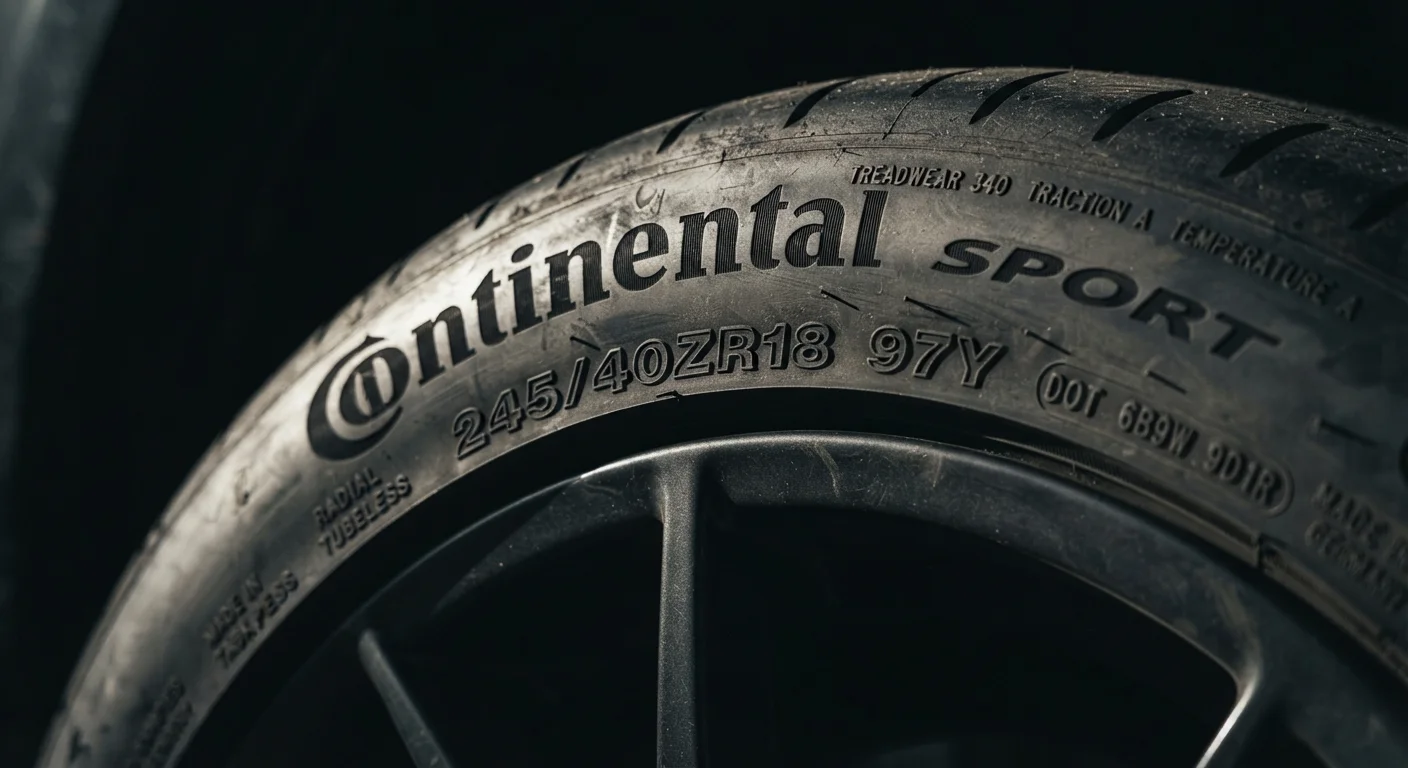
Every tyre sold in the United States carries a standardised alphanumeric code moulded into its sidewall. At first glance it looks like a random string — something like P215/65R16 98H — but each character has a precise meaning that directly affects vehicle safety and performance.
| Legal minimum tread depth (US) | 2/32 inch (US Federal Motor Vehicle Safety Standards) |
| Recommended replacement threshold (wet/winter) | 4/32 inch (General industry safety guidance) |
| Tyre width measurement unit | Millimetres (section width) |
| Rim diameter measurement unit | Inches |
| Maximum tyre age (general guidance) | 6 years before professional inspection (General manufacturer and safety guidance) |
| Speed rating 'H' maximum | 130 mph (210 km/h) (ETRTO / US tyre industry standard) |
Breaking down that example:
- P — Service type. P stands for passenger vehicle. LT indicates light truck, and T designates a temporary spare.
- 215 — Section width in millimetres, measured from sidewall to sidewall at the tyre's widest point.
- 65 — Aspect ratio. This is the tyre's sidewall height expressed as a percentage of the section width. A 65 means the sidewall height is 65% of 215 mm.
- R — Construction type. R stands for radial, which is the dominant construction type on modern passenger vehicles.
- 16 — Rim diameter in inches. The wheel your tyre must fit.
- 98 — Load index. Each number corresponds to a maximum load capacity per tyre. A load index of 98 equates to roughly 1,653 lbs per tyre.
- H — Speed rating. The maximum sustained speed the tyre is designed to handle. H equals 130 mph (210 km/h).
Just as nutrition labels carry precise codes once you know the system, tyre sidewall markings become immediately readable with a simple key.
Tread Depth: Why It Matters and How to Check It
Tread is the patterned rubber surface that contacts the road. Its primary job is to channel water away from the contact patch, maintaining grip on wet surfaces. As tread wears down, that ability diminishes significantly.
2/32"
US legal minimum tread depth
Below this depth, a tyre is considered legally worn out under US Federal Motor Vehicle Safety Standards.
~40%
Increase in wet stopping distance at minimum tread depth
Industry testing consistently shows braking performance degrades substantially as tread depth falls below 4/32 inch on wet roads.
In the US, the legal minimum tread depth is 2/32 of an inch. Many safety organisations recommend replacing tyres at 4/32 of an inch, particularly in wet or winter conditions, because stopping distances increase substantially below that threshold.
Quick Tread Check Methods
- Tread wear indicators: Modern tyres have moulded wear bars running across the grooves. When the tread surface is flush with these bars, the tyre has reached its minimum legal depth.
- Penny test: Insert a penny into a tread groove with Lincoln's head pointing down into the tyre. If you can see the top of Lincoln's head, the tread is at or below 2/32 inch — replacement is needed.
- Quarter test: A quarter instead of a penny gives you a 4/32-inch reference. If Washington's head is fully visible, consider replacement soon, especially if you drive in wet conditions.
Uneven tread wear — more wear on one edge, or cupping patterns — can signal alignment, inflation, or suspension issues. A qualified mechanic should inspect the vehicle before simply replacing the tyre. Maintaining your tyres is one of the most straightforward contributions to overall road safety.
Aspect ratio
The ratio of a tyre's sidewall height to its section width, expressed as a percentage. A lower aspect ratio means a shorter, stiffer sidewall and is typically associated with performance-oriented tyres.
Load index
A numerical code indicating the maximum weight a single tyre can support at its rated inflation pressure. Each vehicle has a minimum load index requirement listed in the owner's manual.
Speed rating
A letter code representing the maximum sustained speed a tyre is designed to handle safely. Replacing a tyre with a lower speed rating than specified by the manufacturer is generally not recommended.
DOT date code
A four-digit number moulded into the tyre sidewall indicating the week and year of manufacture. The first two digits are the week; the last two are the year.
UTQG
Uniform Tyre Quality Grading — a US government-mandated rating system covering treadwear, traction, and temperature resistance. Allows relative comparison between tyre models.
3PMSF
Three-Peak Mountain Snowflake — a symbol indicating a tyre has passed standardised winter traction testing and is rated for severe snow service, distinguishing it from basic all-season M+S tyres.
The Sidewall and Other Markings Worth Knowing
Beyond the main size code, tyre sidewalls carry additional markings that provide useful context:
- DOT code: Required by the Department of Transportation, this code includes a four-digit date stamp at the end — the week and year of manufacture. For example, 2323 means the 23rd week of 2023. Tyres older than six years should be inspected by a professional regardless of tread depth, as rubber compounds degrade over time.
- M+S or Three-Peak Mountain Snowflake (3PMSF): M+S (Mud and Snow) indicates basic all-season capability. The 3PMSF symbol — a snowflake inside a mountain outline — denotes a tyre that has passed a specific winter traction performance test and is considered a genuine winter tyre.
- Max inflation pressure: This is the maximum cold inflation pressure the tyre can hold — not the recommended operating pressure. Your vehicle's correct tyre pressure is found on the driver's door jamb sticker or owner's manual, not on the tyre itself.
- Treadwear, Traction, and Temperature grades (UTQG): These Uniform Tyre Quality Grading ratings appear on most passenger tyres. Treadwear is a relative index (higher numbers indicate longer expected tread life). Traction grades run AA, A, B, C. Temperature grades run A, B, C, with A being the best heat dissipation.
Understanding these markings works the same way as decoding other product labels — from charger output ratings to plant hardiness zones. The information is already there; you just need the translation.
The content on this site is for informational purposes only and is not a substitute for professional advice. Always consult a qualified professional for guidance specific to your situation.