

A Region Defined by More Than Its Beaches
Most Americans have driven along the Gulf Coast at some point — typically on Interstate 10, the major east-west corridor that cuts through the heart of the region. Yet for many, the Gulf remains a vague backdrop: a place glimpsed between destinations rather than a destination in itself. That perception undersells an exceptionally varied stretch of American geography.
The Gulf Coast is not one thing. Its western anchor, Texas, offers a coastline that ranges from industrial port cities like Houston's Galveston gateway to the birding and wetland habitats of the Laguna Madre. Moving east, Louisiana's coast is defined by the Mississippi River Delta, bayou country, and one of the most culturally complex cities in North America. Alabama and Mississippi contribute a quieter coastal character — smaller beach communities, maritime history, and seafood traditions built around oyster and shrimp fisheries. Florida's Panhandle, often called the "Emerald Coast" for its unusually clear, green-tinted Gulf water, completes the arc with some of the country's most photographed white-sand beaches.
Unlike the Pacific Coast Highway route, which follows a single designated scenic road, the Gulf Coast has no single corridor that captures its full range. Exploring it requires deliberate detours.
The Ecological Character of the Gulf Shore
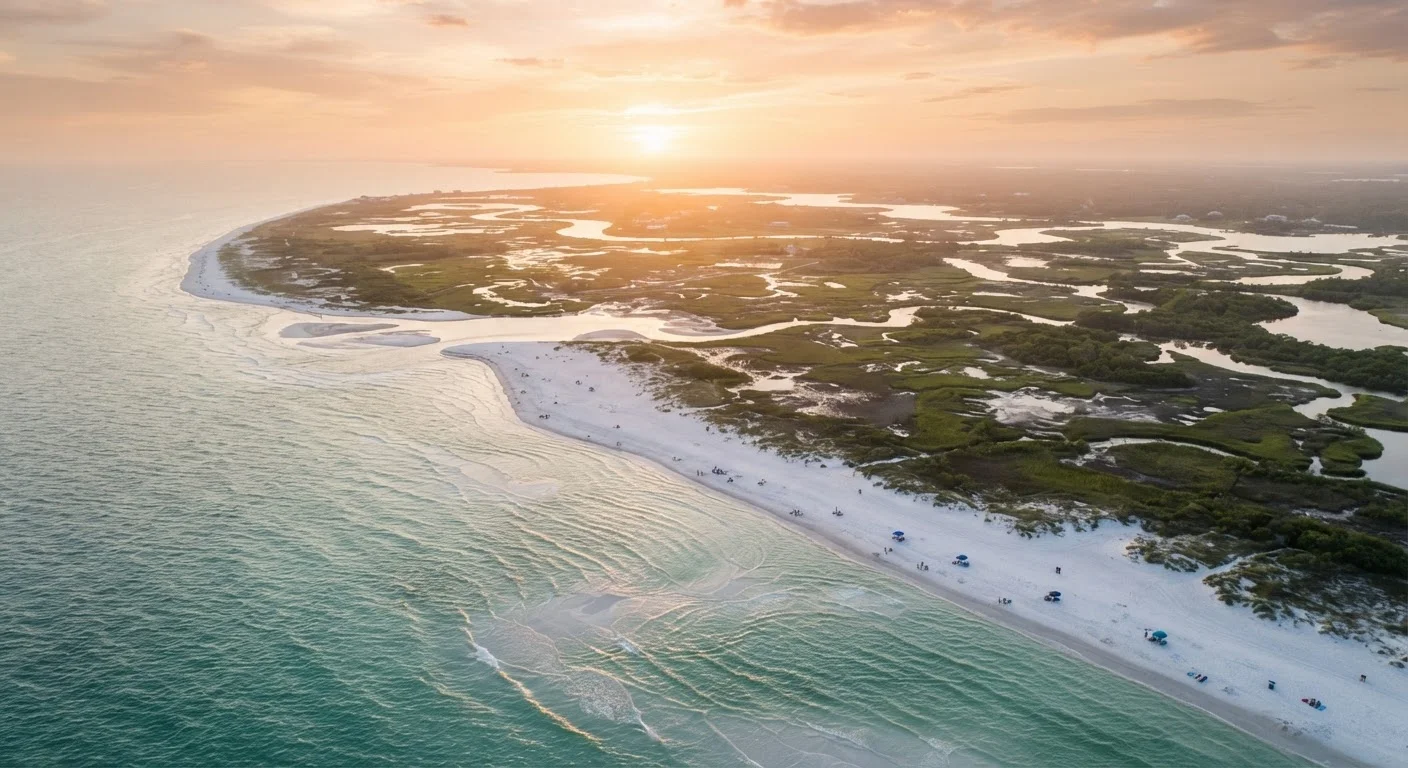
Visitors expecting uniform sandy beaches often find something more complex and, in many places, more ecologically remarkable. The Gulf Coast contains one of the largest estuarine systems in North America, where freshwater rivers meet saltwater in a gradient that supports extraordinary biodiversity.
Louisiana alone has lost significant coastal wetland area over recent decades — a process driven by subsidence, river management changes, and storm damage — making what remains both precious and visually striking. The Atchafalaya Basin, the largest river swamp in the United States, sits just inland and offers a landscape unlike anywhere else in the country. Birders consistently rank the upper Texas coast and the Mississippi Flyway corridor among North America's premier migratory bird observation zones.
Barrier islands, such as the Chandeleur Islands off Louisiana or the string of islands along Mississippi Sound, protect the mainland while harboring nesting shorebirds and sea turtles. Many are accessible only by boat, which keeps them relatively uncrowded.
1,700+
Miles of U.S. Gulf coastline
The National Oceanic and Atmospheric Administration (NOAA) estimates the U.S. Gulf Coast shoreline spans more than 1,700 miles across five states.
~40%
Share of U.S. commercial seafood from Gulf waters
NOAA fisheries data indicates the Gulf of Mexico has historically accounted for a substantial share of total U.S. commercial seafood landings by volume.
500+
Bird species recorded along the Texas upper coast
The upper Texas coast is one of the most species-rich birding corridors in North America, according to the American Birding Association's regional guides.
Cultural Depth That Rewards Slower Travel
No treatment of the Gulf Coast is complete without addressing its cultural density. Louisiana's Creole and Cajun traditions — expressed in food, music, architecture, and dialect — draw from French, Spanish, African, and Indigenous roots in ways that feel genuinely irreducible to any single heritage. New Orleans is the most internationally recognized expression of this, but the culture extends into smaller parishes and towns across southern Louisiana.
Coastal Mississippi and Alabama carry their own histories: the antebellum period, the Civil Rights Movement, and a maritime economy that shaped tight-knit fishing communities. Mobile, Alabama, claims one of the oldest Mardi Gras celebrations in the United States, predating New Orleans' by several years. South Texas, particularly around Corpus Christi and the Valley, reflects deep Tejano roots and a border culture that's distinct from the rest of the Texas coast.
This regional complexity sets the Gulf apart from destinations whose appeal is primarily scenic. Travelers who approach it the way they might approach the American Southwest — with genuine curiosity about layered histories and living traditions — tend to find the most rewarding experiences.
“The Gulf South is not a region you pass through — it's a region that passes through you. The food, the music, the water in the air — they accumulate over days in a way that's hard to prepare for and harder to leave behind.”
— Lolis Eric Elie, New Orleans-based author and cultural commentator on Southern foodways
Practical Considerations for Gulf Coast Travel
Planning a Gulf Coast trip involves a few realities worth understanding before you go. Hurricane season runs from June through November, with the statistical peak in September. This doesn't make summer travel impossible, but it warrants awareness: travelers should monitor National Hurricane Center advisories, understand their accommodation cancellation policies, and consider travel insurance that covers weather disruptions. Official guidance from FEMA and state emergency management agencies is the appropriate source for storm-related decisions.
Heat and humidity are significant factors from May through September across the entire region. The Gulf's warm, shallow water means summer sea surface temperatures can exceed 85°F, which contributes to oppressive onshore humidity. Early mornings and evenings are the most comfortable times for outdoor activity in summer months.
Accessibility varies considerably. Major cities — New Orleans, Houston, Tampa — have well-developed infrastructure. Smaller coastal communities and barrier island destinations may have limited lodging, minimal public transit, and services that operate seasonally. Verify conditions with local visitor bureaus before building tight itineraries around remote stops.
Build in Time for Small Towns
The Gulf Coast's most distinctive character often lives in communities of a few thousand people rather than in its cities. Fishing villages in coastal Louisiana, historic downtown districts in small Alabama towns, and barrier island communities accessible by ferry reward travelers who build slack into their itineraries. A trip anchored entirely around major urban stops will miss much of what makes this region distinct.
For travelers who enjoy comparing coastal road-trip options, the Gulf experience differs meaningfully from better-known routes. The Great Lakes region offers a useful parallel: another underestimated multi-state coastal stretch that rewards curiosity over speed.
Frequently Asked Questions
The Gulf Coast includes Florida, Alabama, Mississippi, Louisiana, and Texas. Each state contributes distinct cultural, culinary, and geographic character to the broader region. Some definitions also include parts of Mexico, but in U.S. travel context the five-state stretch is standard.
The most comfortable travel window is generally October through April, when temperatures are moderate and humidity is lower. Summer months bring heat, humidity, and the risk of tropical storms. Hurricane season officially runs June through November, so travelers planning warm-weather trips should monitor forecasts and check travel insurance options.
Yes, the Gulf Coast lends itself well to road travel, particularly along U.S. Highway 90 and portions of Interstate 10, which run close to the shoreline through multiple states. The experience is quite different from a dedicated scenic highway like the Pacific Coast Highway — the Gulf route rewards those who take exits and explore small towns rather than staying on the interstate.
The region's culture reflects centuries of overlapping influences: Indigenous nations, Spanish and French colonial histories, West African and Creole traditions, and later waves of immigration. This layering is most visible in Louisiana, but extends into coastal Mississippi, Alabama, and South Texas in food, music, architecture, and festivals.
Yes. The Gulf Coast faces ongoing challenges including coastal erosion, wetland loss, hurricane impacts, and water quality issues partly related to industrial and agricultural runoff. Some barrier islands and low-lying communities have experienced significant changes in recent decades. Travelers interested in the region's ecology can visit national wildlife refuges and estuary research reserves that interpret these issues.
The content on this site is for informational purposes only and is not a substitute for professional advice. Always consult a qualified professional for guidance specific to your situation.