

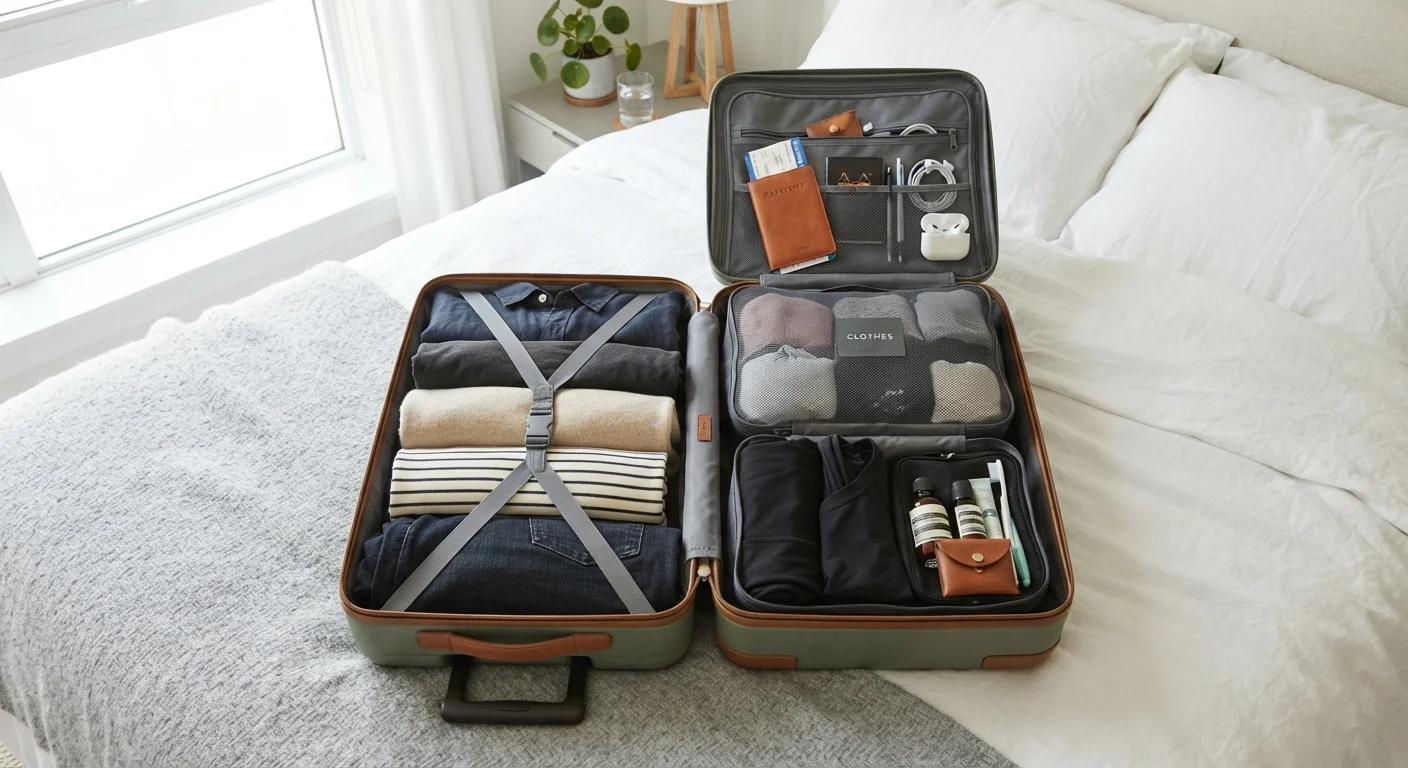
Why Carry-On Travel Changes the Game
Checking a bag is one of the most predictable sources of travel friction — fees, delays, lost luggage risk, and at least 20 extra minutes at baggage claim. Shifting entirely to a carry-on removes all of it. Yet many travelers assume carry-on travel only works for short trips or light packers. The reality is that most trips under seven days, and many longer ones, are fully manageable with a single well-packed cabin bag.
The key insight is that carry-on travel is a skill, not a personality trait. It requires planning, but the planning pays off at every stage of the journey. As our guide on why overpacking happens and how to fix it explains, most excess baggage comes from predictable mental shortcuts — and those shortcuts are correctable.
$35–$40
Average US domestic checked bag fee (each way)
Major US carriers typically charge between $35 and $40 per checked bag each way as of recent published fee schedules — a cost carry-on travelers avoid entirely.
20+ min
Typical baggage claim wait time
Industry data consistently shows baggage claim adds 20 minutes or more to post-flight time, a delay carry-on travelers skip altogether.
Know Your Limits Before You Pack
Airline carry-on policies vary more than most travelers realize. US domestic carriers often allow bags up to 22 × 14 × 9 inches, but many international and budget airlines impose stricter size rules and weight caps — sometimes as low as 15 lbs. Check your specific carrier's policy for every leg of your journey, including codeshare flights, which may apply different rules.
Personal item allowances are equally important. Most airlines permit one carry-on and one personal item (a backpack or tote that fits under the seat). Understanding both slots lets you distribute your load strategically — keep in-flight essentials in your personal item so your carry-on stays in the overhead bin untouched.
Budget and International Carriers Often Have Stricter Rules
Low-cost carriers and many international airlines apply tighter size and weight limits than major US domestic airlines. Some budget carriers also charge for carry-ons above a certain size. Always verify the policy for each airline in your itinerary — especially if your journey includes a connecting flight on a different carrier.
Packing Smarter, Not Lighter
Efficient carry-on packing isn't about owning less — it's about organizing better. A few reliable techniques make a measurable difference:
Use packing cubes to create dedicated zones inside your bag
Packing cubes compress clothing and keep categories separated, so you never have to unpack everything to find one item. They also help you visually audit what you're bringing before you zip up.
Roll clothing instead of folding it flat
Rolling reduces wrinkles in most fabrics and uses vertical space more efficiently than flat folding, which leaves air pockets. Tightly rolled items also stay in place during transit.
Build your wardrobe around a single base color palette
A cohesive palette means every item pairs with every other item, multiplying outfit options without adding pieces. It also reduces the anxiety of 'just in case' packing.
Wear your bulkiest items on travel days
Boots, heavy jackets, and thick sweaters take up disproportionate space in a carry-on. Wearing them through the airport means they don't compete for bag space.
Decant toiletries into reusable travel-size containers
Full-size bottles violate TSA liquid rules and waste space. Refillable silicone containers let you carry exactly what you need without the bulk.
For principles that apply beyond travel, the spatial thinking outlined in small-space storage principles translates directly to luggage — prioritize what earns its place and create dedicated zones for different categories.
Getting Through Security Without Stress
Security prep is where many carry-on travelers stumble. The TSA's 3-1-1 rule for liquids — containers of 3.4 oz or less, in one quart-sized clear bag — applies to US domestic and many international departures. Keeping your liquids bag consistently in the same exterior pocket means you can pull it out without unpacking everything.
Wear shoes that slip off easily, keep your laptop accessible, and avoid wearing a belt or excess metal jewelry. These habits add up. Travelers who build a repeatable security routine move through checkpoints significantly faster — a habit explored in depth in our piece on habits that separate calm travelers from stressed ones.
Making It Work on Longer Trips
A week or more carry-on only? Doable, with the right strategy. Plan around access to laundry — many hotels and Airbnbs offer it, and travel-size detergent packets weigh almost nothing. Build your wardrobe around two or three neutral colors so every item mixes and matches. Five bottoms and seven tops become dozens of outfit combinations when they're all coordinated.
For international trips, where airline size restrictions may tighten, confirm luggage rules before departure. The international pre-departure checklist covers luggage policy verification alongside visa, health, and document prep — worth reviewing before any trip abroad.
Carry-on travel rewards a small investment of preparation with dividends across the entire journey — faster airport navigation, more flexibility, and the quiet confidence of knowing exactly where everything is.
The content on this site is for informational purposes only and is not a substitute for professional advice. Always consult a qualified professional for guidance specific to your situation.