

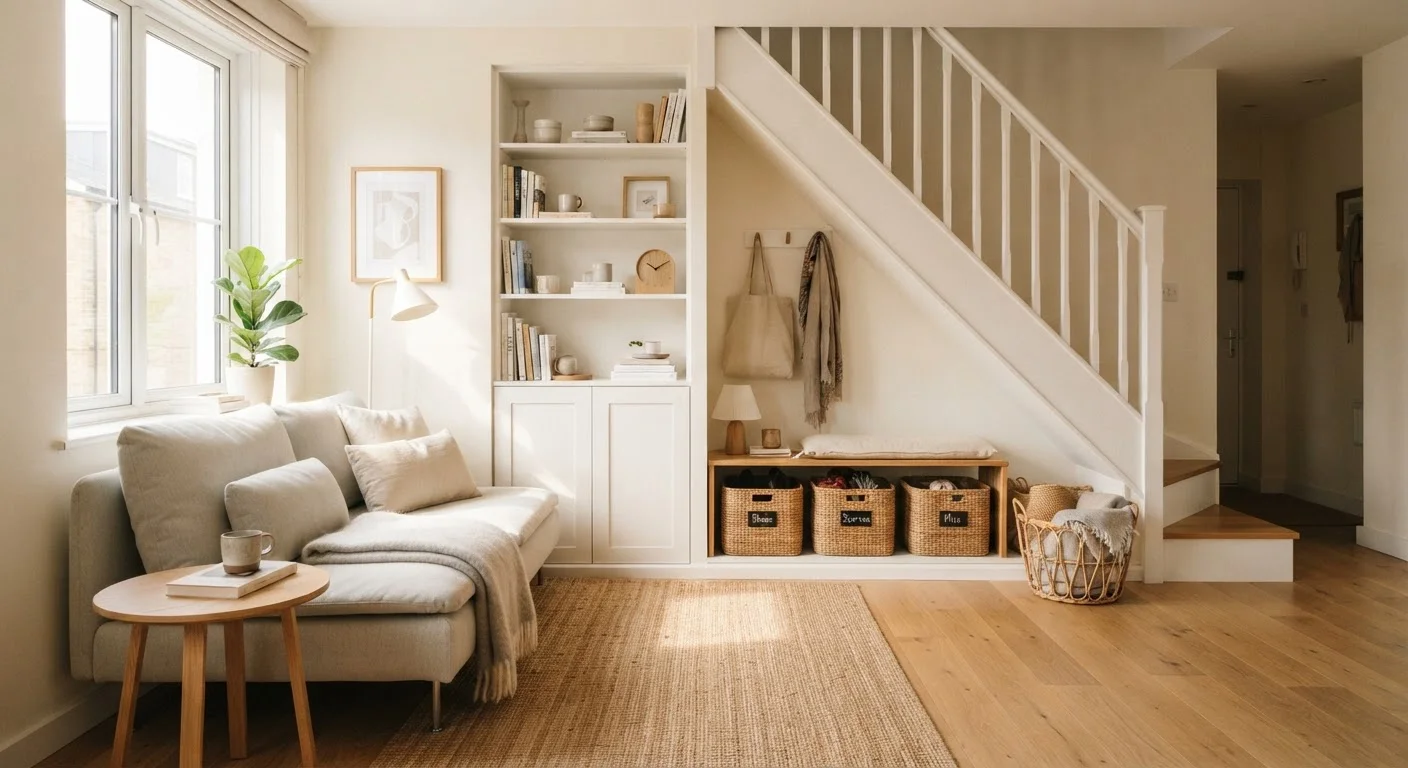
Why Buying More Organizers Usually Doesn't Help
The instinct when storage feels scarce is to reach for bins, baskets, and drawer dividers. But without a clear principle guiding what goes where — and what stays at all — new organizers often just become new clutter with lids on it.
Effective storage in compact homes is a spatial thinking problem before it's a product problem. The most useful first step is an honest audit: identify what you're storing, how often you actually use it, and whether it genuinely needs a home inside your living space. Items accessed weekly deserve accessible, convenient spots. Seasonal or rarely used things can live in less reachable places — or leave the home entirely.
This framework pairs well with the broader design strategies covered in our guide to making rooms feel larger, where visual lightness and considered placement work together.
Principles That Create Real Storage Capacity
Once you've established what stays, these core principles help you find and use space more effectively than any single product can.
It's also worth considering how storage decisions interact with how a room feels. Concealed storage — cabinets with solid doors, ottomans with lids, beds with drawers — tends to read as calm and spacious. Open shelving displays personality but requires ongoing curation to avoid visual overwhelm. A practical balance: use open storage for items you genuinely enjoy looking at, and closed storage for functional everyday items.
The Zones You're Probably Not Using
Most compact homes have underused spatial real estate hiding in plain sight. The vertical plane — the wall above eye level — is consistently overlooked. Shelving installed up to ceiling height provides significant capacity while keeping floor space clear, which itself makes a room feel larger and easier to move through.
Other commonly wasted zones include: the back of interior doors (shallow hooks or organizers work well here for cleaning supplies, accessories, or pantry extras); the space under beds and sofas (shallow rolling bins maintain access without requiring you to move furniture); and stair risers in homes with internal staircases, which can be fitted with pull-out drawers.
Check Load Limits Before Installing Wall Shelving
Wall-mounted shelving installed above normal reach heights can carry significant weight — books, bins, and stored items add up quickly. Always anchor shelves into wall studs or use appropriate hollow-wall anchors rated for the intended load. If you're unsure about your wall type or structural capacity, consulting a handyperson before installation is worthwhile. Improperly anchored shelving is a safety risk, not just a storage inconvenience.
If your compact home shares space with a pet, dedicated storage for their gear — leashes, toys, food — prevents that category from spreading across multiple rooms. Our guide to pet-friendly home setup covers practical approaches to integrating pet essentials without sacrificing your own space.
68%
Homeowners who cite clutter as a daily stressor
According to a survey by the National Association of Professional Organizers, a significant majority of homeowners report that household clutter negatively affects their daily stress levels.
30%
Typical unused storage capacity in average homes
Interior design research frequently notes that vertical wall space above eye level goes unused in the majority of rooms, representing substantial untapped storage volume in most homes.
How to Sustain Storage Systems Over Time
Even well-designed storage systems drift back toward disorder without a light maintenance habit. The most durable approach is a simple rule: everything that comes into the home needs an assigned place before it's put down. Items without a home don't stay organized — they migrate to the nearest flat surface.
A seasonal reassessment, roughly every three to four months, is enough to catch category creep before it becomes a full declutter project. Walk through each storage zone and ask two questions: Is this still the right home for this item? Has anything accumulated here that belongs elsewhere or nowhere?
For broader home upkeep habits that support a functional, low-stress living environment, the Home Maintenance hub offers practical guidance across a range of indoor tasks. And if you're considering layout changes — like opening up a wall to gain flow and flexibility — it's worth reading what open-plan conversion actually involves before committing.
The content on this site is for informational purposes only and is not a substitute for professional advice. Always consult a qualified professional for guidance specific to your situation.