

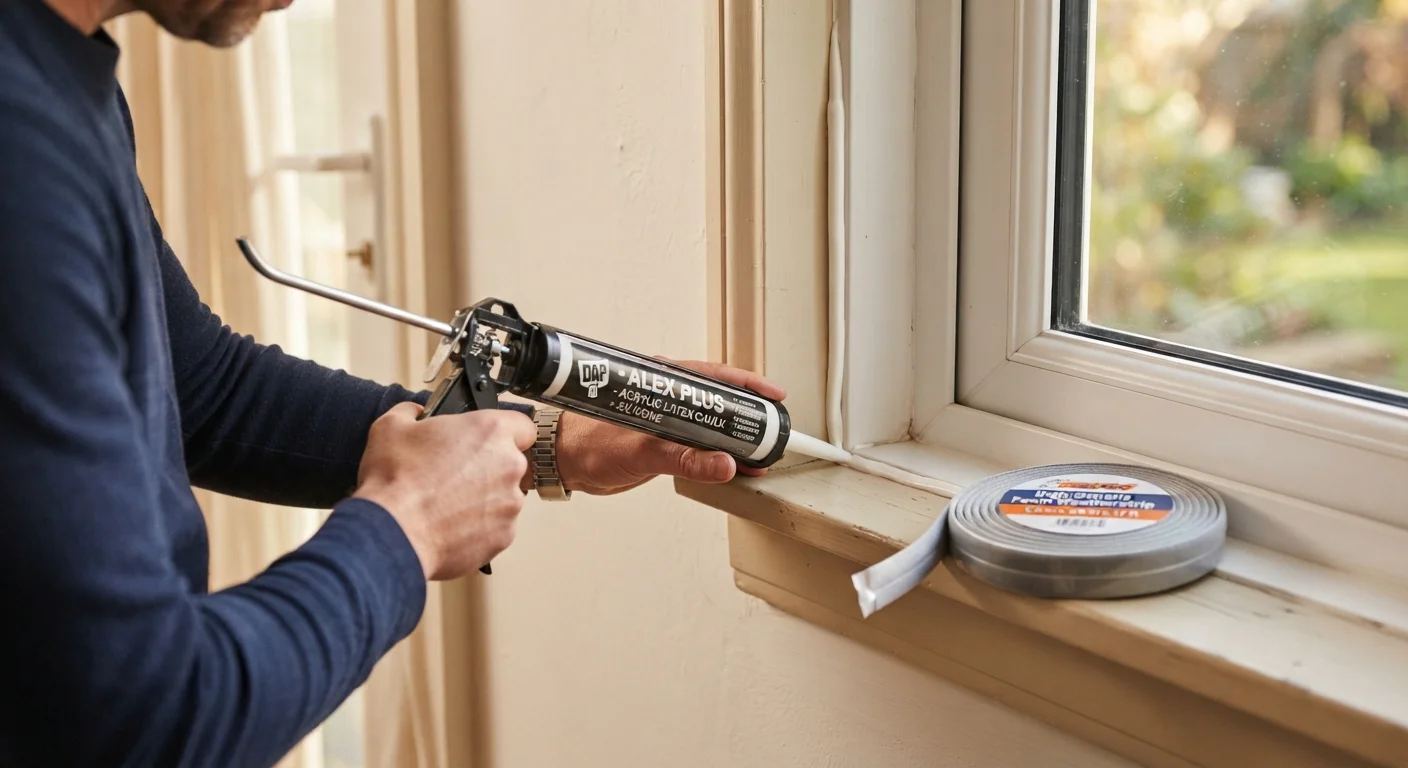
Option A
Caulking
The permanent, paint-able gap filler for stationary joints.
Best for: Sealing fixed cracks and gaps in walls, trim, and frames where surfaces don't move.
Option B
Weatherstripping
The flexible, compressible seal built for moving parts.
Best for: Sealing gaps around doors and operable windows that open, close, and flex regularly.
What Each Material Is Actually Designed to Do
Both caulking and weatherstripping stop air and moisture from moving through gaps — but they're engineered for fundamentally different situations, and confusing the two is one of the most common DIY draught-sealing mistakes.
Caulk is a flexible sealant — typically silicone, latex, or a hybrid — that is applied wet and cures into a semi-rigid bead. It bonds to two adjacent, stationary surfaces and fills the space between them permanently. Once cured, it can usually be painted over, which makes it ideal for interior trim work.
Weatherstripping refers to a family of compressible materials — foam tape, V-strip (tension seal), door sweeps, and rubber gaskets — that are attached to one surface and create a seal by pressing against another when the gap closes. Because the seal is formed by compression rather than adhesion, it can survive repeated movement without cracking or pulling away.
The key distinction: caulk works where surfaces don't move; weatherstripping works where they do. Applying caulk to a door frame, for instance, will hold briefly but eventually crack or pull loose every time the door is slammed. Weatherstripping on a fixed wall crack, meanwhile, will sag, peel, and leave a bigger gap than you started with.
Side-by-Side: How They Compare
Understanding where each material excels — and where it falls short — helps you plan your draught-sealing project without wasting materials or effort.
| Criterion | Caulking | Weatherstripping |
|---|---|---|
| Best application | Fixed, stationary gaps and joints | Movable joints — doors and operable windows |
| How it seals | Adheres and bonds to both surfaces | Compresses against surfaces when closed |
| Typical lifespan | 5–20+ years (material dependent) | 2–10 years (type dependent) |
| Paintable | Yes (latex); silicone usually not | Rarely — most remain visible |
| DIY difficulty | Low — requires caulk gun and prep | Very low — adhesive-backed types need no tools |
| Handles movement | No — cracks under repeated flexing | Yes — designed for repeated compression |
| Moisture resistance | High (silicone); moderate (latex) | Varies by material; foam degrades faster when wet |
One practical tip: before buying anything, run your hand slowly along suspected gaps on a windy day. If you feel air movement at a door edge, that's a weatherstripping job. If you see a visible crack in painted trim or along a window frame, reach for caulk. If you're unsure whether your symptoms point to a gap seal issue or a broader insulation problem, see our guide to diagnosing insulation problems.
Where to Use Each One in Your Home
Mapping the right material to the right location prevents rework and ensures your seals last as long as possible.
Use caulk for:
- Gaps between interior window trim and drywall
- Cracks around baseboards and door casings
- Exterior joints where siding meets window or door frames
- Gaps around pipes and conduit penetrating walls or floors
- The perimeter of a fixed (non-operable) window pane
Use weatherstripping for:
- The top and sides of exterior door frames (door stop area)
- The bottom of exterior doors (use a door sweep or threshold seal)
- Around operable casement, sliding, or double-hung windows
- Attic hatch edges, which open and close periodically
Many homes need both applied in the same room — caulk around the fixed window frame and weatherstripping on the operable sash. These methods complement each other rather than compete.
25–30%
Home energy lost through air leaks
The U.S. Department of Energy estimates that air leaks through gaps, cracks, and openings account for roughly 25–30% of heating and cooling energy use in a typical home.
$0.50–$1
Cost per linear foot of weatherstripping
Basic foam and V-strip weatherstripping is among the most cost-effective draught-sealing materials available for DIY use, generally costing under a dollar per foot.
Application, Longevity, and Maintenance
Both materials are genuine DIY-friendly tasks, though each requires a slightly different approach to do well.
Caulking requires a clean, dry surface. Remove old, cracked caulk completely — new caulk applied over failed caulk rarely bonds properly. Apply a continuous bead, tool it smooth with a wet finger or caulk tool, and allow full cure time (check the product label) before painting or exposing to moisture. Silicone caulk is more durable and moisture-resistant; latex caulk is easier to paint over and clean up. For wet rooms, always use a product specifically rated for high-moisture environments. Our guide to keeping wet rooms watertight covers sealant application in bathrooms and kitchens in more detail.
Weatherstripping requires a clean, flat surface for adhesive-backed types. Measure door or window perimeters carefully and cut strips to fit before peeling the backing. The seal should be snug enough to compress slightly when the door or window closes, but not so thick that it prevents proper latching. Door sweeps typically screw into the door face and should just graze the threshold without dragging heavily.
In terms of longevity, quality silicone caulk can last 20 years or more on low-movement joints. Foam weatherstripping, being softer, typically needs replacement every 2–5 years. V-strip and rubber gasket types often last longer — sometimes a decade or more — depending on traffic and exposure.
Inspect all seals annually, ideally in autumn before heating season begins. A simple candle or incense stick held near suspect edges on a windy day will reveal air movement. If you spot damp staining near a sealed joint, that gap may need fresh caulk — and it's worth checking our guide to damp patches on walls to rule out a more serious moisture issue behind the surface.
The content on this site is for informational purposes only and is not a substitute for professional advice. Always consult a qualified professional for guidance specific to your situation.