

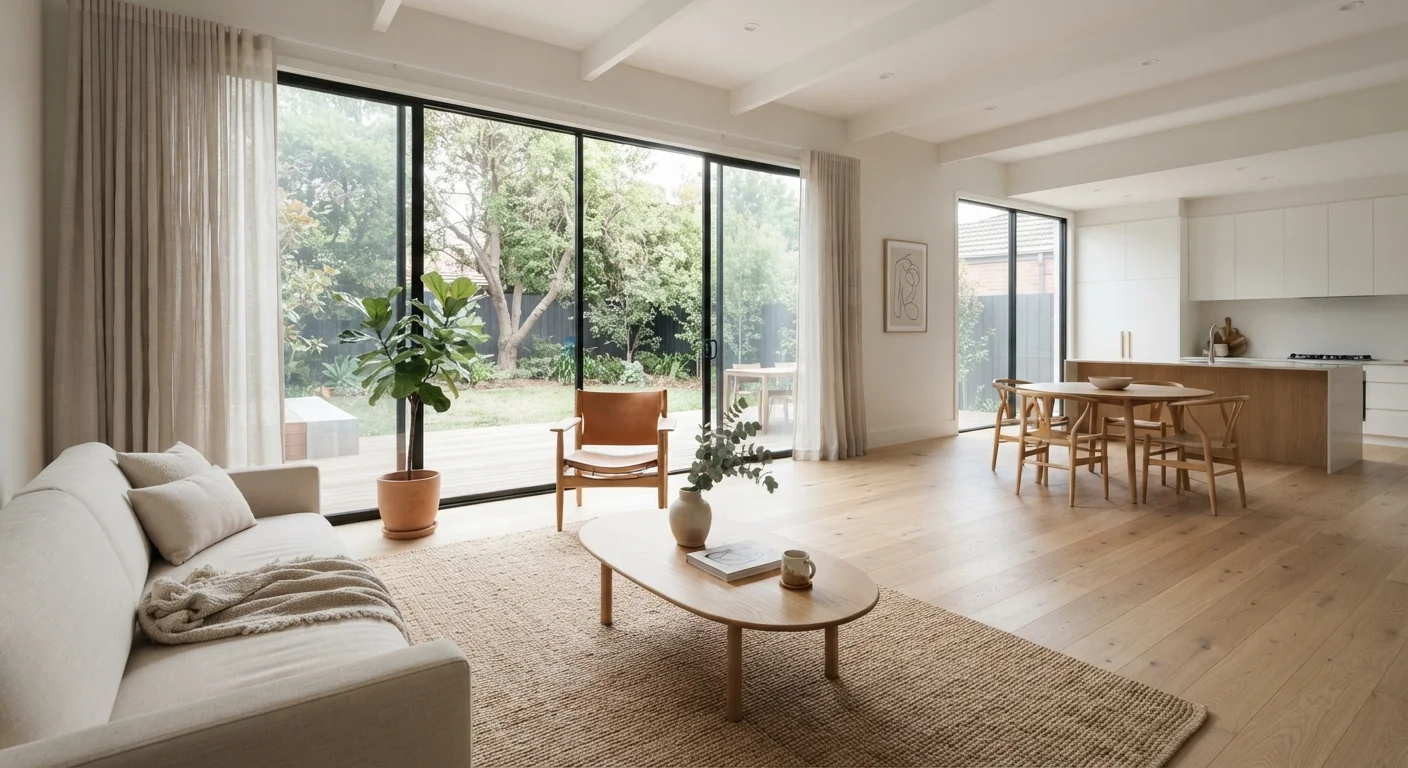
Why Perception Matters as Much as Square Footage
A room's actual dimensions are fixed, but how spacious it feels is surprisingly malleable. Interior designers consistently rely on a set of perceptual principles — rooted in how the human eye and brain interpret space — to make compact rooms feel generous and comfortable. None of these principles require demolition or a major budget. Most involve thoughtful decisions about color, light, scale, and layout.
Whether you're working with a studio apartment, a narrow bedroom, or a small living area, understanding these ideas gives you a confident foundation for any décor project. For readers also thinking about storage alongside spaciousness, the spatial principles behind smarter storage pair well with everything covered here.
Choose a Light, Unified Color Palette
Color is one of the most powerful spatial tools available. Light, cool, or neutral tones on walls — whites, soft grays, warm creams — reflect more light and make boundaries feel less defined. Darker colors absorb light and visually advance surfaces toward you, which shrinks perceived space.
The real amplifier is consistency. When walls, trim, and ceiling share the same or closely related tones, the eye doesn't register hard stops at edges and corners. A monochromatic scheme, where furnishings echo the wall color in varying shades, reinforces this continuous, receding effect.
A monochromatic palette removes visual stops at corners, making walls seem to recede.
Maximize and Redirect Natural Light
Light — especially daylight — is the single biggest contributor to a feeling of spaciousness. Rooms flooded with natural light seem to extend beyond their walls. Practical steps include keeping window treatments sheer or minimal, trimming exterior plantings that block glass, and placing mirrors on walls adjacent to or opposite windows to bounce light deeper into the room.
Where natural light is limited, layered artificial lighting — ambient, task, and accent — prevents the flat, heavy feeling that comes from a single overhead source. Uplighting in particular draws attention upward and adds perceived height.
Mirrors placed near windows can effectively double the amount of light a room receives.
Scale Furniture to the Room — and Raise It Off the Floor
Oversized furniture in a small room does two harmful things: it consumes floor area and visually fills the sightline. Choosing pieces proportioned to the space — lower-profile sofas, slimmer-legged tables — keeps the room from feeling overwhelmed.
Equally important is leg visibility. Furniture with exposed legs allows the eye to see floor beneath each piece, creating a sense of continuation rather than blockage. A sofa that floats on tapered legs will always read as lighter than a fully skirted one, even if their footprints are identical.
Furniture on visible legs lets the floor 'read through,' making the room feel more open.
Use Continuous Flooring to Unify the Space
Flooring that runs uninterrupted through a space — the same material, color, and direction — removes visual breaks that would otherwise signal a boundary or transition. Every seam, threshold strip, or sudden change of material acts as a full stop for the eye.
If rugs are part of your scheme, choose sizes that are generously proportioned rather than small islands in the middle of the room. An undersized rug fragments the floor plane and makes the room feel smaller, not larger. The front legs of all major seating pieces should ideally sit on the rug, anchoring the arrangement.
An undersized rug fragments the floor and makes a room read smaller, not larger.
Draw the Eye Upward With Vertical Emphasis
Height is an underused dimension in most rooms. When the eye is directed upward, the brain registers the room as taller and, by extension, more spacious overall. Practical techniques include hanging curtains close to the ceiling rather than just above the window frame, choosing tall bookcases that run floor to ceiling, and using vertical stripes or paneling on feature walls.
Even artwork placement matters: hanging pieces slightly higher than convention suggests encourages upward gaze and adds perceived height without touching a single structural element.
Curtains hung at ceiling height make windows — and the whole room — appear dramatically taller.
Preserve Clear Sightlines Through the Room
A sightline is the unobstructed visual path from one point in a room to another — ideally to a wall or window at the far end. When that line is blocked by furniture, clutter, or tall objects, the room feels shorter and more enclosed than it is.
Arranging furniture to keep the path from entry to the room's focal point clear is a foundational move. Glass-topped tables and open shelving preserve sightlines while still serving their function. Clutter management is essential here — even a well-designed room will feel cramped when surfaces are heavily loaded.
A clear sightline to the far wall is one of the simplest ways to open up any room instantly.
Putting the Principles to Work
These principles work best when layered together rather than applied in isolation. A room with pale walls but heavy, oversized furniture and blocked windows will still feel cramped. Conversely, a thoughtfully lit space with well-scaled pieces and a continuous floor can feel genuinely expansive — even in a modest footprint.
Start With One Principle at a Time
Trying to implement all six principles at once can feel overwhelming and expensive. Instead, audit your room for the single biggest spatial obstacle — usually either scale of furniture or lack of light — and address that first. Improvement compounds quickly once you've established a stronger foundation.
If you're considering a more structural approach to creating openness, it's worth understanding what open-plan conversion actually involves before committing to any wall removal. The perceptual strategies here, however, can deliver real results without touching a single load-bearing element.
The content on this site is for informational purposes only and is not a substitute for professional advice. Always consult a qualified professional for guidance specific to your situation.