

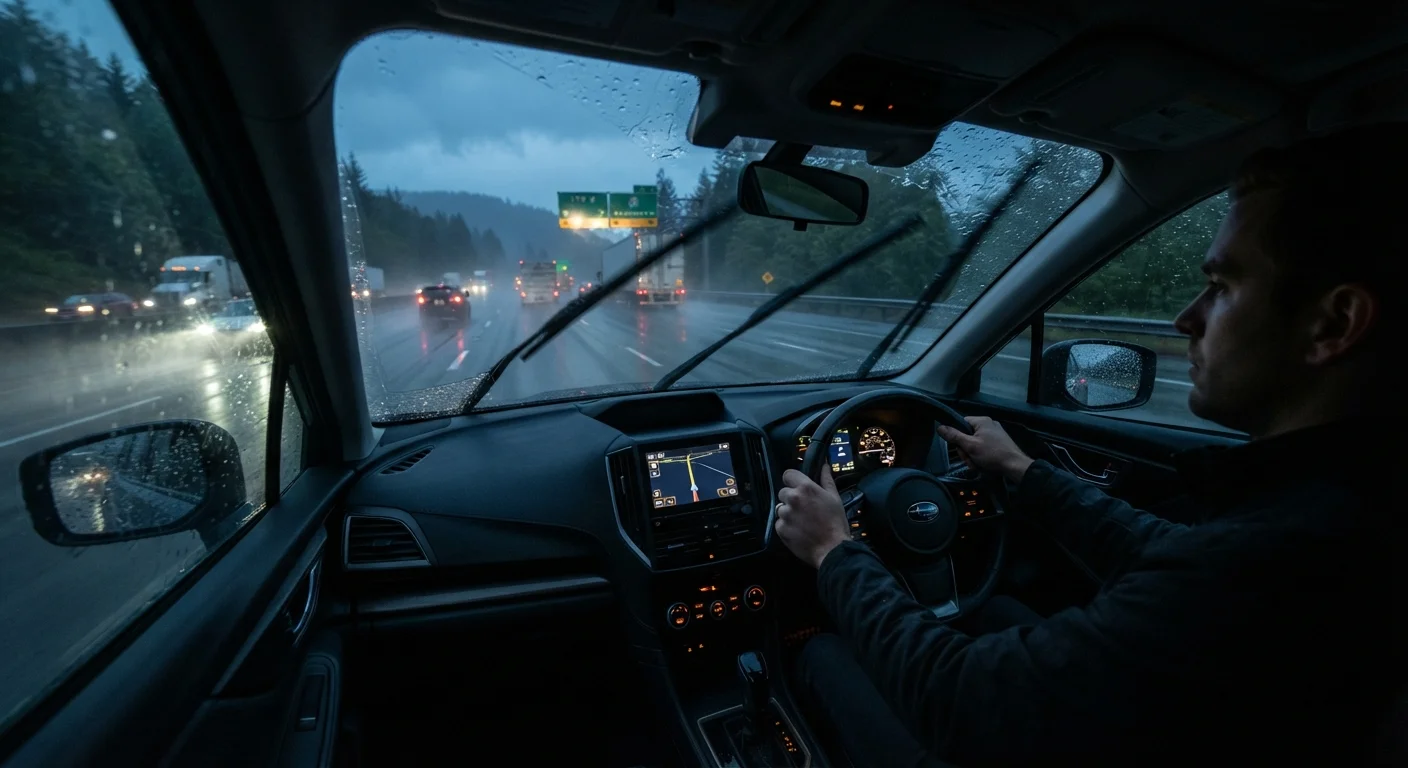
Why Adverse Weather Demands a Different Mindset
Most drivers understand that bad weather requires some caution. Fewer adjust their behavior in the specific, deliberate ways that actually reduce risk. Rain cuts tyre grip and extends stopping distances. Ice can reduce traction by a factor of ten or more compared to dry pavement. Fog collapses the decision-making window between seeing a hazard and responding to it. Each condition is distinct, and treating them all the same — by simply slowing down a little — leaves significant safety margins unaddressed.
The habits that work in clear, dry conditions are not wrong; they are just insufficient when the road changes beneath you. Understanding what each weather type does to your vehicle's physics — and to your own perception — is what allows you to adapt rather than simply react. For a broader look at how different driving environments change the risk equation, see our guide on motorway vs. urban driving risk profiles.
What you will need
What You'll Need Before You Start
Winter or All-Season Tyres
Provide adequate grip on wet, icy, and snowy surfaces — the single biggest mechanical factor in adverse-weather control.
Ice Scraper and Snow Brush
Clear all windows, mirrors, and lights before driving in winter conditions — legally and safety critical.
Roadside Emergency Kit
Includes a flashlight, reflective triangles, jumper cables, and a blanket in case of breakdown in poor conditions.
Tyre Pressure Gauge
Cold temperatures cause tyre pressure to drop; checking pressure regularly keeps handling predictable.
Check Your Wipers and Defrosters Before You Need Them
Wiper blades degrade over time and may streak or skip when it matters most. Test your front and rear defrosters before the first cold spell of the season. Maintaining visibility systems is one of the easiest and most overlooked parts of adverse-weather preparation — see our seasonal car maintenance guide for a full checklist.
Step-by-Step: Adjusting Your Driving for Each Condition
Prepare your vehicle before you leave
Before pulling out in any adverse weather, spend a few minutes on the vehicle itself. Clear all snow and ice from every window, mirror, and light — not just a small peephole on the windshield. Check that your headlights and taillights are working, and confirm tyre pressure hasn't dropped overnight (cold air reduces tyre pressure). A vehicle that can't see or be seen is dangerous regardless of how carefully you drive.
Adjust your speed and following distance for rain
Wet roads reduce tyre grip significantly, even at speeds that feel normal. The general guidance is to increase your following distance to at least 4–5 seconds in rain, compared to the standard 2–3 seconds in dry conditions. Reduce your speed smoothly and early — sudden braking on a wet surface increases skid risk. Avoid driving through large puddles at speed, as hydroplaning (where your tyres lose contact with the road entirely) can occur without warning.
Use the correct lights in rain and low visibility
Turn on your headlights whenever visibility is reduced, even during daylight rain. In the US, many states legally require headlights when windshield wipers are in use — check the rules for your state. Never use high beams in rain or fog: the light reflects off moisture particles and actually reduces your effective sightline. Use your low beams, and if equipped, use rear fog lights only when visibility drops below roughly 300 feet.
Navigate fog with discipline and patience
Fog is uniquely deceptive — it can make speeds feel slower than they are, encouraging drivers to speed up unconsciously. Use your speedometer as your reference, not how the road feels. Drive with low beams on, reduce speed well below the posted limit, and increase your following distance substantially. Pull off the road at a safe location — not on the highway shoulder — if visibility drops to the point where you cannot see ahead safely. If you must stop on a road, turn on hazard lights and get away from the vehicle.
Respond correctly to ice and slippery surfaces
On ice, all inputs — steering, braking, and acceleration — must be slow and gentle. Abrupt actions transfer weight suddenly and can cause a skid. In a vehicle with ABS, apply firm, steady brake pressure and let the system pulse — do not pump the pedal. In a vehicle without ABS, apply steady pressure just short of wheel lockup. Accelerate from stops slowly to avoid wheel spin. If you begin to skid, look and steer where you want to go, and ease off all pedals.
Know when not to drive
The most effective safety measure in severe weather is sometimes choosing not to travel. If a storm is actively ongoing, conditions are forecasted to worsen, or you can see other vehicles struggling, delay your trip if possible. Being an hour late is rarely as consequential as a collision. Defensive driving fundamentally includes anticipating hazards before entering them — and severe weather is a hazard you can often avoid entirely by adjusting your schedule.
Black Ice Gives Almost No Warning
Black ice forms when moisture freezes on pavement, creating a nearly transparent layer that looks like wet road. It is most common on bridges, overpasses, and shaded stretches in temperatures at or just below 32°F. If you begin to skid, resist the urge to brake hard — ease off the accelerator and steer gently in the direction you want to go. If conditions are dangerous enough, the safest choice is not to drive at all.
Don't Rely Solely on AWD in Winter Conditions
All-wheel drive improves traction during acceleration but does not shorten stopping distances on ice or snow. Drivers of AWD vehicles sometimes overestimate their safety margin. Appropriate speed, winter-rated tyres, and increased following distance matter for every vehicle regardless of drivetrain.
After the Weather Clears: What to Check
Once conditions improve, take a few moments to assess how your vehicle performed. Unusual noises, pulling to one side, or steering that feels different than normal can all indicate that something was stressed or damaged during difficult conditions. Tyres in particular bear the brunt of adverse-weather driving. Understanding tyre wear and condition can help you recognize signs that a tyre has been compromised before it becomes a safety issue.
Adverse-weather driving is also a useful prompt to review your overall vehicle maintenance schedule. A vehicle that handles well in normal conditions may reveal weaknesses when pushed by poor weather — in the brakes, suspension, or tyres. Staying current on seasonal maintenance means fewer surprises when conditions deteriorate. And if you want to develop the underlying habits that make all of this second nature, our overview of defensive vs. reactive driving is a strong next read.
The content on this site is for informational purposes only and is not a substitute for professional advice. Always consult a qualified professional for guidance specific to your situation.