

Option A
Defensive Driving
The proactive, hazard-anticipating mindset.
Best for: Drivers who want to reduce collision risk by scanning ahead, managing space, and planning responses before situations escalate.
Option B
Reactive Driving
The instinct-driven, after-the-fact response.
Best for: Understanding as a baseline habit to move away from — most drivers reactive drive by default without realizing the added risk it creates.
The Core Distinction: Before vs. After
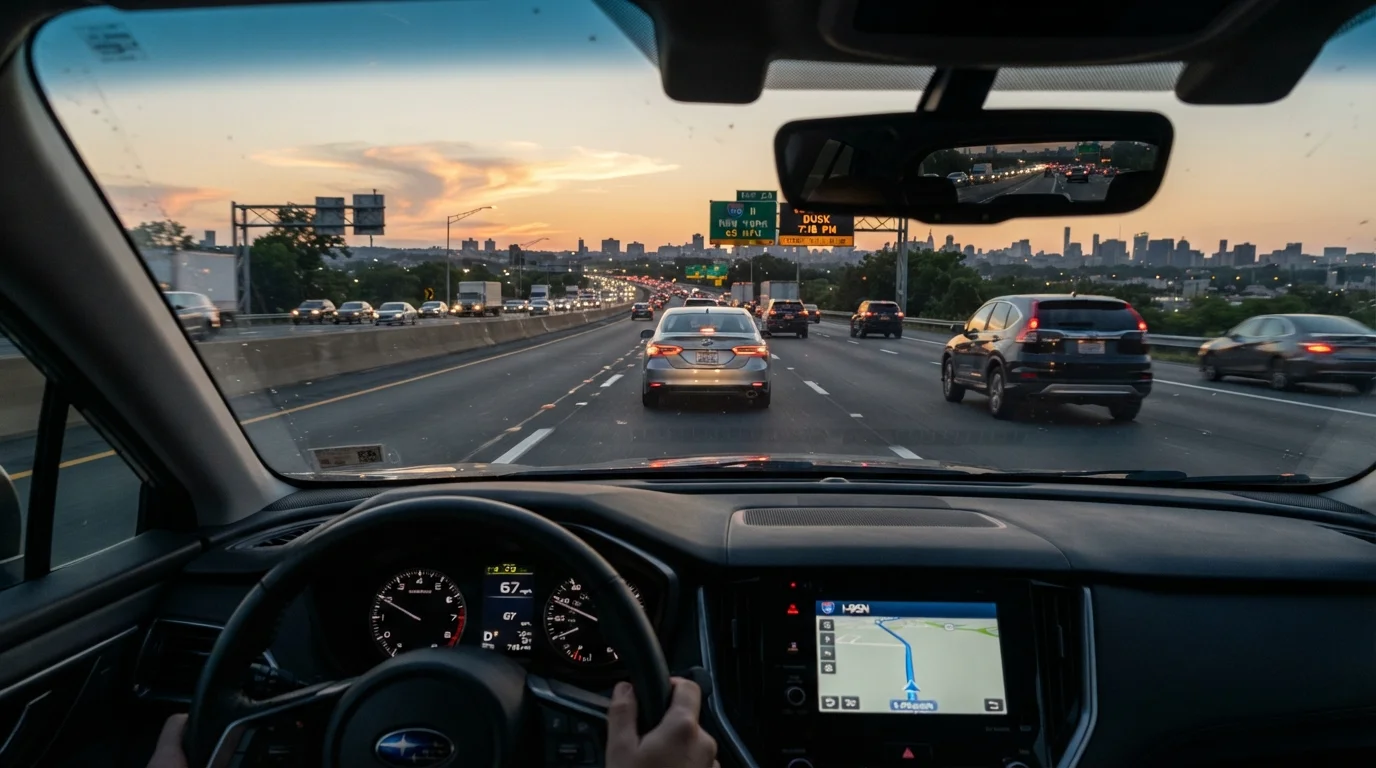
Every driving decision falls somewhere on a spectrum between anticipation and reaction. Defensive driving sits at the anticipation end — the driver is continuously reading the road ahead, identifying potential hazards, and adjusting speed, position, or following distance before a threat becomes critical. Reactive driving sits at the opposite end: the driver responds only once a hazard has already materialized, relying on instinct and whatever space is available.
The practical gap between these two approaches is time. At 60 mph, a vehicle travels approximately 88 feet per second. By the time a reactive driver perceives a hazard, processes it, and applies the brakes, the car has typically covered 150–300 feet — a distance that frequently leaves insufficient room to stop safely. Defensive driving compresses that gap by building in margin before the emergency clock starts.
Before every drive, building foundational awareness begins even before you pull out. See our pre-drive safety walkthrough for the habits that set a defensive mindset from the moment you approach your vehicle.
| Criterion | Defensive Driving | Reactive Driving |
|---|---|---|
| Timing of response | Before hazard develops | After hazard appears |
| Following distance | 3+ seconds maintained | Often inconsistent or short |
| Scanning range | 10–15 seconds ahead | Vehicle immediately ahead |
| Speed management | Adjusted to conditions | Matched to posted limit only |
| Collision risk | Significantly reduced | Higher, especially at speed |
| Performance in adverse weather | Adapts proactively | Relies on diminished margins |
| Mental engagement level | Active and continuous | Passive, habit-driven |
What Defensive Driving Actually Looks Like
Defensive driving is not timid or overly cautious driving — it is informed driving. Core practices include:
- Scanning 10–15 seconds ahead rather than fixating on the vehicle immediately in front.
- Maintaining a three-second following distance (extending to five or more in wet or icy conditions) to preserve reaction margin.
- Anticipating others' errors — assuming the driver at an intersection may roll through a stop sign rather than assuming they won't.
- Managing speed relative to conditions, not just posted limits — a posted 65 mph limit does not mean 65 mph is safe in heavy rain.
- Positioning the vehicle to maximize visibility and avoid blind spots of large trucks or buses.
In adverse weather, these habits become even more critical. Our guide on driving in rain, ice, and fog covers the condition-specific adjustments that defensive drivers make when grip and visibility are compromised.
~90%
Crashes attributable to human error
The National Highway Traffic Safety Administration (NHTSA) has consistently found human error to be a critical factor in the vast majority of U.S. road crashes.
1.5 sec
Average driver perception-reaction time
Research on driver response times indicates the average unimpaired driver takes roughly 1.5 seconds to perceive and begin responding to an unexpected hazard.
132 ft
Distance traveled during reaction at 60 mph
At 60 mph, a vehicle covers approximately 132 feet during a 1.5-second reaction window — before braking even begins.
Why Reactive Habits Form — and Why They're Hard to Break
Reactive driving is essentially the default state for most licensed drivers. Familiarity breeds complacency: on a route driven a hundred times, the brain begins to predict rather than actively observe. This reduced vigilance is a form of reactive readiness — assuming the unexpected won't happen and planning only to respond if it does.
Cognitive load also plays a role. Drivers distracted by navigation, conversation, or fatigue have diminished capacity to scan ahead, which collapses their driving style toward the reactive end of the spectrum regardless of intent. The irony is that high-distraction situations are precisely when reactive driving is most dangerous.
Understanding how minor inattention can escalate is explored in depth in our article on road rage and aggressive driving escalation — many confrontations begin with reactive responses to perceived slights rather than deliberate aggression.
Defensive Driving Courses Are Widely Available
Many U.S. states recognize accredited defensive driving courses that can qualify drivers for insurance discounts or satisfy court-ordered requirements. Programs vary by state, so check with your state's DMV or a licensed provider for specific options. Completing a course is one structured way to move deliberate defensive habits from theory into practiced routine.
Applying the Right Mindset Across Different Road Environments
The defensive vs. reactive distinction plays out differently depending on where you're driving. Motorways demand sustained forward scanning and lane discipline; the high speeds involved mean hazards travel toward you faster than in urban settings. Urban environments involve more unpredictable actors — pedestrians stepping out between parked cars, cyclists filtering traffic, vehicles double-parking — each requiring proactive spatial awareness rather than reactive braking.
Our analysis of how risk profiles differ between motorway and urban driving illustrates why a single mental model doesn't cover all driving contexts — the defensive approach must be calibrated to the environment.
For motorway-specific technique, including how poor merging habits force reactive responses in surrounding traffic, see our guide on motorway merging and lane discipline.
Ultimately, shifting from reactive to defensive driving is less about individual techniques and more about a sustained shift in how you engage with the road — from passenger-like passivity to active, continuous risk assessment. That shift is available to any driver willing to apply it.
The content on this site is for informational purposes only and is not a substitute for professional advice. Always consult a qualified professional for guidance specific to your situation.