

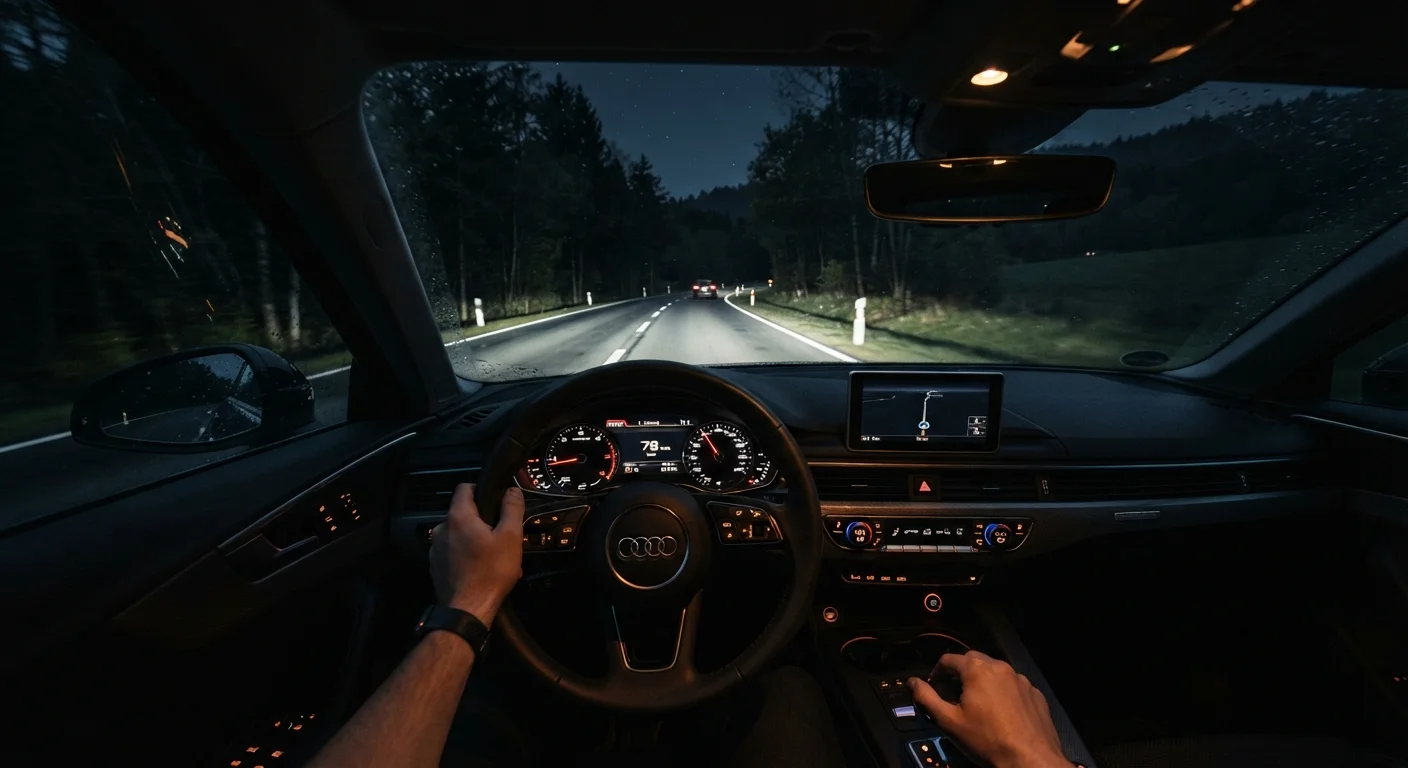
How Darkness Impairs Your Vision
The human eye is not well-adapted for high-speed navigation in darkness. When light levels drop, the eye shifts from using cone cells — which deliver sharp, color-rich detail — to rod cells, which are more light-sensitive but offer lower acuity and no color discrimination. The result is a meaningful reduction in your ability to judge distances, detect contrast, and perceive objects at the edges of your visual field.
Peripheral vision, which daytime drivers rely on to catch movement from driveways, intersections, and sidewalks, narrows considerably at night. Depth perception also suffers, making it harder to accurately gauge the speed and distance of oncoming vehicles or road features. Older drivers experience this more acutely: the pupil's ability to dilate and admit light diminishes with age, meaning a 60-year-old may need significantly more light to see as clearly as a 20-year-old.
Glare from oncoming headlights compounds the problem. After a bright light source passes, it can take several seconds for the eye to re-adapt to darkness — seconds during which your effective vision is severely reduced.
Before a long night drive, spend at least 30 minutes in lower light indoors to begin pre-adapting your eyes, and avoid staring directly at your phone screen immediately before getting behind the wheel.
The eyes take time to adjust to darkness, and bright screen exposure immediately prior to driving slows that adaptation, reducing your initial night vision.
If glare from oncoming headlights is intense, shift your gaze slightly to the right edge of your lane rather than looking directly into the light source.
This technique preserves your lane position reference while protecting your central vision from the blinding effect of oncoming high-intensity headlights.
The Fatigue Factor After Dark
Darkness doesn't just reduce visibility — it works against your body's alertness systems. The circadian rhythm, which governs your sleep-wake cycle, signals the brain to wind down as night progresses. Melatonin production increases after sunset, making it harder to stay fully alert even when you haven't driven long distances.
This means that night driving compounds two separate risks: reduced visual input and reduced cognitive sharpness. Reaction times slow, decision-making becomes less precise, and drivers are more likely to underestimate how impaired they actually are. Drowsy driving impairs reaction time in ways comparable to certain degrees of intoxication — see our guide on fatigue behind the wheel for the full picture on recognizing these warning signs before they become dangerous.
Don't Underestimate How Tired You Are
Fatigue impairs your ability to accurately assess your own alertness — drivers often feel more capable than they are. If you notice any drowsiness warning signs after dark, pull over safely and rest rather than pushing through. No destination justifies the risk of microsleep at highway speeds.
What the Crash Data Actually Shows
According to the National Safety Council, roughly half of all traffic fatalities in the United States occur at night or in low-light conditions, even though nighttime accounts for a smaller share of total miles driven. That statistical gap points to a substantially elevated per-mile risk after dark.
Pedestrian fatalities follow a similar pattern. Most pedestrian deaths occur in darkness, often on roads without adequate lighting. Wildlife crossings — deer strikes in particular — spike dramatically around dusk and dawn when animals are most active and light conditions are most deceptive.
~50%
Of US traffic fatalities occur at night
According to the National Safety Council, roughly half of all traffic deaths happen in darkness or low-light conditions despite lower nighttime traffic volume.
3x
Higher fatality rate per mile at night vs. day
Research consistently shows that mile-for-mile, nighttime driving carries a substantially elevated fatality risk compared to daytime conditions.
70%+
Potential headlight output lost to lens oxidation
Heavily yellowed or hazy headlight lenses can reduce effective light output by more than 70%, according to automotive safety testing organizations.
These figures don't exist to frighten drivers, but to calibrate expectations. Understanding that night driving is objectively higher risk helps motivate the habit adjustments that actually reduce exposure to harm. Combining night conditions with other adverse factors — rain, fog, or unfamiliarity with a route — multiplies risk further. Our guide on adapting to adverse conditions covers how to handle those combinations.
Adjusting Speed and Following Distance
One of the most common and consequential errors night drivers make is failing to slow down to match their actual stopping distance. Standard low-beam headlights typically illuminate road ahead to roughly 160–250 feet. At 60 mph, a vehicle travels approximately 88 feet per second — meaning a driver has only about two seconds of visual warning before reaching the edge of their headlight range. That's often not enough stopping distance for an unexpected obstacle.
This is sometimes called "overdriving your headlights" — traveling fast enough that you cannot stop within the distance your lights reveal. Reducing speed after dark, even on familiar roads, directly addresses this gap. Posted limits set a legal ceiling, not a safe target; as our article on speed limits and road conditions explains, actual safe speed depends on visibility, traffic, and conditions.
Increasing following distance to at least four seconds behind the vehicle ahead gives you more reaction time and reduces the chance of being caught in a chain-reaction collision. This matters more at night when brake lights may be the first warning you get of slowing traffic.
Use the Four-Second Following Rule at Night
Pick a fixed point on the road ahead and count the seconds between when the vehicle in front passes it and when you do. Aim for at least four seconds of gap in normal conditions, more in rain or fog. This buffer compensates for slower perception and reaction in low-light environments.
Headlight Maintenance and Proper Use
Headlights are your primary safety tool after dark, yet many drivers operate with significantly degraded units. Yellowed or oxidized plastic lenses can reduce light output by 70% or more compared to new, clear lenses. Many vehicles develop this issue gradually over years, making the decline easy to miss. Cleaning or restoring headlight lenses is a straightforward maintenance task worth confirming periodically — check with a qualified mechanic if you're unsure of your lights' condition.
Headlight aim matters too. Lights that point too low illuminate only a short stretch of road; those aimed too high blind oncoming drivers without improving your own visibility. Aim can shift over time due to suspension wear or accident damage and can be checked and adjusted during routine service visits.
High beams are underused by many drivers on dark rural roads where they would make a meaningful difference. Use them whenever oncoming traffic or leading vehicles are absent, and remember to dim them promptly when another vehicle comes within roughly 500 feet. Keeping your windshield clean — inside and out — also reduces glare scatter significantly, a simple step that's easy to overlook.
For a broader view of the vehicle upkeep that supports safe driving, see our car maintenance hub.
Other Hazards Unique to Night Driving
Beyond vision and fatigue, night driving introduces several hazards that are less prominent during daylight. Impaired drivers are statistically more common on roads between midnight and 3 a.m. — understanding how alcohol affects judgment, and how drivers often misjudge their own impairment, is covered in depth in our companion piece on drink-driving limit myths.
Pedestrians and cyclists are harder to detect at night, especially when wearing dark clothing. Scanning intersections and crosswalks more deliberately — rather than relying on peripheral vision — helps compensate for reduced ambient detection. In rural areas, deer and other wildlife present a genuine hazard; reducing speed near wooded areas and fields at dusk and dawn is a practical precaution.
Staying alert to your own state is perhaps the most underrated aspect of safe night driving. If you find yourself yawning repeatedly, struggling to hold your lane, or unable to recall the last few miles of road, treat these as genuine warnings. Applying defensive driving principles — anticipating hazards rather than reacting to them — becomes even more critical when your senses and alertness are operating at a reduced level after dark.
Night Driving Risk Varies by Route Type
Urban roads with streetlighting carry different risks than unlit rural highways. On lit urban roads, pedestrian detection improves but intersection complexity and impaired-driver proximity increase. On rural roads, the absence of ambient light makes headlight quality and speed management the dominant safety factors. Adjust your mental model for each environment.
The content on this site is for informational purposes only and is not a substitute for professional advice. Always consult a qualified professional for guidance specific to your situation.