

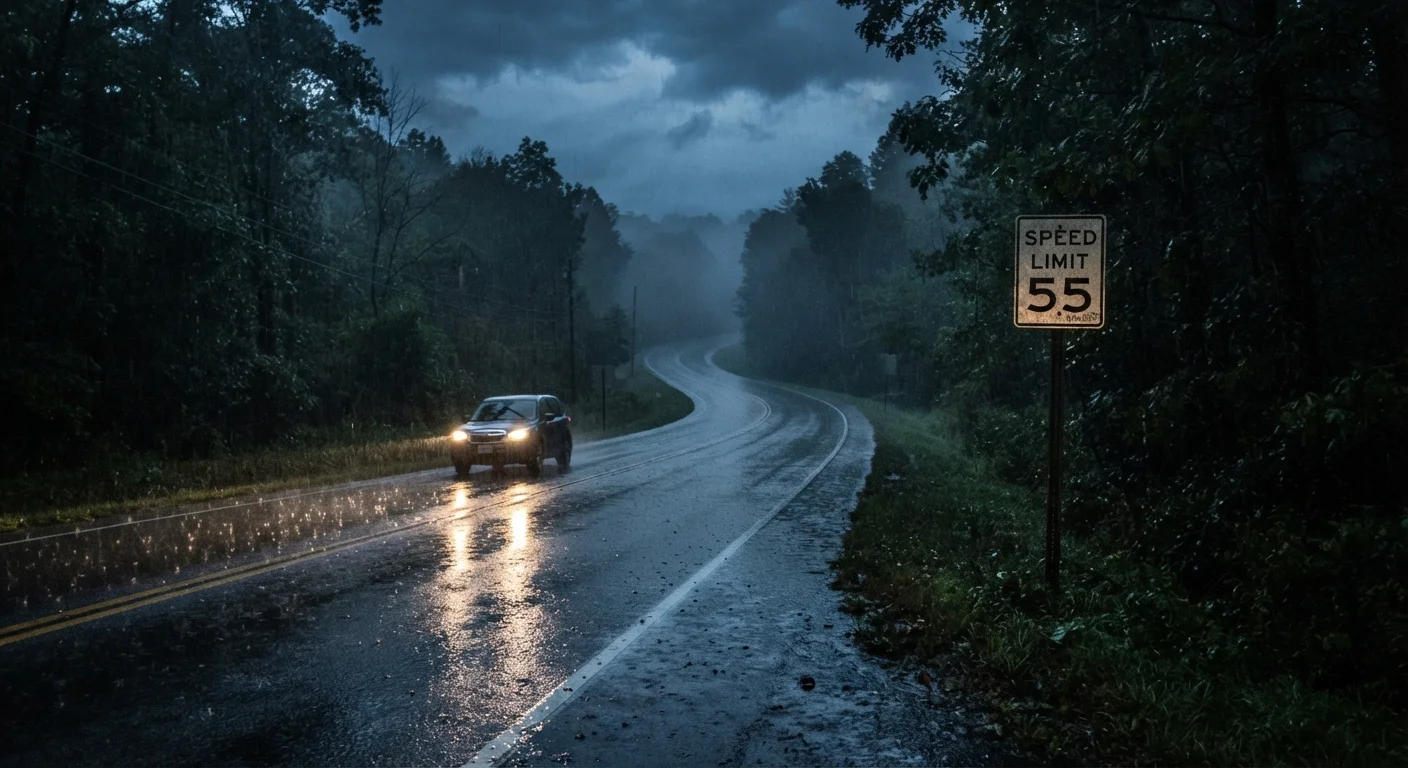
What the Sign Actually Tells You — and What It Doesn't
Speed limit signs communicate one specific piece of information: the maximum lawful speed for that road under normal, ideal conditions. Traffic engineers determine posted limits based on road geometry, surrounding land use, and the 85th-percentile speed — roughly the speed at or below which most drivers naturally travel. What signs cannot do is factor in fog, ice, a distracted pedestrian stepping off a curb, or the truck ahead with faulty brake lights.
This distinction matters enormously. Many drivers treat the speed limit as a target — a number they should reach and maintain. That mindset shifts full responsibility onto the sign and away from the driver, which is exactly the opposite of how traffic law actually works in the US.
Speed Limits Vary by Road Type and State
Maximum speed limits differ significantly across the US — from 85 mph on certain Texas highways to 55 mph on many urban interstates. State law governs posted maximums, while local jurisdictions may impose lower limits in specific zones. Always verify limits when driving in unfamiliar areas, especially in school zones, construction corridors, and residential neighborhoods where limits can drop without prominent signage.
Understanding how your risk profile changes depending on road type is equally important. Our article on motorway vs. urban driving risk profiles breaks down why the same speed can carry very different dangers in different environments.
Conditions That Demand a Speed Below the Posted Limit
Several common situations require drivers to actively reduce their speed regardless of what a sign says:
- Wet or icy roads: Precipitation dramatically reduces tire grip. Wet pavement can extend your stopping distance by half or more. Ice can reduce traction to a fraction of dry-road levels.
- Reduced visibility: Fog, heavy rain, glare, and nighttime driving all shrink the distance at which you can identify hazards. If you cannot stop within the distance you can see, you are overdriving your headlights — a well-established danger. See our guide on how darkness changes driving risk for a deeper look.
- Heavy traffic or congestion: When vehicles are closely spaced, reaction time becomes the critical factor. The posted limit was not designed for stop-and-go density.
- Pedestrian and cyclist presence: School zones, busy commercial areas, and bike lanes all introduce unpredictable movement that warrants slower speeds.
- Vehicle condition: Worn tires, a heavily loaded vehicle, or a trailer all affect handling and stopping performance — independently of what the road sign says.
Adjust Speed Before You Need To
Don't wait until you're in the middle of a hazardous situation to reduce speed. If weather is deteriorating, visibility is dropping, or traffic is thickening, slow down preemptively. Proactive speed management gives you more control and more time — two things you cannot recover once a hazard appears.
The Legal Standard: Basic Speed Law
Most US states operate under what is commonly called the basic speed law, which requires drivers to travel at a speed that is reasonable and prudent given actual conditions. This means law enforcement can cite a driver for traveling at — or even below — the posted limit if that speed was unsafe for the circumstances at the time.
In practice, this standard also affects civil liability. If a driver causes a crash while traveling at the posted limit but road conditions made that speed unreasonable, they may still be found at fault. The posted limit, in legal terms, establishes the ceiling — not a defense.
~30%
Fatal crashes involving excessive speed
The National Highway Traffic Safety Administration (NHTSA) consistently attributes roughly 29–31% of all traffic fatalities in the US to speeding-related factors.
2×+
Stopping distance increase on wet roads
Traffic safety research broadly confirms that wet pavement can more than double stopping distances compared to dry road surfaces at the same speed.
40%
Reduction in reaction time at highway speeds
Studies on driver response times show that high-speed travel compresses available reaction distance, leaving drivers significantly less time to identify and respond to hazards.
Translating Awareness into Habit
Adjusting speed based on conditions is not about being overly cautious — it is about maintaining the margin of safety that gives you time to react. A few practical habits make a consistent difference:
- Scan further ahead. Looking 12–15 seconds down the road gives you earlier warning of hazards and more time to respond.
- Increase following distance. The standard three-second rule should extend to five or more seconds in rain, fog, or heavy traffic.
- Reduce speed before curves, not within them. Braking mid-curve shifts vehicle weight in ways that reduce stability.
- Match speed to visibility. If your headlights illuminate only 150 feet but you need 200 feet to stop at your current speed, slow down.
Impairment from alcohol further compounds all of these risks by degrading the judgment needed to make these real-time adjustments. The myths around drink-driving limits are worth understanding, as many drivers significantly overestimate their ability to self-assess impairment.
Speed limit signs are valuable reference points, but they are the beginning of the conversation about safe travel speed — not the end of it.
Frequently Asked Questions
Driving below the posted limit is generally legal and often appropriate for conditions. However, driving unreasonably slowly on high-speed roads like highways can also be a traffic violation in many states, as it disrupts traffic flow and can create hazards.
Yes. Most US states enforce a 'basic speed law,' which holds drivers responsible for operating at a speed reasonable for actual conditions. If road or weather conditions make the posted limit unsafe, driving at that speed could still result in a citation or liability in a crash.
Wet pavement can increase stopping distance by 50% or more compared to dry conditions. This effect is even greater on roads with worn pavement markings or poor drainage. Reducing speed is the most effective way to compensate.
Key factors include visibility, road surface condition, traffic density, weather, the presence of pedestrians or cyclists, and your vehicle's tires and braking capability. All of these can require you to travel well below the posted limit to remain safe.
Yes. School zones and active construction zones typically carry reduced speed limits that are legally enforceable, often with doubled fines for violations. These limits apply regardless of whether children or workers are visibly present in some states — always verify local rules.
The content on this site is for informational purposes only and is not a substitute for professional advice. Always consult a qualified professional for guidance specific to your situation.