

The Core Idea Behind Dollar-Cost Averaging
Most people who want to invest face an immediate, uncomfortable question: When is the right time to buy? Markets rise and fall unpredictably, and the fear of investing at the wrong moment stops many people from getting started at all.
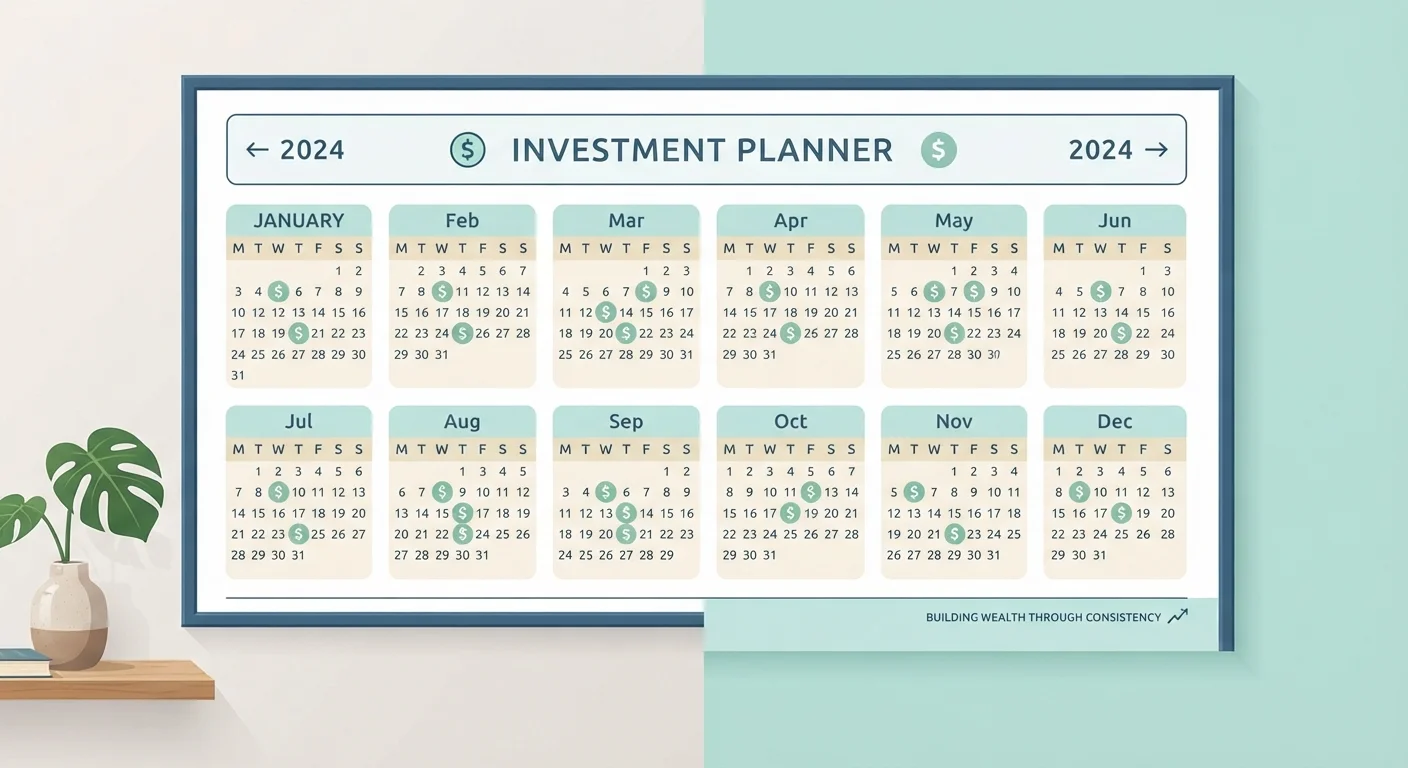
Dollar-cost averaging sidesteps that question entirely. Instead of trying to identify the perfect entry point, you commit to investing a set dollar amount on a fixed schedule — weekly, bi-weekly, or monthly. You invest that amount whether the market is climbing or sliding.
The math behind this is straightforward. If you invest $200 per month in a fund and its share price is $20 one month, you get 10 shares. If the price drops to $10 the following month, that same $200 buys 20 shares. Your average cost per share across both months is $13.33 — lower than the $15 midpoint average of the two prices. This effect, called lowering your average cost basis, is the mechanical benefit DCA offers.
To understand why this matters in context, it helps to first understand what investing actually means versus simply saving money.
~$7T
Assets held in U.S. defined-contribution plans
According to the Investment Company Institute, trillions flow through 401(k)-style plans where payroll deductions effectively practice DCA automatically.
66%
of time lump-sum investing outperforms DCA
Vanguard research found that investing a lump sum immediately outperformed a 12-month DCA strategy roughly two-thirds of the time in historical U.S. market data.
Why It Removes Emotional Decision-Making
One of DCA's most underappreciated benefits is behavioral, not mathematical. Markets are volatile, and that volatility triggers emotional responses. When prices fall sharply, the instinct is to sell or stop contributing. When prices surge, the temptation is to pour in extra money. Both reactions tend to hurt long-term returns.
A pre-committed DCA schedule counters both impulses. Because the decision to invest is already made — the amount, the timing, and the account — there's less room for emotion to interfere. Many investors automate contributions for exactly this reason: it removes the monthly decision entirely.
Automate to Stay Consistent
Most brokerage and retirement accounts allow you to schedule recurring contributions on a fixed date each month. Setting up automatic transfers removes the monthly decision and protects your strategy from emotional interference during volatile markets. Treating it like a recurring bill — similar to a fixed expense in your budget — is one of the most effective ways to maintain the habit long term.
This discipline-first framing connects directly to budgeting. If you treat your regular investment contribution like a fixed expense — non-negotiable, built into your monthly plan — it becomes easier to sustain. The 50/30/20 budgeting framework allocates a portion of income to savings and financial goals, which can serve as the funding source for a DCA plan.
Trade-Offs and Limitations to Understand
Dollar-cost averaging is a useful framework, but it is not a guaranteed path to profit, and it has real trade-offs worth understanding before relying on it.
Opportunity cost in rising markets: If an asset trends steadily upward, investing a lump sum at the start would produce better returns than spreading the same total investment over months. Money held back for future installments misses early gains. Studies of historical market data generally show lump-sum investing outperforming DCA in upward-trending conditions — though not in every period or every market.
It does not eliminate risk: If an investment declines steadily and never recovers, DCA simply means you bought more of a losing asset at multiple price points. Choosing what to invest in still matters enormously. Pairing DCA with diversification principles helps manage the risk that any single investment performs poorly.
Discipline is required: The strategy only works if contributions continue during downturns — the very moments when it feels most uncomfortable. Stopping contributions when markets fall eliminates DCA's core advantage of buying more shares at lower prices.
This article is for general informational and educational purposes only and does not constitute personalized investment, financial, or tax advice. Consult a qualified financial adviser before making investment decisions.
Frequently Asked Questions
Research suggests lump-sum investing outperforms DCA more often than not when markets trend upward over time, because money invested earlier has more time to grow. However, DCA reduces the risk of investing a large amount right before a market downturn. For many people, DCA is also more realistic because they invest from ongoing income rather than a windfall.
Common intervals are monthly or bi-weekly, often aligned with a paycheck. The specific frequency matters less than consistency — the key is sticking to a regular schedule so the strategy can work over time.
In a prolonged downturn, DCA allows you to accumulate more shares at lower prices, which can benefit you when the market eventually recovers. However, it does not protect against permanent loss if an investment never recovers, which is one reason diversification also matters.
Yes — in fact, many workers already practice DCA without realizing it. When a fixed percentage of each paycheck goes into a 401(k), that is dollar-cost averaging in action. IRAs can be set up with recurring contributions to achieve the same effect.
The primary drawback is opportunity cost: if markets generally rise, money held back for future installments misses out on earlier gains. DCA also requires discipline — skipping contributions during market downturns, when emotions run high, undermines the strategy.
The content on this site is for informational purposes only and is not a substitute for professional advice. Always consult a qualified professional for guidance specific to your situation.