

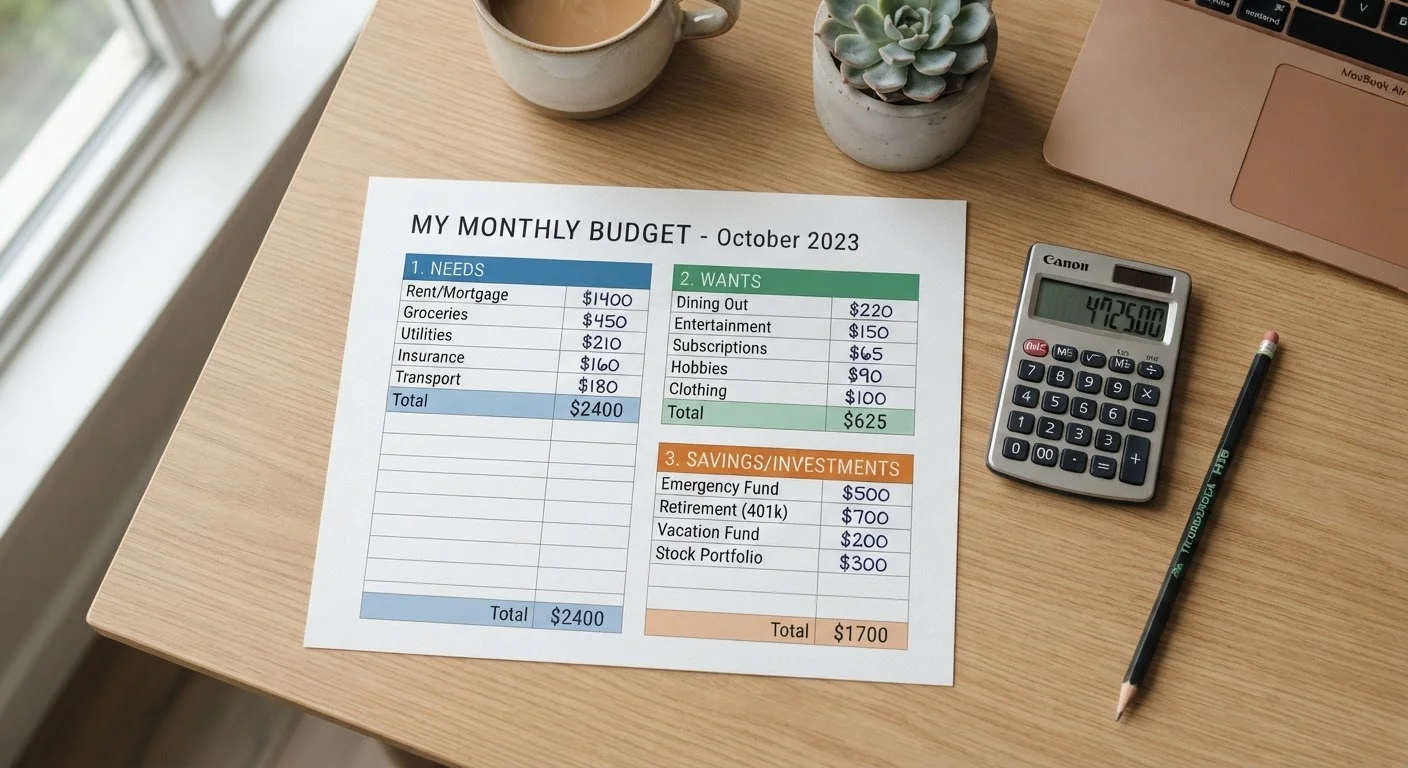
How the Three Categories Break Down
The framework rests on three buckets, each defined by how essential the spending is to daily life.
50% — Needs
Needs are non-negotiable expenses: costs you must pay to maintain housing, health, and employment. Common examples include rent or mortgage payments, utility bills, groceries, health insurance premiums, and minimum debt payments. Transportation costs — gas, public transit, or a car payment if the vehicle is required for work — typically fall here too.
A useful test: if skipping this expense would create a serious hardship or legal obligation, it is likely a need. For a full reference on how these categories break down in practice, see our guide to common budget categories.
30% — Wants
Wants are discretionary — lifestyle spending you choose to include. This covers dining out, entertainment subscriptions, travel, hobby expenses, clothing beyond basics, and gym memberships. The 30% allocation acknowledges that a workable budget needs to leave room for enjoyment; eliminating discretionary spending entirely is rarely sustainable long-term.
20% — Savings and Debt Repayment
The final fifth is directed toward building financial security. This includes contributions to an emergency fund, retirement accounts, and any debt payments above the required minimum. The order in which you prioritize these depends on your circumstances — generally, financial guidance suggests securing a basic emergency fund before aggressively investing, though individual situations vary. A licensed financial adviser can help you sequence these priorities for your specific case.
Start by Auditing One Month of Spending
Before restructuring your budget around the 50/30/20 percentages, review your last full month of bank and credit card statements. Categorize each transaction as a need, want, or savings contribution. This baseline reveals where your money is actually going — and which category needs the most adjustment — before you set any targets.
Where the Rule Works Well — and Where It Strains
The 50/30/20 rule earns its popularity because it is genuinely simple. There are no spreadsheets tracking individual transactions, no complex calculations. For someone beginning to budget for the first time, a three-category framework is far easier to adopt and maintain than a 20-line itemized plan.
The rule also builds in balance. Unlike stricter frameworks that heavily restrict discretionary spending, the 30% wants allocation treats enjoyment as legitimate — reducing the feeling that budgeting means deprivation.
50%
Maximum recommended share for essential needs
The 50/30/20 framework, as described by Warren and Tyagi, designates half of after-tax income as the upper bound for unavoidable living expenses.
~37%
Average US household share spent on housing and transport
According to the U.S. Bureau of Labor Statistics Consumer Expenditure Survey, housing and transportation together represent a substantial share of American household spending, often making the 50% needs ceiling tight for many households.
20%
Recommended allocation for savings and debt repayment
Financial planners frequently cite consistent savings of around 20% of net income as a meaningful benchmark for building long-term financial security, though individual circumstances vary.
However, the framework has clear limitations:
- High housing costs: In cities where rent alone can absorb 40–50% of take-home pay for middle-income earners, hitting the 50% needs ceiling becomes structurally impossible without significant trade-offs elsewhere.
- Lower incomes: When income is modest, essential costs often represent a much larger share than 50%, leaving little room for the wants or savings categories.
- Irregular income: Freelancers and gig workers whose monthly earnings fluctuate may find it difficult to apply fixed percentages consistently. Budgeting on an irregular income requires a modified approach.
- High-debt situations: Someone carrying significant high-interest debt may need to direct more than 20% toward repayment, compressing the other categories.
For those who want more precision, a comparison of zero-based and percentage-based budgeting outlines when a more granular method might be worth the extra effort.
Putting the Framework Into Practice
Applying the rule starts with one number: your monthly after-tax income. Multiply that figure by 0.50, 0.30, and 0.20 to establish your three category ceilings for the month.
Next, list your current spending and assign each item to a category. Most people find this exercise revealing — common surprises include needs that have crept above 50%, or wants that have quietly compounded through subscriptions and recurring charges.
If your actual numbers don't match the targets, the framework still provides direction:
- If needs exceed 50%, look first at whether any expenses in that bucket are actually wants (a premium cable package counted as a utility, for instance).
- If savings fall below 20%, assess whether reducing wants spending could close the gap before assuming the framework doesn't apply to you.
- Accept that the percentages may need recalibration for your income level or location — using the structure while adjusting the ratios is still more intentional than budgeting without any framework.
For a practical walkthrough of constructing a full monthly plan, our step-by-step monthly budget guide covers the process from income tallying to setting realistic category limits. Once you have a budget in place, a regular monthly budget review helps identify drift before it becomes a problem.
“The key to financial security isn't earning more — it's making sure your spending structure gives savings a guaranteed seat at the table before discretionary choices crowd it out.”
— Money & Finance Editorial Team, Personal Finance Editors
As you build savings through the 20% allocation, those funds can eventually serve as the foundation for investing. Understanding concepts like dollar-cost averaging becomes more relevant once a savings habit is established. For broader guidance on reducing debt and growing savings simultaneously, the Saving & Debt hub offers additional resources.
This article is for general informational and educational purposes only and does not constitute personalized financial, investment, tax, or legal advice. Consult a qualified financial professional before making decisions based on your individual circumstances.
Frequently Asked Questions
It applies to net income — the amount you actually take home after taxes and payroll deductions. Using gross income would overstate your available budget, since taxes are not discretionary spending.
Needs are expenses that are essential for basic living and work — housing, utilities, groceries, transportation to your job, and minimum debt payments. Wants are things that improve your quality of life but are optional, such as dining out, streaming services, or gym memberships. The line isn't always perfectly clear, and some expenses fall in a gray area.
The 20% bucket is meant to cover savings and debt repayment beyond the minimum. This can include contributions to an emergency fund, retirement accounts such as a 401(k) or IRA, and extra payments toward high-interest debt. The priority order will depend on your personal situation.
It can be challenging. When income is lower, needs may consume well over 50% of take-home pay — particularly in areas with high housing costs. For people with variable income, the framework still provides useful guidance on proportions, though the dollar amounts change each month. See strategies for <a href="/money-finance/budgeting-basics/budgeting-on-an-irregular-income-frameworks-that-work-without-a-fixed-paycheque">budgeting on an irregular income</a> for adapted approaches.
Zero-based budgeting assigns every dollar of income to a specific category, often requiring more granular tracking. The 50/30/20 rule is broader and less time-intensive. Neither approach is universally superior — your preference for detail versus simplicity will often determine which fits better.
Yes. The 50/30/20 split is a guideline, not a rule set in stone. If your needs genuinely exceed 50%, reducing the wants percentage is a logical response. The important principle is intentional allocation — knowing where your money goes — rather than hitting exact targets.
The content on this site is for informational purposes only and is not a substitute for professional advice. Always consult a qualified professional for guidance specific to your situation.