

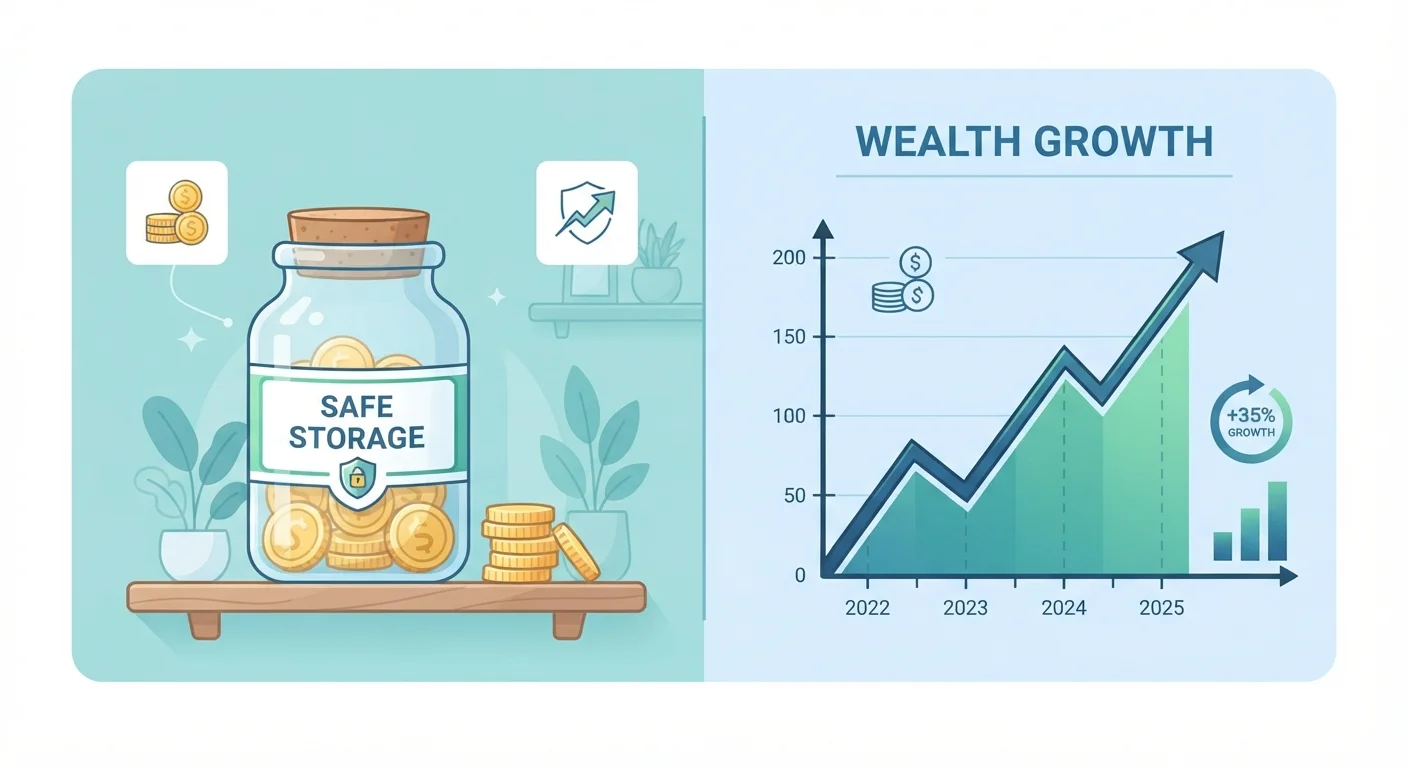
The Core Distinction: Preservation vs. Growth
When people talk about saving, they usually mean setting money aside in a place where it stays safe and accessible — a checking account, a savings account, or a similar cash-equivalent vehicle. The goal is preservation: the money you put in should still be there when you need it, plus a modest amount of interest in many cases.
Investing operates on a different premise entirely. Rather than simply holding money, investing involves purchasing an asset — a share of a company, a bond, a piece of real estate, or another instrument — with the expectation that its value will increase over time. That expectation, however, is not a guarantee. The same forces that can grow an investment can also shrink it.
This is the fundamental trade-off: saving offers relative security but limited growth potential; investing offers greater growth potential but introduces the possibility of loss. Neither approach is universally superior — they serve different goals at different stages of life.
For a deeper look at how savings vehicles compare to one another, see this overview of savings accounts and cash equivalents.
3.1%
Average U.S. inflation rate over the past 30 years
Based on historical U.S. Bureau of Labor Statistics CPI data, illustrating why simply holding cash can reduce purchasing power over time.
~10%
Historical average annual return of U.S. large-cap stocks
The S&P 500 has historically averaged roughly 10% annually before inflation; past performance does not guarantee future results.
56%
Share of U.S. adults who own stock
According to Gallup polling, stock ownership among U.S. adults has hovered around the mid-50s percentage range in recent years.
Why People Choose to Invest
The primary motivation for investing is the potential for returns that outpace inflation. Over time, inflation erodes the purchasing power of money sitting in low-yield savings. A dollar that buys a certain amount today will buy less in ten or twenty years. Investing in assets that grow in value — or that pay dividends or interest — is one way many people attempt to stay ahead of that erosion.
A second motivation is compound growth: when returns are reinvested, they generate their own returns. Over long periods, this compounding effect can substantially increase the value of a portfolio. The key word, though, is long — compounding tends to become meaningful over years and decades, not months.
“The stock market is a device for transferring money from the impatient to the patient.”
— Warren Buffett, Chairman and CEO of Berkshire Hathaway, widely cited investor
This is why time horizon matters so much in investing. People with longer timelines — say, those saving for retirement decades away — are generally in a position to tolerate more risk and benefit more from compounding than those with short-term financial goals. For a closer look at how time horizon shapes strategy, see how short-term and long-term investing differ.
Risk Is Part of the Definition
One of the most important things to understand about investing is that risk is not incidental — it is intrinsic. The potential for growth exists precisely because outcomes are uncertain. A company whose stock you buy might perform well or poorly. A bond issuer might meet its obligations or default. Real estate can appreciate or depreciate.
This does not mean investing is reckless or equivalent to gambling. Structured, diversified investing is grounded in the idea that spreading money across many assets reduces the impact of any single loss. But it does mean that anyone investing should go in with clear eyes about what can happen.
Build a Safety Net Before You Invest
Most financial guidance recommends having an emergency fund — typically three to six months of essential expenses — in an accessible savings account before putting money into investments. This way, an unexpected expense does not force you to sell investments at an inopportune time, potentially locking in a loss.
Many beginners hold misconceptions that either overstate or understate this risk — for example, believing that investing is just gambling or, conversely, that certain strategies are risk-free. Common investing myths worth understanding explores several of these in plain terms.
If you are new to the topic and want a broader foundation, this foundational guide for complete beginners covers how markets work and how portfolios are structured, with no prior knowledge assumed.
This article is for general informational and educational purposes only. It does not constitute personalized financial or investment advice. Please consult a qualified financial adviser before making decisions about your own money.
Frequently Asked Questions
No. Saving typically means setting aside money in a low-risk account that preserves its value, such as a savings account. Investing involves buying assets that can grow in value but also carry the risk of loss. The two serve different purposes in a financial plan.
Yes. Unlike federally insured savings accounts, most investments can decline in value. The level of risk varies widely depending on the type of investment. Understanding your risk tolerance is an important step before committing any funds.
The minimum varies by account type and platform, but many options allow people to begin with very small amounts. The more important factor is having a clear goal and a basic understanding of what you are purchasing. Consider consulting a financial adviser for personalized guidance.
Most financial guidance suggests building an emergency fund in accessible savings before investing. This protects you from needing to sell investments at a loss when unexpected expenses arise. Both saving and investing can coexist in a balanced financial plan.
Compound growth means that returns generated by an investment can themselves generate additional returns over time. This effect becomes more pronounced the longer money remains invested. It is one of the core reasons investing is associated with long-term wealth building.
No. Risk levels vary considerably across different types of investments. Government bonds, for example, are generally considered lower-risk than individual stocks. Diversifying across asset types is one way to manage overall portfolio risk, though it does not eliminate it.
The content on this site is for informational purposes only and is not a substitute for professional advice. Always consult a qualified professional for guidance specific to your situation.