

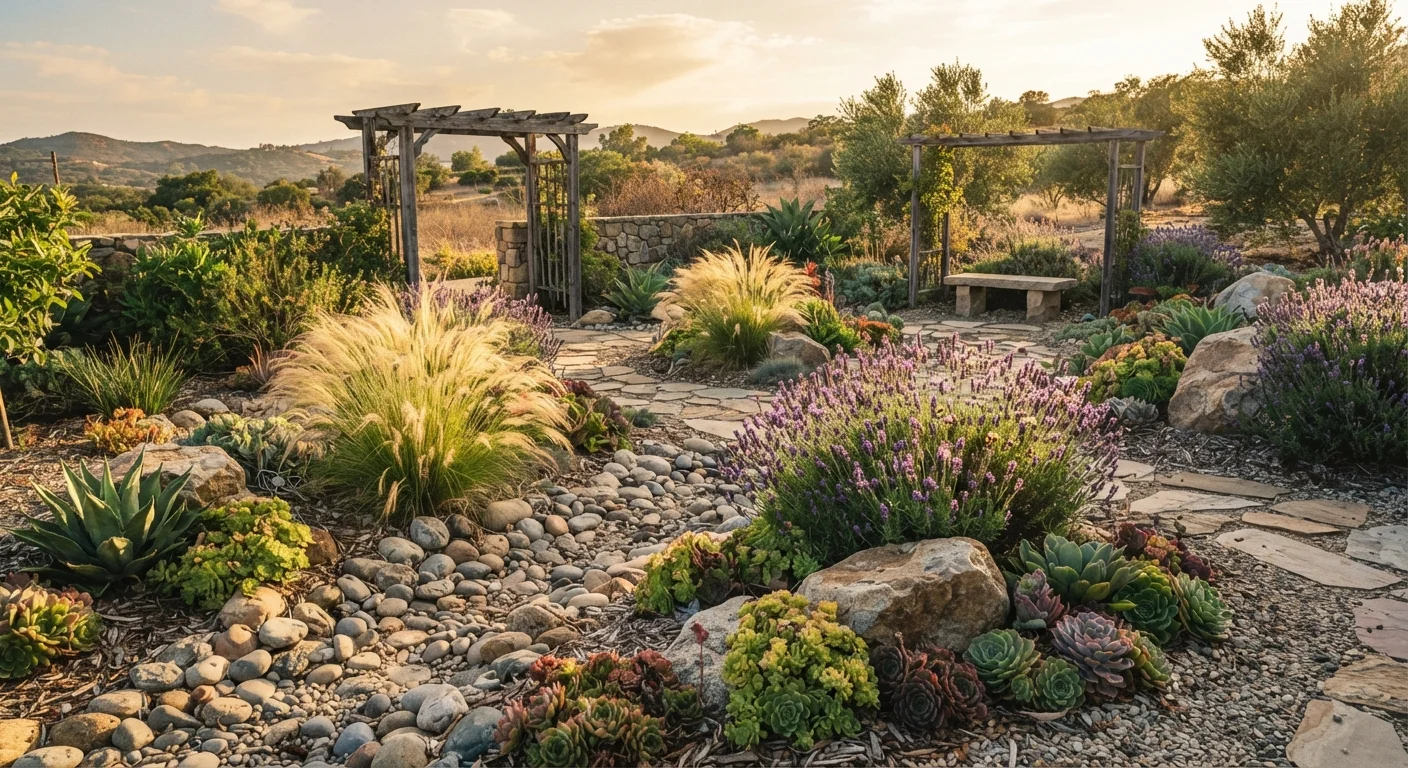
Why Water-Smart Gardening Matters Now
Prolonged dry spells are no longer rare events in much of the United States. Gardeners who once relied on consistent summer rainfall are increasingly facing restrictions on outdoor water use, unpredictable precipitation patterns, and plants stressed by heat. The good news is that gardening with less water doesn't mean settling for a dusty, sparse yard.
Drought-tolerant gardening is a set of practical, proven techniques that work together — from how you water, to what you plant, to how you prepare your soil. When these approaches are layered thoughtfully, even a modest garden can stay productive and visually rich through dry stretches. The techniques below are worth understanding whether you're redesigning an established space or starting from scratch.
Establishment Period Still Requires Water
Even drought-tolerant and native plants need regular watering during their first one to two growing seasons while their root systems develop. 'Drought-tolerant' describes a plant's long-term needs once established — not its requirements immediately after planting. Plan to water new plantings consistently through their first summer, then gradually reduce frequency as the plant matures.
Techniques That Make a Real Difference
Water Deeply and Infrequently
The most common watering mistake is applying small amounts of water frequently. This encourages plant roots to stay shallow — right at the surface where they're most vulnerable to heat and dry spells. A better approach is to water less often but more thoroughly, soaking the root zone deeply each time.
For most established garden plants, this means watering once or twice a week rather than daily, allowing the soil to partially dry between sessions. This signals roots to follow moisture downward. It's a counterintuitive habit to build, but the payoff is plants that are far more drought-resilient. Our article on common garden watering myths breaks down why frequency isn't the same as effectiveness.
Shallow, frequent watering keeps roots near the surface where drought damage hits hardest.
Mulch Every Exposed Soil Surface
Bare soil loses moisture rapidly through evaporation — especially during hot, sunny days. A 2–4 inch layer of organic mulch (such as shredded bark, wood chips, or straw) acts as an insulating blanket. It slows evaporation, moderates soil temperature, suppresses weeds that compete for water, and gradually breaks down to improve soil structure.
Apply mulch around — not directly against — plant stems and tree trunks to prevent rot. Refresh the layer each season as it decomposes. This single habit can reduce how often you need to water more than almost any other technique.
A proper mulch layer can cut soil moisture loss significantly during peak summer heat.
Choose Native and Regionally Adapted Plants
Plants that evolved in your region are already adapted to its natural rainfall cycles, soil types, and temperature swings. Once established, many native species require little to no supplemental irrigation beyond what rain provides. They also tend to support local pollinators and wildlife in ways that imported ornamentals often don't.
You don't have to convert your entire garden overnight. Start by replacing one or two high-water plants with native alternatives when they decline or when you're ready to redesign a bed. Native plants offer real ecological and practical benefits — including less watering — though it's worth understanding their limitations too. Reading plant labels carefully helps you spot which varieties are drought-tolerant before you buy.
Regionally native plants often need little supplemental water once they're fully established.
Group Plants by Water Needs (Hydrozoning)
Hydrozoning is a core xeriscape principle: place plants with similar water requirements together so you can irrigate each zone precisely, without over-watering drought-tolerant plants or under-watering thirstier ones. It's a practical design decision as much as a conservation strategy.
In a typical garden, this might mean placing vegetables and herbs — which generally need consistent moisture — nearest a water source, while drought-adapted perennials and shrubs occupy drier, less-irrigated areas. Even small adjustments to grouping can eliminate a surprising amount of water waste over a season.
Grouping plants by thirst level prevents over-watering drought-hardy plants alongside thirstier ones.
Improve Soil Structure and Organic Matter
Sandy soils drain too fast for moisture to be useful to roots; compacted or clay-heavy soils may waterlog rather than absorb. In both cases, adding organic matter — compost is the most accessible option — moves soil toward a structure that holds moisture longer while still draining well enough to prevent root rot.
Work compost into beds each season, and consider a soil test to understand your garden's current composition. Understanding soil health is one of the highest-leverage investments a gardener can make, because better soil means plants access available water more efficiently — reducing the amount you need to apply.
Compost-rich soil holds more usable moisture, reducing how often plants need supplemental watering.
Use Drip Irrigation or Soaker Hoses
Overhead sprinklers lose a significant portion of water to evaporation before it ever reaches the root zone — especially in hot, dry conditions. Drip irrigation systems and soaker hoses deliver water slowly and directly to the soil surface near plant roots, where it's immediately available and far less likely to evaporate.
These systems are increasingly affordable and adaptable for beds of any size, including container gardens. If overhead watering is your only option, watering in the early morning minimizes evaporation loss and reduces the risk of fungal disease that can develop when foliage stays wet overnight.
Drip systems apply water directly where roots can use it, cutting losses to evaporation.
Time Your Watering Strategically
Early morning is widely considered the best time to water. Temperatures are cooler, wind is typically calmer, and the soil has time to absorb moisture before midday heat peaks. Avoid watering in the hottest part of the day, when evaporation is highest. Evening watering can work in a pinch, but wet foliage overnight may encourage fungal problems in some climates.
Building a Garden That Works With Less
No single technique here is a silver bullet — but used together, they form a system that genuinely reduces your garden's water dependency. If you're curious about how your soil's structure and biology affect its moisture-holding capacity, our guide on soil health for gardeners goes deep on what's actually happening below the surface.
For gardeners drawn to the idea of lower overall maintenance — not just lower water use — designing a low-maintenance outdoor space offers a broader framework that complements these water-wise approaches. Small shifts in how you water, what you plant, and how you prepare your soil add up to a garden that's more resilient — and often more interesting — than one that depends on constant intervention.
The content on this site is for informational purposes only and is not a substitute for professional advice. Always consult a qualified professional for guidance specific to your situation.