

Why Right-of-Way Rules Matter
Right-of-way rules exist to create predictable order at intersections, where conflicting traffic paths create the highest collision risk in everyday driving. The Federal Highway Administration consistently identifies intersections as a leading location for crashes on US roads. Yet many drivers operate on instinct rather than a clear understanding of the underlying rules — especially when junction types vary.
This reference breaks down who yields at the most common junction and intersection types found on US roads. Whether you're approaching a roundabout, a four-way stop, or a T-junction, the rules below give you a reliable framework to apply in real time. For a broader look at how urban road environments create distinct hazards, see how urban and motorway risk profiles differ.
| Roundabout yield rule | Entering traffic yields to circulating traffic (Federal Highway Administration roundabout guidance) |
| Four-way stop tiebreaker | Yield to the driver on your right (Standard US traffic law) |
| T-junction default | Minor road yields to through road (Standard US traffic law) |
| Left turn rule | Always yield to oncoming traffic (Universal US right-of-way principle) |
| Uncontrolled intersection rule | Yield to vehicle on the right (Standard US traffic law) |
| Emergency vehicle rule | Pull right and stop — all other rules suspended (Required by law in all 50 US states) |
Junction Type by Junction Type: Who Yields
Roundabouts
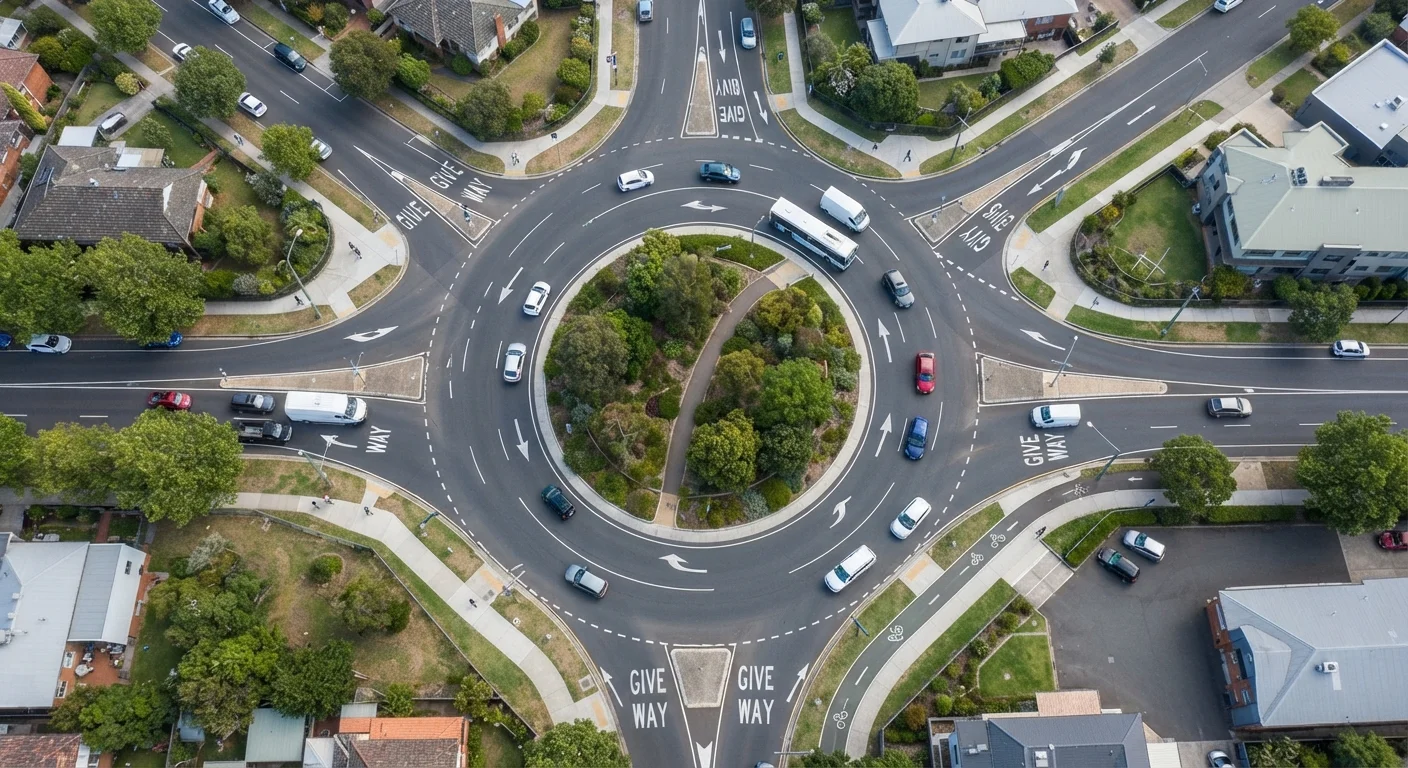
At a roundabout, entering traffic always yields to circulating traffic. Drivers already inside the roundabout have right of way. You must wait at the yield line — not the edge of the roadway — until a safe gap exists in the circulating lane or lanes. Do not stop inside the roundabout unless forced to; maintain a steady, slow speed through the circle.
In multi-lane roundabouts, choose your lane before you enter based on your exit: generally, right-lane exits use the right lane, while left-lane exits or going more than halfway around use the left lane. Signal when exiting.
Multi-Lane Roundabouts Require Extra Care
In a multi-lane roundabout, you must also yield to vehicles in adjacent circulating lanes when exiting. Avoid changing lanes inside the roundabout — enter in the correct lane for your exit and stay in it. Mirror and blind-spot checks are especially important before exiting across an inner lane.
Four-Way Stops
When four vehicles arrive simultaneously, yield to the driver on your right. In practice, the driver who arrived first proceeds first. If two vehicles arrived at the same time and are across from each other, a driver going straight has priority over a driver turning left. When in doubt, make eye contact and use a hand signal to establish a shared understanding.
T-Junctions
At a T-junction, the driver on the minor road (the stem of the T) yields to all traffic on the through road (the top of the T). This applies whether you intend to turn left or right onto the main road. A stop sign or yield sign at the junction reinforces this obligation legally.
Uncontrolled Intersections
Where no signs or signals exist, the general US rule is yield to the vehicle on your right. Treat these intersections with extra caution: slow to a speed at which you can stop if necessary. Uncontrolled intersections are most common in rural areas and older residential grids.
Left Turns Across Oncoming Traffic
A left-turning driver must yield to all oncoming traffic travelling straight or turning right, regardless of junction type. This rule applies at signalized intersections, roundabouts, and driveways alike. A green light does not grant automatic right of way for a left turn — it only permits you to enter the intersection and wait for a legal gap. This is one of the most commonly misunderstood right-of-way situations. See common lane and merging errors for related yielding missteps on faster roads.
Right of Way
The legal entitlement of a driver, cyclist, or pedestrian to proceed through a road space ahead of others. It is established by traffic laws, signs, signals, and road markings — not by driver assertion or vehicle size.
Yield
To slow or stop and allow another road user to proceed first. A yield obligation exists even when no yield sign is posted if the applicable right-of-way rule places your vehicle in a subordinate position.
Roundabout
A circular, one-way junction where traffic flows continuously around a central island. Entering vehicles always yield to circulating vehicles already in the roundabout.
T-Junction
An intersection where one road meets another at a right angle without continuing through, forming a T shape. The driver on the minor (stem) road yields to traffic on the through road.
Uncontrolled Intersection
An intersection with no traffic signals, stop signs, or yield signs. The default US rule requires drivers to yield to the vehicle approaching from the right.
Circulating Traffic
Vehicles already moving within a roundabout. These vehicles have right of way over any vehicle attempting to enter the roundabout from a side road or entry point.
Practical Tips for Every Junction
Knowing the rule is only part of safe junction navigation. Here's how to apply that knowledge consistently:
- Approach speed matters. Slow before the yield or stop line, not at it. This gives you time to assess traffic without creating a sudden stop hazard behind you.
- Scan all directions twice. A single glance misses cyclists, pedestrians, and vehicles in blind spots. At roundabouts, look left; at four-way stops, check all four legs.
- Never assume the other driver knows the rule. Even when you have right of way, proceed only when it's safe. Right of way is a legal concept; it doesn't prevent a crash if the other driver is inattentive.
- Pedestrians typically have priority. At marked crosswalks, pedestrians generally have the right of way over turning vehicles regardless of junction type. State laws vary slightly, but yielding to pedestrians in or entering a crosswalk is a near-universal US standard.
- Emergency vehicles always supersede right of way. Pull to the right and stop whenever an emergency vehicle approaches with lights and sirens active, regardless of who technically has right of way at that moment.
Before you even reach a junction, your vehicle condition affects how safely you can respond. A well-maintained braking system and clear sightlines from your mirrors and windows make every junction interaction safer. A pre-drive safety walkthrough can help you build that habit.
~40%
Of all US traffic crashes occur at intersections
According to Federal Highway Administration research, intersections represent a disproportionate share of crash locations on US roads.
75%
Reduction in serious injury crashes at roundabouts vs. traditional intersections
FHWA studies comparing roundabout performance to signalized intersections in the US show significant injury crash reductions.
The content on this site is for informational purposes only and is not a substitute for professional advice. Always consult a qualified professional for guidance specific to your situation.