

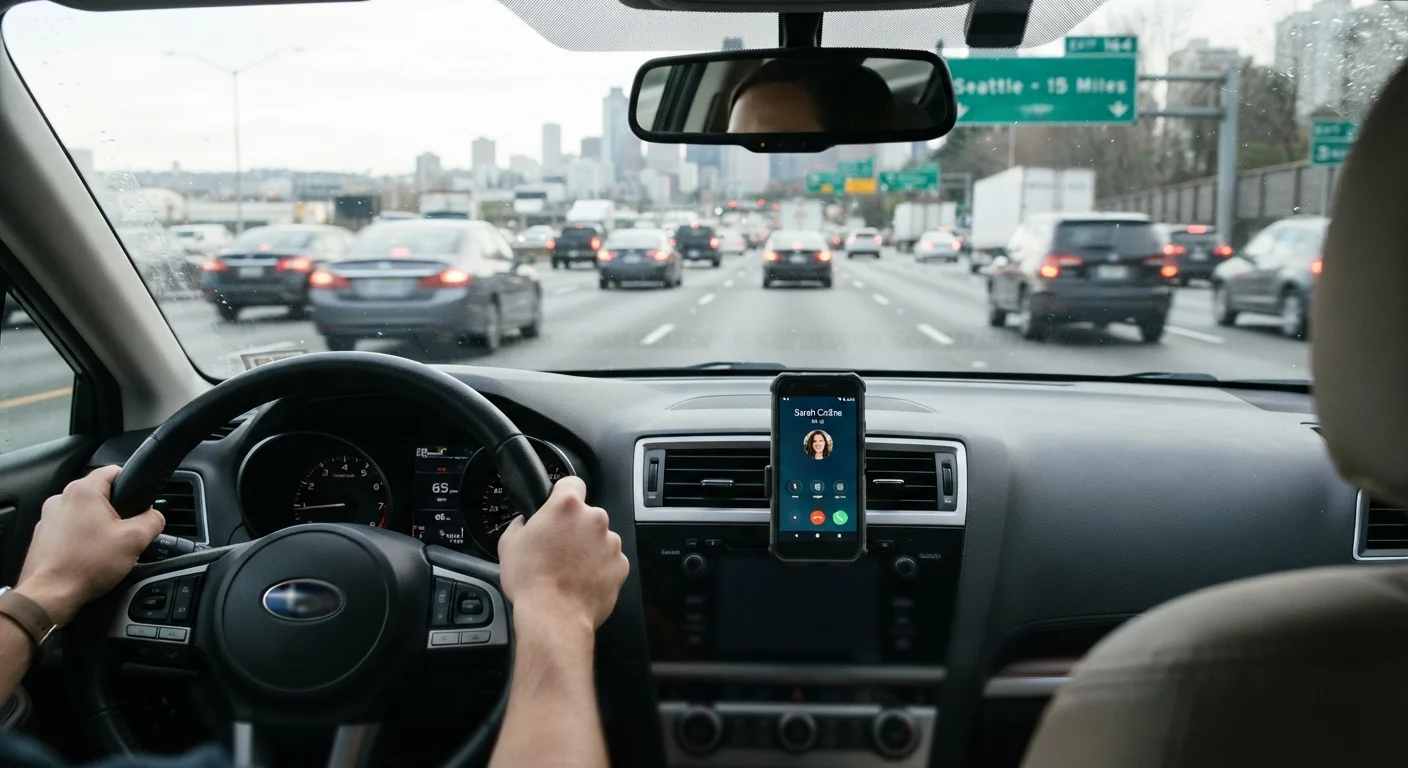
The Illusion of Safety in Hands-Free Technology
When hands-free calling became standard in vehicles, many drivers — and lawmakers — treated it as a solution to distracted driving. Keep both hands on the wheel, eyes on the road, and the risk disappears. That logic is intuitive, but the science tells a more complicated story.
Driving is not a single task. It is a continuous stream of simultaneous demands: tracking lane position, monitoring speed, reading road signs, anticipating the behavior of other vehicles, and reacting to the unexpected. These tasks draw on the same limited pool of cognitive resources. When a phone conversation occupies a significant portion of that pool, something else has to give — and what gives is often the processing that keeps you safe.
This is the core concept researchers call cognitive distraction: a form of impairment that is entirely invisible from the outside but measurably real in its effects on driver performance. Unlike reaching for a phone or glancing at a screen, cognitive distraction leaves your hands where they belong and your eyes pointed forward — yet your brain is somewhere else entirely.
Hands-Free Is Not the Same as Risk-Free
Hands-free technology addresses two of the three categories of distraction — manual (taking a hand off the wheel) and visual (looking away from the road). It does not address the third and least visible category: cognitive distraction. All three types are recognized by the National Highway Traffic Safety Administration (NHTSA) as contributors to distracted driving crashes.
What the Research Actually Shows
Studies examining driver performance during hands-free calls consistently find meaningful impairment. Work conducted by the AAA Foundation for Traffic Safety found that cognitive distraction increases reaction time, causes drivers to scan a narrower field of view, and reduces their ability to detect and respond to hazards — even when their eyes appear to be on the road.
One of the more striking findings involves what researchers call inattention blindness: drivers in cognitively demanding conversations may look directly at an object — a pedestrian, a red light, a vehicle braking ahead — and still fail to consciously process it. Their eyes register the scene, but the brain doesn't fully analyze it because working memory is occupied elsewhere.
4x
Increased crash risk during phone use while driving
According to the National Safety Council, cell phone use while driving — including hands-free — is estimated to be involved in about 26% of all car crashes.
27 seconds
Cognitive distraction lingering after a call ends
AAA Foundation for Traffic Safety research found that mental distraction can persist for up to 27 seconds after completing a voice-activated or hands-free task.
~50%
Reduction in brain activity processing visual information
Research cited by the National Safety Council suggests that listening to a phone conversation can reduce the brain's activity dedicated to processing driving-related visual input by approximately half.
This is meaningfully different from talking to a passenger. A co-pilot in the vehicle shares your context: they see the traffic slow ahead, they notice the merge, and they instinctively pause the conversation. A caller on the other end of the phone has none of that information and applies none of that restraint, sustaining the cognitive demand regardless of what you're navigating.
Distraction doesn't end the moment you hang up, either. Research suggests cognitive load can linger for up to 27 seconds after a call ends — a window during which reaction time and hazard awareness remain below normal levels. At highway speeds, 27 seconds covers a substantial distance.
Why the Law Lags Behind the Science
Most US states draw a legal line at handheld phone use while driving. Picking up a phone and holding it to your ear is illegal in many jurisdictions; conducting the same conversation through a Bluetooth earpiece or a vehicle's built-in system is typically permitted. The distinction reflects the real risk of manual and visual distraction — but it stops short of addressing cognitive distraction.
The gap isn't a secret. Traffic safety researchers have pointed to it for years, and the National Safety Council has long classified cell phone use — including hands-free — as a significant crash risk. But translating research findings into legislation is slow, particularly when the technology in question has become normalized and is embedded in vehicles from the factory.
It's also worth noting that self-assessment is unreliable here. Drivers consistently rate their own performance during phone calls as unimpaired, even when objective measurements show otherwise. This mirrors a pattern seen in other impairment contexts — similar to how drivers often misjudge their own impairment after drinking. The subjective sense of control doesn't align with the measurable decline in capability.
Practical Steps for Reducing Cognitive Load Behind the Wheel
Understanding the science changes the calculation — even if it doesn't change the law. There are concrete, low-effort steps that drivers can take to reduce phone-related cognitive risk without abandoning connectivity entirely.
- Use Do Not Disturb while driving. Most smartphones offer a driving mode that silences notifications and sends automatic replies to callers and texters. Enabling it removes the temptation to engage entirely.
- Pull over for complex conversations. Emotionally charged, logistically detailed, or mentally demanding calls deserve your full attention. Finding a safe place to stop costs minutes; the alternative can cost far more.
- Delay the call entirely. If a call can wait until you've reached your destination, let it wait. Voice messages and callbacks are underused alternatives to real-time driving conversations.
- Be honest about your driving environment. Merging onto a freeway, navigating an unfamiliar area, or driving in adverse weather are not the conditions to sustain a phone conversation — hands-free or otherwise.
Managing phone notifications more broadly is also part of the picture. Reducing the volume of interruptions you receive throughout the day can lower the habitual pull to engage with your device — a pattern worth building before you ever get behind the wheel. For more on that, see reclaiming control of your phone's attention demands.
Cognitive distraction is one of several invisible risk factors that accumulate behind the wheel. Drivers navigating unfamiliar roads at night face a different but overlapping set of challenges — explored in our piece on how darkness changes your driving risk. Similarly, driver fatigue impairs reaction time in ways that compound with any other distraction you bring into the vehicle.
Set Your Phone Before You Start the Engine
Activating Do Not Disturb or your phone's built-in driving mode before you pull away removes the moment-to-moment decision of whether to answer. Making it a consistent pre-drive habit — like buckling a seatbelt — means you don't have to rely on willpower when a call comes in. Most modern vehicles also allow you to configure automatic do-not-disturb through the infotainment system.
Frequently Asked Questions
Hands-free calling eliminates the manual and visual distraction of holding a device, but it does not eliminate cognitive distraction. Research from institutions including the AAA Foundation for Traffic Safety indicates reaction times and hazard detection are still measurably impaired during hands-free conversations. It is safer in one dimension, but not risk-free.
A passenger physically shares the driving environment and naturally adjusts their conversation — pausing during complex maneuvers or alerting the driver to hazards. A phone caller has no awareness of road conditions and does not moderate the cognitive demands of the conversation accordingly.
Voice-to-text systems reduce manual distraction but can actually increase cognitive load compared to a simple phone call. Composing, reviewing, and correcting dictated messages requires sustained mental attention that competes directly with driving tasks.
Laws vary by state. Most US states permit hands-free device use for adult drivers but ban handheld phone use. Some states impose stricter rules, including full bans for novice or young drivers. Always verify the laws applicable to your state and any state you drive through.
Research from the AAA Foundation has suggested that cognitive distraction can persist for up to 27 seconds after a task ends — meaning a driver's attention may not be fully restored immediately after hanging up, particularly in busy traffic environments.
The content on this site is for informational purposes only and is not a substitute for professional advice. Always consult a qualified professional for guidance specific to your situation.