

Our Verdict
Dashcams are a practical, low-cost tool for documenting road incidents and supporting insurance claims, but they are not a safety device in the traditional sense. Their value is evidentiary, not preventive, and their footage has real limitations around angle, quality, and storage. Drivers who understand what a dashcam can and cannot do will get the most out of one.
Dashcams are best suited to frequent commuters, rideshare drivers, and anyone who wants an objective record of road incidents for insurance or legal purposes.
What Dashcams Actually Record
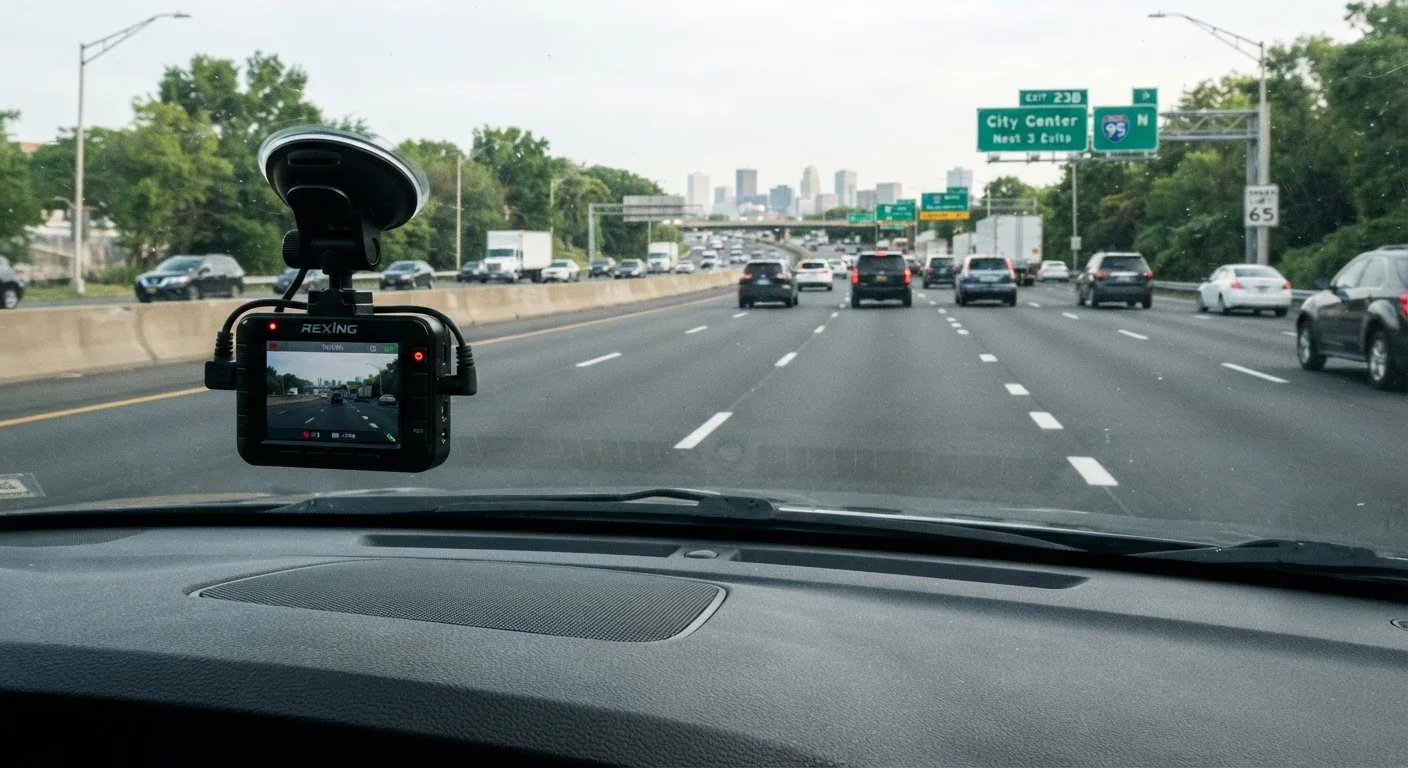
A dashcam — short for dashboard camera — is a compact, continuously recording video device mounted to a vehicle's windshield or dashboard. Most consumer models record the road ahead at resolutions ranging from 1080p to 4K, capturing footage in a loop that overwrites older files when storage is full.
In clear daytime conditions, a quality dashcam records useful detail: license plates within a reasonable distance, traffic signal states, lane positions, and the general sequence of events leading up to a collision. Some models include rear-facing cameras, interior cabin views (common in rideshare vehicles), and GPS overlays that log speed and location alongside video.
These features make dashcam footage genuinely useful in several scenarios. When two drivers give conflicting accounts of an accident, video can clarify who had the right of way or who crossed the lane line. Footage has been used to contest fraudulent insurance claims — a practice sometimes called "crash for cash" — where a driver deliberately causes a collision to collect a payout. It can also document hit-and-run incidents, capturing a vehicle description or plate number that police can act on.
For drivers who want a clearer picture of their overall vehicle documentation, the guide to keeping vehicle records organised is a useful companion resource.
Provides objective video evidence after a collision
Dashcam footage gives insurers and law enforcement a factual record of the sequence of events, reducing disputes based on conflicting driver accounts.
Helps counter fraudulent insurance claims
Staged collisions are a documented form of insurance fraud; continuous video footage can expose dishonest claims before they cost a driver money or a rate increase.
Captures hit-and-run vehicle details
A forward camera recording at the moment of impact can capture a license plate, vehicle color, or model that gives law enforcement a workable lead.
GPS-enabled models log speed and location
When footage alone isn't definitive, GPS metadata can corroborate a driver's account of their speed and route at the time of an incident.
Passive operation requires no driver attention
Once installed and configured, a dashcam runs automatically — it records without requiring any action from the driver, making it a low-friction addition to a vehicle.
Where Dashcams Fall Short
The limitations of dashcams are just as important to understand as their benefits. The most significant is field of view. A forward-facing camera captures what happens directly ahead, but side-impact collisions, incidents in adjacent lanes, or events behind the vehicle may fall entirely outside the frame unless additional cameras are installed.
Low-light performance is another meaningful gap. Many entry-level dashcams struggle at night or in tunnels, producing blurry or underexposed footage that may not be legible enough to identify plates or confirm traffic conditions. High-end models with wide dynamic range (WDR) perform better, but no camera eliminates all lighting challenges.
Storage is a practical constraint that many drivers overlook. Continuous loop recording means footage from an incident several days ago — say, a slow-developing dispute about vehicle damage — may already be overwritten. Dashcams with event-triggered saving (which locks footage when the vehicle senses an impact) help mitigate this, but they're not foolproof.
Finally, dashcams do nothing to make driving safer in real time. They are a record-keeping tool, not an active safety system. Features like automatic emergency braking, lane-keeping assist, and blind-spot monitoring — found in many modern vehicles — are the technologies that actually intervene to prevent crashes. A dashcam captures the crash; those systems work to avoid it.
Understanding your coverage gaps as a car owner is equally important — a dashcam supports a claim, but doesn't replace comprehensive insurance.
Limited field of view misses side and rear events
A single forward-facing camera cannot capture what happens beside or behind the vehicle; side-impact collisions and rear-end incidents require additional cameras to document.
Low-light footage is often too poor to be useful
Budget dashcams frequently produce blurry, grainy, or underexposed footage in nighttime conditions, making it difficult to read license plates or confirm traffic signals.
Loop recording overwrites footage before it's retrieved
Unless an event-triggered lock feature saves a clip, continuous loop recording may delete footage of a relevant incident within days — especially on cards with limited storage capacity.
Does not prevent accidents or intervene actively
A dashcam is purely a documentation tool; it cannot brake, steer, or alert a driver to an imminent hazard the way dedicated active safety systems can.
Footage can work against the recording driver
If footage shows the recording driver speeding, distracted, or at fault, that same video can be used as evidence against them in an insurance dispute or legal proceeding.
State laws create a patchwork of compliance rules
Mounting restrictions, audio consent laws, and professional disclosure requirements vary by state, meaning what is fully legal in one state may require adjustments in another.
Legal and Privacy Considerations
Dashcam legality in the US is generally permissive for recording public roads, but the specifics vary by state. Some states restrict where a device can be mounted on the windshield — typically to a small area in the lower driver's corner or upper passenger's corner — to avoid obstructing the driver's view. Others have laws governing audio recording inside a vehicle, particularly in two-party consent states where all parties must agree to being recorded.
Audio Recording Laws Vary Significantly
Many dashcams record audio inside the cabin, which can trigger two-party or all-party consent laws in states like California, Florida, and Illinois. In those states, recording a conversation without the knowledge of all parties may violate state wiretapping statutes. If your dashcam records audio, consult your state's laws or disable the audio function if you're uncertain about local requirements.
If you use a dashcam in a professional or rideshare context, disclosure requirements may apply. Passengers in some jurisdictions must be notified that they are being recorded, and failure to comply can expose drivers to legal liability. Before mounting a dashcam, it's worth checking your state's specific regulations and any platform policies that apply to your situation.
From an insurance standpoint, footage is generally admissible as evidence, but it is not automatically in your favor. Footage that shows you were speeding, distracted, or otherwise at fault can be used against you just as readily as it can support your case. As with many tools, informed use matters. For a deeper look at how road conditions should shape driving decisions, see why posted speed limits aren't the full safety picture.
~$3B
Annual cost of staged auto insurance fraud (US estimate)
The Insurance Information Institute has estimated that staged accident fraud costs the US auto insurance industry billions of dollars annually, a figure that dashcam evidence can help reduce.
150°
Typical wide-angle dashcam field of view
Most consumer dashcams advertise a field of view between 120° and 170°, but effective usable resolution drops toward the edges, limiting how much peripheral detail is actually legible in footage.
The content on this site is for informational purposes only and is not a substitute for professional advice. Always consult a qualified professional for guidance specific to your situation.