

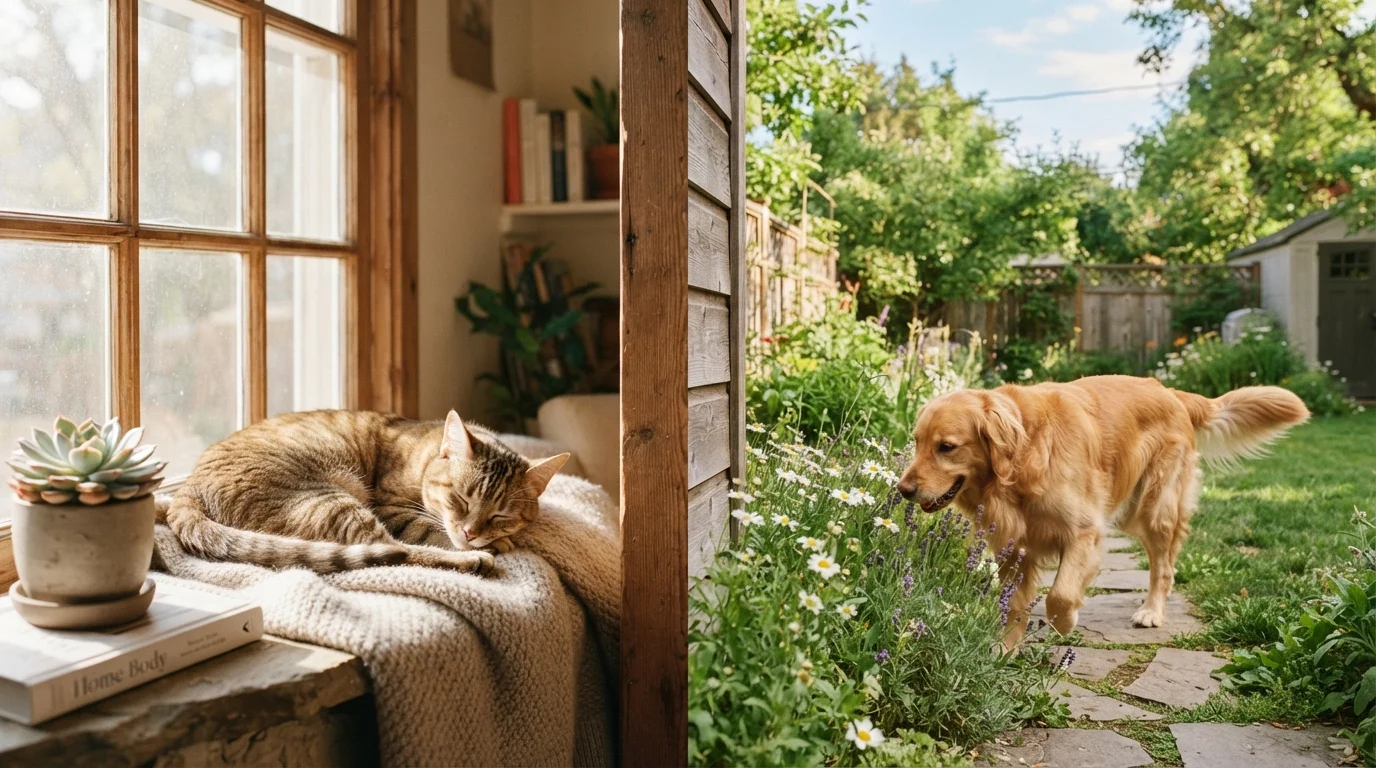
Option A
Indoor Pet Lifestyle
The controlled, protective environment option.
Best for: Owners in urban settings, those with species prone to outdoor hazards, or pets that thrive with routine and close human contact.
Option B
Outdoor Pet Lifestyle
The stimulus-rich, nature-integrated alternative.
Best for: Owners with secure outdoor spaces, animals with strong instinctual needs, and species that are naturally adapted to outdoor environments.
Why the Indoor vs. Outdoor Question Matters More Than You Think
For many pet owners, whether a cat roams the neighbourhood or a dog sleeps inside feels like a personal preference. In reality, it is one of the most consequential decisions affecting a pet's lifespan, physical health, and psychological wellbeing. The answer is rarely universal — it depends on species, breed, individual temperament, and the environment available to the animal.
Before bringing any animal home, understanding how lifestyle fundamentally shapes their daily experience is foundational — not optional. The indoor-outdoor question is also inseparable from broader topics like animal behaviour and what conditions allow pets to express natural instincts safely.
| Criterion | Indoor Pet Lifestyle | Outdoor Pet Lifestyle |
|---|---|---|
| Average lifespan (cats) | Typically longer (10–15 yrs) | Often shorter (2–5 yrs free-roaming) |
| Disease and parasite exposure | Lower risk overall | Higher risk; regular prevention essential |
| Physical injury risk | Lower; controlled environment | Higher; traffic, predators, falls |
| Sensory and behavioural enrichment | Requires active owner effort | Naturally higher variety |
| Suitability for all species | Universally applicable with adaptation | Species- and breed-dependent |
| Owner supervision demands | Lower day-to-day monitoring | Higher; requires safety management |
| Wildlife and environment impact | Minimal to none | Potentially significant (especially cats) |
The Case for Keeping Pets Indoors
Indoor living offers one clear and well-documented advantage: protection. Studies in veterinary epidemiology consistently show that indoor cats live significantly longer on average than cats with outdoor access — estimates typically range from 10 to 15 years indoors versus 2 to 5 years for free-roaming outdoor cats, though these figures vary by source and study methodology.
Indoor environments shield animals from traffic, predators, infectious diseases spread by wildlife or strays, and accidental ingestion of pesticides or other toxins. For species like rabbits, guinea pigs, and domestic cats, this protection is substantial. The design of your indoor space plays a significant role in how well it supports a pet's needs.
The main limitation of indoor-only living is understimulation. Pets confined without adequate mental and physical enrichment are at risk of boredom-related behaviours — destructive activity, excessive vocalisation, overgrooming, or anxiety. This is not an argument against indoor living; it is an argument for investing seriously in enrichment, socialisation, and mental stimulation.
10–15 yrs
Typical indoor cat lifespan
Veterinary and epidemiological sources generally estimate indoor cats live significantly longer than their free-roaming counterparts, though individual variation is wide.
2–5 yrs
Estimated free-roaming outdoor cat lifespan
Outdoor cats face compounded risks from vehicles, disease, and predation; published estimates vary but consistently show reduced longevity compared to indoor cats.
1 in 3
Cats reported as indoor-only in the US
American Pet Products Association surveys have indicated roughly one-third of owned cats in the US are kept exclusively indoors, a figure that has grown over recent decades.
The Case for Outdoor Access
Outdoor environments offer something no indoor space can fully replicate: genuine sensory complexity. Variable terrain, natural scents, and unpredictable stimuli all engage an animal's cognition in ways that structured indoor play cannot entirely substitute. For dogs especially, off-lead time in a secure space supports physical conditioning and fulfils instinctual drives around exploration and scent-tracking.
Certain species and breeds have been selectively developed for outdoor roles — herding dogs, working terriers, and livestock guardians, for example — and confining them without adequate alternative outlets is genuinely detrimental to their welfare. Early socialisation experiences, including controlled outdoor exposure during critical developmental windows, can also shape how confidently an animal engages with the world throughout its life.
The risks of unsupervised outdoor access, however, are substantial and should not be minimised. These include: road accidents, attacks from other animals, exposure to parasites and infectious disease, theft, and in some ecosystems, the significant impact that free-roaming cats can have on local wildlife populations. Responsible outdoor access is managed, not passive.
A Practical Framework for Making the Decision
There is no single correct answer, but there is a useful framework. Start with species-typical needs: what does your animal's biology and evolutionary background require? Then layer in individual temperament — a naturally anxious cat may find outdoor freedom overwhelming rather than liberating, while a confident, high-energy dog may struggle significantly when confined.
Consider your local environment honestly. A quiet rural property with a secure fence is a fundamentally different context from a suburban street adjacent to a busy road. Mismatched expectations between lifestyle and the pet's actual needs are a leading driver of animals entering shelters.
A hybrid approach works well for many owners: an indoor base with structured, supervised outdoor access via harness walking, an enclosed catio, or a securely fenced yard. This provides protection while meeting the animal's need for novelty and physical activity. Whatever approach you choose, regular veterinary check-ups are essential — your vet can assess whether the lifestyle is working for your specific animal and flag emerging health or behavioural concerns early.
This article provides general educational information about pet care approaches and is not a substitute for advice from a qualified veterinarian familiar with your individual animal's health and circumstances.
The content on this site is for informational purposes only and is not a substitute for professional advice. Always consult a qualified professional for guidance specific to your situation.