

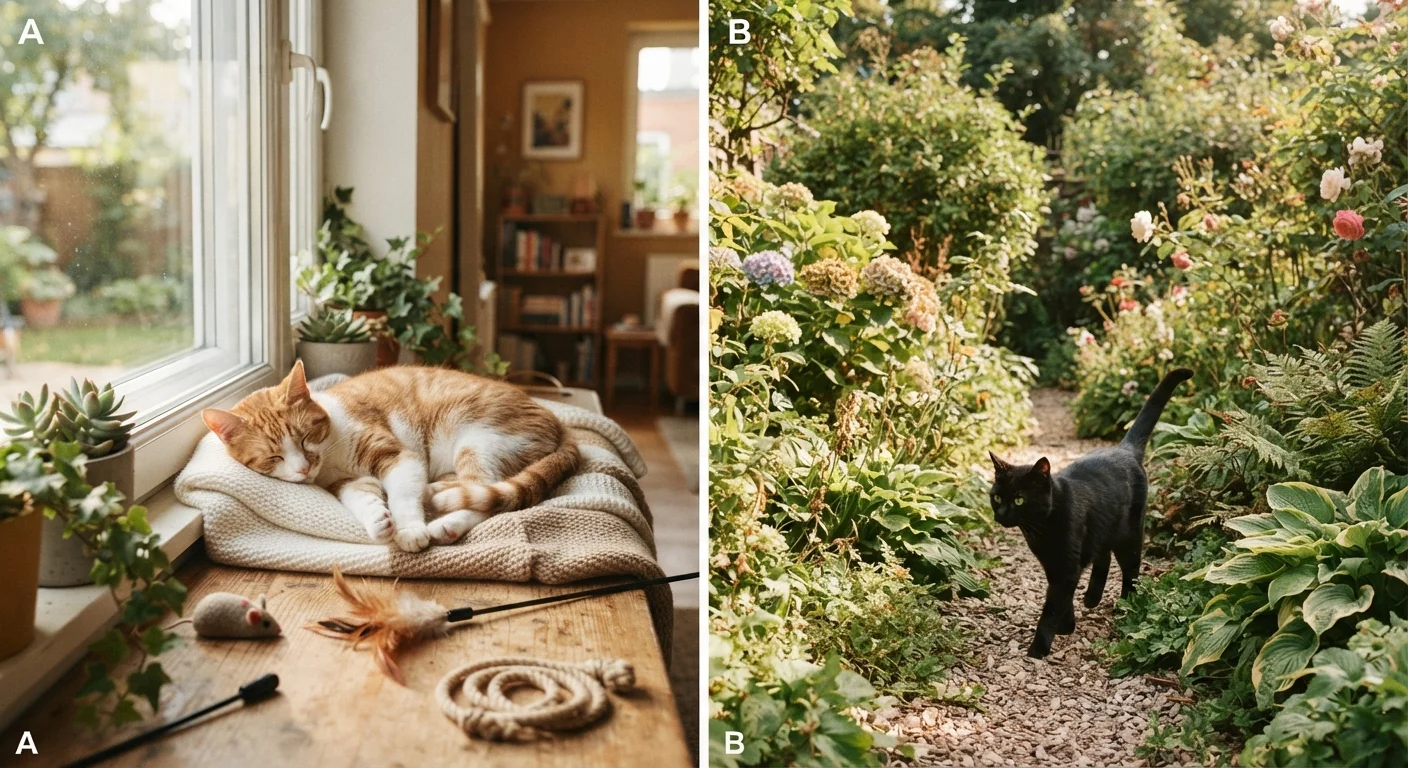
Our Verdict
Both indoor and outdoor environments shape feline behavior in meaningful ways, with real trade-offs on either side. Indoor living offers safety and longevity but demands deliberate enrichment to prevent behavioral problems. Outdoor access supports instinctual expression but carries genuine health and safety risks. The right choice depends on your cat's individual temperament, your local environment, and your capacity to meet their behavioral needs.
| Best for | Recommended |
|---|---|
| Owners in urban or high-traffic areas prioritizing safety and longevity | Indoor lifestyle with structured enrichment |
| Cats with strong predatory drive and high activity needs in safe, rural settings | Supervised outdoor or catio-based access |
| Owners seeking a middle-ground approach that balances stimulation and safety | Indoor cat with supervised outdoor time or leash walks |
How Environment Becomes Part of a Cat's Behavioral Identity
Cats are highly adaptive animals, yet the environment they inhabit consistently shapes their behavioral tendencies in measurable ways. Whether a cat spends its life inside a home or roaming freely outdoors is not merely a lifestyle detail — it influences how that cat communicates, responds to stress, expresses predatory instincts, and relates to humans.
Understanding these behavioral patterns helps owners respond more effectively to their cat's needs. For a deeper look at how environment affects pet wellbeing broadly, see the trade-offs of indoor vs. outdoor pet living. And because early life experience is foundational, it's also worth understanding how socialization windows shape a pet's behavior for life before drawing conclusions about any individual cat.
Behavioral Tendencies of Indoor Cats
Cats living exclusively indoors typically develop a close attunement to their household environment and the humans within it. With fewer external stimuli, they often become more socially dependent on their owners — displaying increased vocalization, greeting behaviors, and lap-seeking tendencies.
However, the indoor environment also creates behavioral challenges. Without adequate outlets for predatory behavior — stalking, pouncing, chasing — indoor cats may redirect these instincts toward furniture, ankles, or other pets. Boredom and understimulation can manifest as excessive grooming, lethargy, or anxiety-driven behaviors such as over-grooming or house-soiling.
Enrichment Is a Behavioral Necessity
For indoor cats, enrichment is not a luxury — it's essential for mental and physical health. Puzzle feeders, vertical climbing spaces, window perches with outdoor views, and regular interactive play sessions replicate key aspects of outdoor stimulation. Rotating toys and introducing novel scents can further sustain curiosity. Aim for at least two dedicated play sessions daily using wand-style or motion toys that trigger the full predatory sequence: stalk, chase, pounce, and catch.
Enrichment is not optional for indoor cats — it's a behavioral necessity. Puzzle feeders, vertical climbing spaces, window perches, and scheduled interactive play sessions are among the most evidence-supported ways to meet an indoor cat's instinctual needs. See why enrichment matters deeply to pet wellbeing for a thorough breakdown.
Behavioral Tendencies of Outdoor Cats
Cats with outdoor access express a broader behavioral repertoire. Regular exposure to unpredictable stimuli — moving prey, unfamiliar scents, changing terrain — keeps predatory sequences active and provides the kind of sensory variety that indoor spaces rarely replicate. These cats frequently display sharper alertness, more confident body language, and stronger territorial behavior including scent marking and patrolling.
Outdoor cats also tend to be more self-reliant. They may be less demonstratively affectionate but are not necessarily less bonded to their owners. Their behavioral independence often reflects the cognitive demands of navigating an open environment rather than emotional distance.
Outdoor Access Carries Real, Documented Risks
Free-roaming outdoor cats face exposure to infectious diseases such as FIV and FeLV, internal and external parasites, toxic plants or chemicals, wildlife encounters, and traffic. Veterinary and animal welfare organizations consistently report lower average lifespans in outdoor cats compared to indoor-only counterparts. If outdoor access is important to you and your cat, supervised outings, secure catios, or leash training can meaningfully reduce these risks while preserving behavioral benefits.
Outdoor access does carry documented risks: exposure to infectious diseases, parasites, wildlife encounters, toxins, and traffic are all associated with reduced average lifespan in free-roaming cats. These are not reasons to shame owners of outdoor cats, but they are factors that deserve serious consideration when evaluating what environment best serves a specific animal.
| Indoor Cat | Outdoor Cat | |
|---|---|---|
| Average lifespan | Typically longer (12–18+ years) | Often shorter due to environmental risks |
| Predatory behavior expression | Reduced; may redirect to play or household objects | Regularly expressed through hunting and stalking |
| Social dependence on humans | Generally higher; more vocalization and bonding | More self-reliant; less demonstratively affectionate |
| Boredom and stress risk | Higher without deliberate enrichment | Lower due to constant environmental novelty |
| Exposure to disease and parasites | Lower; controlled environment | Higher; contact with wildlife and other animals |
| Territorial behavior | Expressed indoors; may include resource guarding | Active patrolling and scent marking outdoors |
Reading Your Cat's Behavioral Signals Across Environments
Regardless of whether your cat lives indoors or outdoors, behavioral signals provide essential information about their wellbeing. A cat that hides persistently, over-grooms, or becomes suddenly aggressive may be signaling stress, pain, or unmet needs — not simply acting out. Context matters: an indoor cat that has recently lost access to a favorite perch may show territorial tension; an outdoor cat transitioning to indoor-only living may display frustration-based behaviors while adjusting.
Owners who learn to read feline body language — tail position, ear orientation, pupil dilation, slow blinking — are better positioned to respond to these signals before they escalate. This kind of attentiveness is a core element of responsible ownership, covered in more detail across the Pet Care Basics hub.
The indoor-outdoor question ultimately has no universal answer. What matters is an honest assessment of your cat's individual temperament, history, and daily needs — and your commitment to meeting them within whichever environment you choose.
This article is for general informational purposes only and does not constitute veterinary or professional behavioral advice. Consult a qualified veterinarian or certified animal behaviorist for concerns about your cat's specific behavior or health.
The content on this site is for informational purposes only and is not a substitute for professional advice. Always consult a qualified professional for guidance specific to your situation.