

Option A
Exchange-Traded Fund (ETF)
The flexible, exchange-traded pooled vehicle.
Best for: Investors who want intraday trading flexibility, typically lower costs, and broad market exposure.
Option B
Mutual Fund
The established, professionally managed pooled structure.
Best for: Investors who prefer automatic investing, professional active management, or access through employer-sponsored retirement plans.
What Both Structures Have in Common
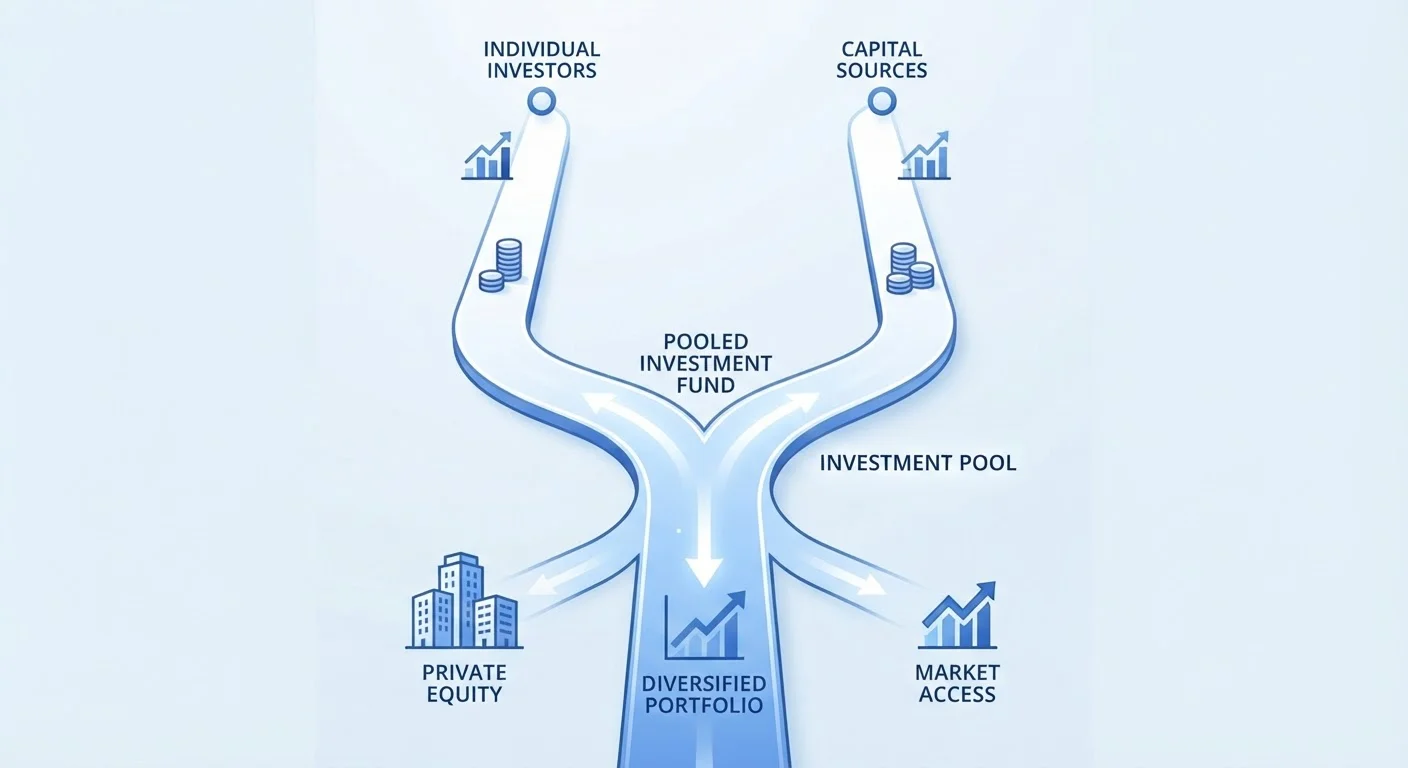
Before contrasting ETFs and mutual funds, it helps to understand what makes them similar. Both are pooled investment vehicles — structures that collect money from many individual investors and use that combined capital to purchase a portfolio of securities such as stocks or bonds.
This pooling achieves two things most individual investors couldn't easily replicate alone: diversification (spreading risk across many holdings) and economies of scale (access to a range of assets at lower per-unit cost). If you're new to the concept of investing itself, our guide to what investing actually means provides useful foundational context before diving deeper here.
Both vehicle types can hold a mix of stocks, bonds, or other asset classes, and both charge an ongoing expense ratio — an annual fee expressed as a percentage of assets — to cover operating costs. Neither guarantees returns, and both carry investment risk tied to the performance of their underlying holdings.
How ETFs and Mutual Funds Differ Structurally
Despite sharing the pooling concept, these two structures work quite differently in practice.
| Criterion | ETF | Mutual Fund |
|---|---|---|
| How it trades | On an exchange, throughout the day | Once daily, at end-of-day NAV |
| Pricing | Real-time market price | Net asset value (NAV) calculated at close |
| Minimum investment | Price of one share (often low) | Often $500–$3,000 or more |
| Typical management style | Mostly passive; active ETFs exist | Active and passive options available |
| Average expense ratio | Often lower on average | Often higher, especially for active funds |
| Tax efficiency | Generally more tax-efficient | Capital gains distributions more common |
| Automatic investing | Less common; depends on broker | Widely supported |
| Sales loads | Not applicable | Some funds carry sales loads |
Pricing and trading represent the most fundamental difference. A mutual fund's price — called its net asset value (NAV) — is calculated once per day after the stock market closes. Investors who submit a buy or sell order receive that end-of-day price, regardless of when during the day the order was placed.
ETFs, by contrast, trade on stock exchanges throughout the day, just like individual shares of stock. Their price fluctuates continuously based on supply and demand, meaning the price you pay or receive depends on when exactly you transact.
Minimum investments differ too. Many mutual funds require a minimum initial investment — often ranging from a few hundred to several thousand dollars — though some waive this for retirement accounts. ETFs generally have no minimum beyond the price of a single share, and many brokerages now offer fractional shares, lowering the entry point further.
There's also a structural difference in how they handle capital gains distributions. Mutual funds periodically distribute realised capital gains to shareholders, which can create a tax event even if you didn't sell any shares. ETFs are structured in a way that generally makes such distributions less frequent, which may result in greater tax efficiency in taxable accounts — though this is not universal and depends on the specific fund.
Active Management, Index Tracking, and Cost
Both ETFs and mutual funds can be either actively managed — where a portfolio manager makes ongoing decisions about which securities to hold — or passively managed, meaning the fund simply tracks a market index like the S&P 500.
Historically, mutual funds were more closely associated with active management, while ETFs were introduced primarily as index-tracking tools. That distinction has blurred: actively managed ETFs now exist, and index mutual funds have been available for decades. Understanding this distinction further is covered in our article on index funds vs. actively managed funds.
On cost, ETFs have tended to carry lower average expense ratios than mutual funds — in part because many popular ETFs are index-based, and index strategies generally cost less to run than active ones. However, cost varies enormously within both categories. An actively managed ETF may cost more than a passively managed mutual fund. Always compare the expense ratio of the specific fund, not just the vehicle type.
$8.9T+
U.S. ETF assets under management
According to the Investment Company Institute, U.S. ETF assets surpassed $8.9 trillion by end of 2023, reflecting significant growth in this structure.
~0.44%
Average mutual fund expense ratio (asset-weighted)
ICI data indicates the asset-weighted average expense ratio for actively managed U.S. equity mutual funds was approximately 0.44% in recent years.
~0.16%
Average ETF expense ratio (asset-weighted)
ICI data shows the asset-weighted average expense ratio for U.S. equity ETFs was approximately 0.16%, reflecting the prevalence of low-cost index ETFs.
Some mutual funds also carry sales loads — upfront or deferred commissions paid to the broker or adviser who sells the fund. No-load mutual funds and ETFs typically do not have these charges, though brokerage trading commissions may apply in some cases.
This article is for general informational and educational purposes only. It does not constitute personalised financial, investment, tax, or legal advice. Past investment performance does not guarantee future results. Consult a qualified, licensed financial professional before making decisions about your own circumstances.
Choosing Between Them: Practical Considerations
For many everyday investors, the choice between an ETF and a mutual fund may be shaped less by philosophical preference and more by practical circumstance.
If you invest through a workplace retirement plan such as a 401(k), the decision is often made for you — most such plans offer mutual funds. If you're investing through a taxable brokerage account and want the ability to trade flexibly or prioritise tax efficiency, an ETF structure may suit that context better.
Your investment time horizon also matters. Long-term investors who contribute on a fixed schedule may find mutual funds' dollar-cost averaging features — investing a set dollar amount regardless of share price — more convenient. Short-term or more active investors may prefer the intraday pricing control ETFs offer.
The Fund Wrapper vs. The Fund Strategy
It's easy to conflate the investment vehicle (ETF or mutual fund) with the investment strategy (index tracking or active management). These are separate dimensions. An index ETF and an index mutual fund tracking the same benchmark will produce very similar investment results — the main differences are structural, such as how they trade and their cost. Comparing like-for-like strategies within each vehicle type gives a clearer picture than comparing vehicle types alone.
Neither structure is inherently superior. The underlying holdings, cost, and fit with your financial goals matter far more than the wrapper around them. Reviewing both options with a licensed financial adviser can help you understand which structure aligns with your situation.
The content on this site is for informational purposes only and is not a substitute for professional advice. Always consult a qualified professional for guidance specific to your situation.