

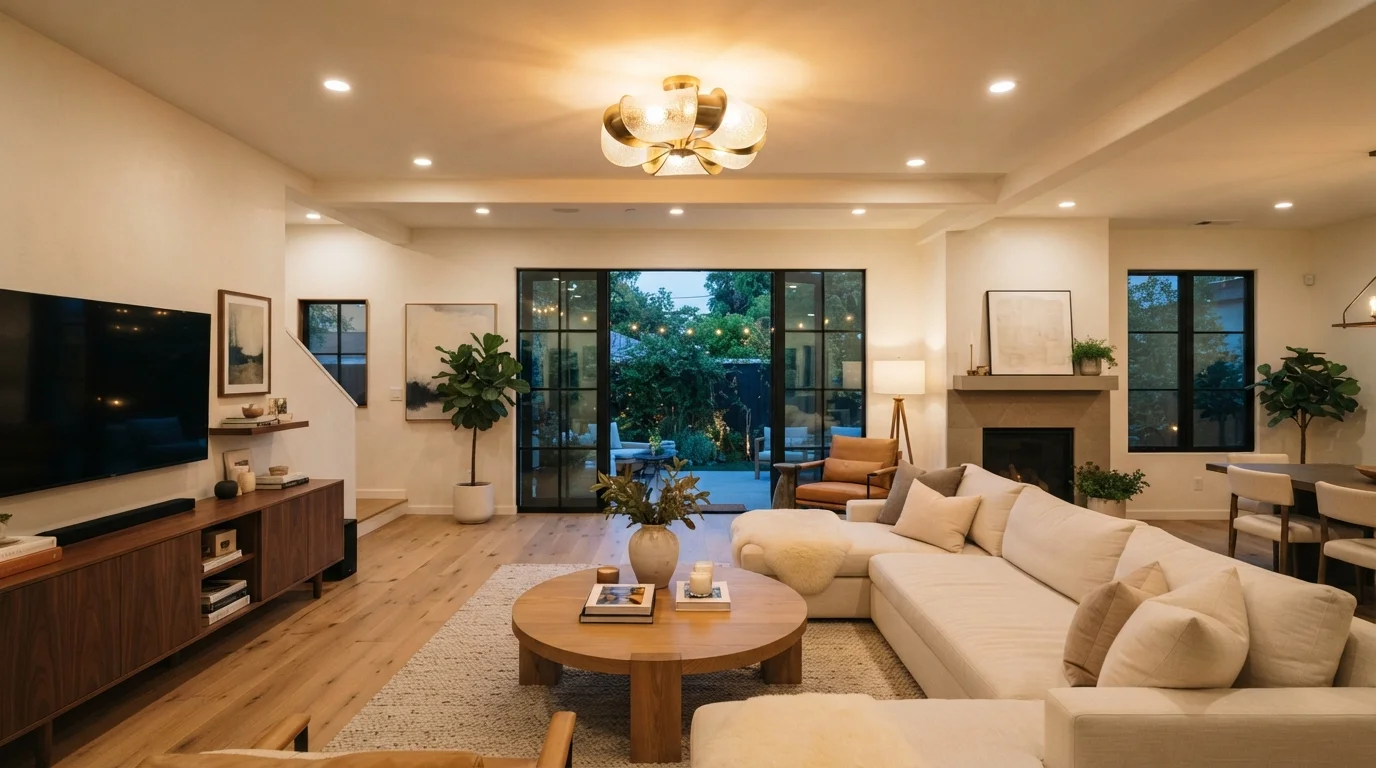
Option A
Recessed Lighting
The sleek, flush-to-ceiling solution for a clean look.
Best for: Homeowners who want a minimalist aesthetic, layered ambient light, and unobstructed ceiling space.
Option B
Surface-Mounted Fixtures
The versatile, statement-making alternative for any ceiling type.
Best for: Rooms where ceiling access is limited or where a decorative focal point is desired.
How Each Lighting Type Shapes a Living Room
Lighting is one of the most powerful tools in a living room renovation, capable of making a space feel expansive, cozy, dramatic, or crisp — depending on what you choose. Recessed lighting and surface-mounted fixtures represent two very different philosophies, and understanding their core differences helps you make a confident decision.
Recessed lighting (also called can lights or downlights) is installed inside the ceiling so only the trim ring is visible. This flush design keeps visual noise low, which is why designers frequently use it in rooms where a streamlined ceiling is a priority. Light projects downward in a focused beam or spread, depending on the bulb and trim style selected.
Surface-mounted fixtures attach directly to the ceiling surface and hang below it — though flush-mount styles sit close to the ceiling, while semi-flush styles drop slightly lower. These fixtures are inherently visible design elements, ranging from simple discs to sculptural pendants and ornate chandeliers. That visibility is both their strength and a consideration to plan around. Understanding how both choices interact with scale, proportion, and sightlines can be especially helpful — design principles for rooms that feel larger offer useful context here.
| Criterion | Recessed Lighting | Surface-Mounted Fixtures |
|---|---|---|
| Ceiling visibility | Flush — nearly invisible | Visible design element |
| Installation complexity | Higher — requires ceiling access | Lower — mounts to existing box |
| Ceiling type suitability | Best with accessible cavity above | Works on any finished ceiling |
| Aesthetic impact | Minimalist, architectural | Decorative focal point |
| Light distribution | Directional, downward focused | Omnidirectional, more diffuse |
| Dimmer compatibility | Yes, with compatible bulbs | Yes, with compatible bulbs |
| Typical installation cost | Higher — more labor involved | Lower — simpler retrofit |
Installation Complexity and Ceiling Suitability
Installation is where these two options diverge most sharply in terms of effort, cost, and feasibility.
Recessed lighting requires cutting holes in the ceiling drywall, running electrical cable through the ceiling cavity, and installing housing units inside that cavity. This typically means having accessible attic space or an unfinished area above. In homes where the living room ceiling is directly beneath another finished floor — a common situation in two-story homes — installation becomes significantly more complex and usually warrants a licensed electrician. Always verify local permit requirements before beginning any electrical work; in many jurisdictions, new circuit wiring requires a permit and inspection.
Surface-mounted fixtures are generally more straightforward to install. They mount to a standard electrical junction box already in the ceiling, making them a practical retrofit option for ceilings that are already closed up. Swapping an existing surface fixture for a new one is often a manageable task for a homeowner comfortable with basic wiring — though any work involving new wiring or panel connections should still be handled by a qualified electrician.
4–6 ft
Recommended spacing between recessed cans
Lighting designers generally suggest spacing recessed fixtures 4 to 6 feet apart to achieve even ambient coverage without hotspots or dark zones.
8–9 ft
Ceiling height where recessed lighting works best
Standard ceiling heights of 8 to 9 feet are well-suited to recessed lighting; lower ceilings may limit housing depth for certain fixture types.
Ceiling height also plays a role. Recessed lights work well in standard 8- to 9-foot ceilings. Semi-flush surface fixtures are generally recommended for ceilings under 9 feet, as they provide better clearance than a full pendant while still offering more decorative presence than a flush-mount disk.
Ambience, Light Quality, and Long-Term Flexibility
Beyond installation, consider how each option performs day-to-day in terms of light quality and adaptability.
Recessed lighting creates a clean, diffuse ambient layer when spaced correctly — typically every 4 to 6 feet depending on ceiling height and beam spread. However, a common mistake is relying solely on recessed cans, which can result in a flat, shadowless light that actually makes a room feel less interesting. Pairing them with floor lamps, wall sconces, or table lamps builds the layered lighting that interior designers recommend.
Surface-mounted fixtures, particularly those with diffusing glass shades, distribute light more evenly in all directions, which can feel warmer and more enveloping. A semi-flush fixture in the center of a living room can serve as both general illumination and a visual anchor. The trade-off is that a single central fixture may leave corners dimmer, so supplementary lighting is still advisable.
A Note on LED Bulb Compatibility
Not all LED bulbs are rated for use with dimmer switches, and mismatched combinations can cause flickering or shorten bulb life. When selecting LEDs for either recessed or surface-mounted fixtures, look for packaging that explicitly states dimmer compatibility. Some dimmers are also designed specifically for LED loads, so checking both the bulb and the dimmer specifications is worthwhile before installation.
Both fixture types are compatible with dimmer switches — a relatively simple upgrade that meaningfully expands your lighting control. Confirm that any bulbs you select (particularly LED types) are rated for dimmer compatibility before purchasing.
Ultimately, many well-designed living rooms use a combination of both: recessed lights for ambient coverage and a surface-mounted statement piece for character. Thinking about lighting as a layered system rather than a single choice often yields the most livable result.
The content on this site is for informational purposes only and is not a substitute for professional advice. Always consult a qualified professional for guidance specific to your situation.