

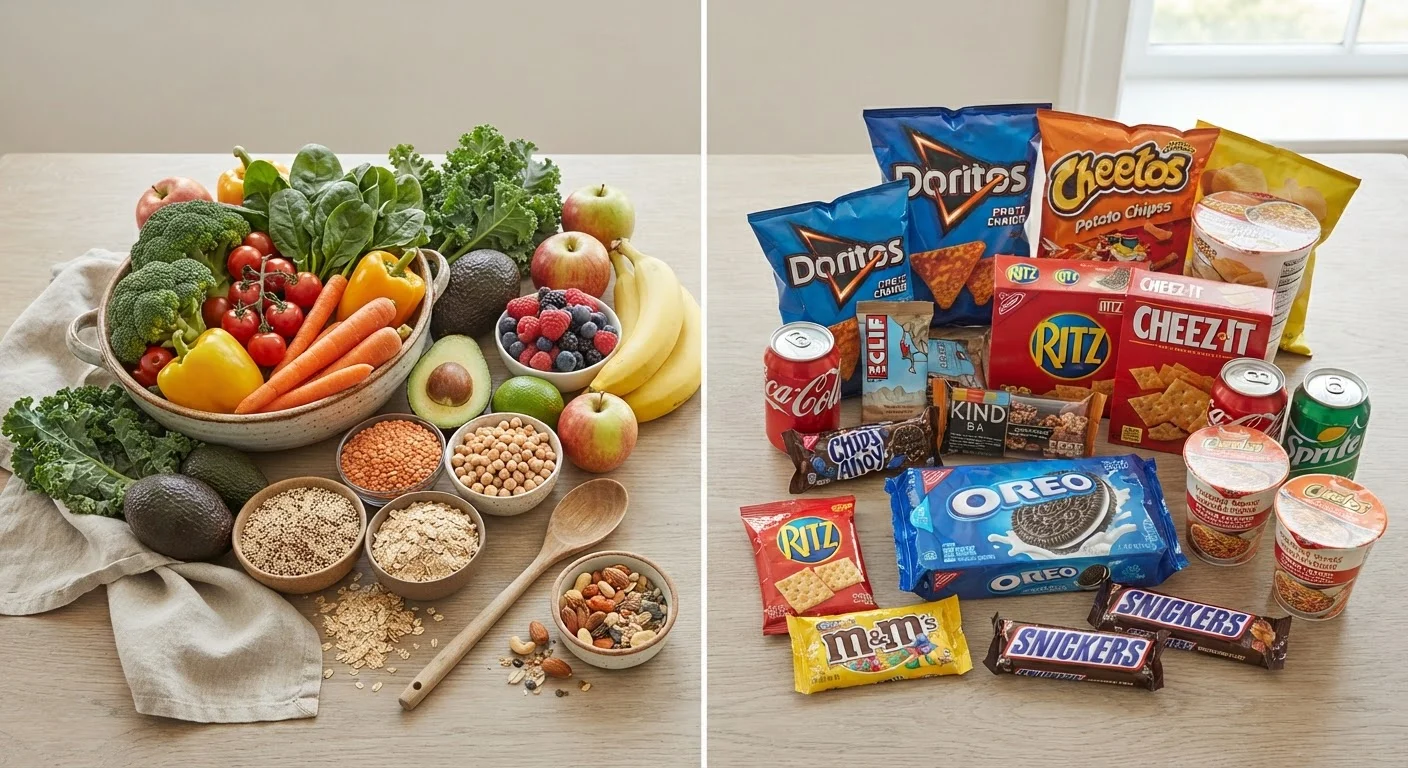
Option A
Whole Foods
Foods in or close to their natural, unaltered state.
Best for: Maximizing nutrient density, fiber intake, and long-term dietary quality with minimal effort to identify ingredients.
Option B
Ultra-Processed Foods
Industrially formulated products containing additives rarely found in a home kitchen.
Best for: Convenience and shelf stability, though regular heavy reliance is associated with lower overall diet quality.
Defining the Terms: What Makes a Food 'Whole' or 'Ultra-Processed'?
The phrase whole foods refers to foods that are eaten in—or very close to—their natural form. Think fresh vegetables, fruits, legumes, whole grains, eggs, plain dairy, and unsalted nuts. Minimal processing such as freezing, drying, or pasteurizing still qualifies; these methods preserve food without fundamentally altering its nutritional structure.
Ultra-processed foods are defined more precisely by the NOVA classification system, developed by researchers at the University of São Paulo. NOVA groups foods into four categories based on the extent and purpose of processing—not simply calorie or fat content. Ultra-processed products (Group 4) are industrial formulations made largely from substances extracted from foods, with little or no whole food remaining in the final product. Common examples include packaged flavored snacks, carbonated soft drinks, instant noodle soups, and reconstituted meat products.
What distinguishes ultra-processed foods is the presence of additives that have no culinary function at home—such as emulsifiers, modified starches, artificial colorants, flavor enhancers, and preservatives designed to extend shelf life or improve palatability. As our guide to reading nutrition labels explains, ingredient lists are the most reliable place to spot these additives.
How They Compare Nutritionally
Whole foods generally provide nutrients within their natural cellular structure—fiber, vitamins, minerals, and phytonutrients—in combinations that researchers believe interact synergistically. For example, an apple delivers fiber, vitamin C, and polyphenols together in proportions that a synthetic supplement cannot fully replicate. Our article on fiber, vitamins, and minerals explores why these nutrients matter in everyday health.
Ultra-processed foods, by contrast, often have fiber and micronutrients reduced or removed during manufacturing, then partially replaced with synthetic versions. This reformulation isn't nutritionally equivalent—the food matrix has been disrupted. Some products are fortified, but fortification typically replaces only a fraction of what was removed.
| Criterion | Whole Foods | Ultra-Processed Foods |
|---|---|---|
| Definition | Unaltered or minimally processed natural foods | Industrially formulated multi-ingredient products |
| Nutrient Integrity | Fiber, vitamins, minerals largely intact | Often stripped; sometimes partially fortified |
| Ingredient Complexity | Simple, recognizable ingredients | Long lists with industrial additives |
| Shelf Life | Shorter (varies by food type) | Extended via preservatives and packaging |
| Satiety | Generally higher due to fiber and protein | Can be lower; formulated for palatability |
| Research Association | Linked to better long-term diet quality | Associated with higher chronic disease risk |
| Cost & Accessibility | Variable; staples can be affordable | Often cheaper and widely available |
It's also worth noting that ultra-processed foods are frequently engineered to be highly palatable—combining fat, sugar, and salt in ratios that encourage overconsumption. This isn't a moral failing on the consumer's part; it's a design outcome. Understanding this distinction is part of seeing past the misleading language of diet culture that often surrounds food choices.
What the Research Suggests
A substantial and growing body of epidemiological research associates high ultra-processed food intake with elevated risks of cardiovascular disease, type 2 diabetes, certain cancers, and depression. A widely cited 2019 study published in The BMJ found that a 10% increase in ultra-processed food consumption was associated with a 12% higher risk of overall cancer. It's important to interpret such findings carefully—association does not prove causation, and dietary studies are complex to control for confounding variables.
Still, the consistency of findings across different populations and research designs is notable. Public health bodies in multiple countries have begun incorporating processing level—not just nutrient thresholds—into dietary guidance.
57%
Share of US calories from ultra-processed foods
Research published in BMJ Open (2016) estimated that ultra-processed foods account for roughly 57% of energy intake in the average American diet.
12%
Higher cancer risk per 10% UPF increase
A 2019 prospective cohort study in The BMJ found a 12% increase in overall cancer risk associated with a 10% increase in ultra-processed food consumption.
4 groups
NOVA food classification categories
The NOVA system, developed by University of São Paulo researchers, organizes all foods into four groups based on extent and purpose of industrial processing.
Equally important: not all processed foods are ultra-processed. Plain canned tomatoes, frozen peas, or natural yogurt are processed for practical reasons but retain nutritional integrity. The key is distinguishing degree and purpose of processing rather than treating all packaged food as equivalent.
This article is for general informational and educational purposes only and is not a substitute for professional medical or dietary advice. Consult a registered dietitian or qualified healthcare provider for guidance specific to your health needs.
The content on this site is for informational purposes only and is not a substitute for professional advice. Always consult a qualified professional for guidance specific to your situation.