

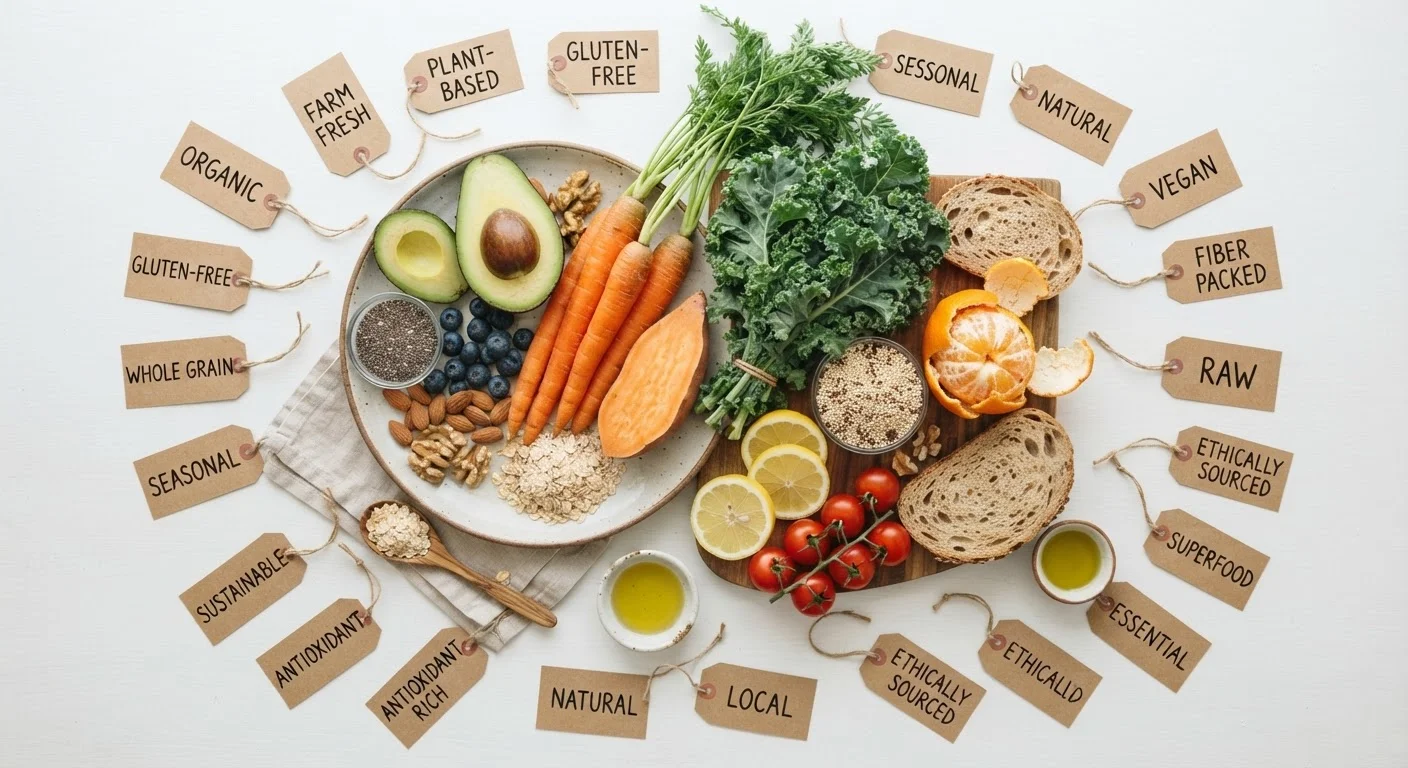
Why Diet Culture Language Deserves Scrutiny
Walk through any grocery store, scroll a wellness feed, or glance at a magazine rack and you will encounter a dense thicket of nutrition buzzwords. "Clean eating." "Detox." "Superfoods." "Gut-friendly." These phrases feel authoritative, yet most carry no legal definition, no regulatory standard, and no agreed-upon scientific meaning. They are, in large part, marketing constructs — and understanding that distinction is the first step toward more grounded, confident food choices.
This matters because misleading language does not just sell products; it shapes how people think and feel about eating. Research in nutritional psychology suggests that moralized food language — labeling foods as inherently "good" or "bad" — can contribute to guilt, anxiety, and disordered eating patterns in some individuals. Empowering yourself with clearer vocabulary is genuinely protective. See also our guide on spotting credible nutrition sources online for a broader look at evaluating health claims.
Myth
"Clean eating" is a scientifically defined approach to nutrition that guarantees better health.
Fact
"Clean eating" has no universal definition in nutrition science or food regulation; it is a cultural concept that varies widely depending on who is using it.
The phrase "clean eating" gained mainstream traction in the 2010s but has never been codified by any regulatory or scientific body. Depending on context, it can mean anything from avoiding processed foods to eliminating entire food groups. Nutrition researchers have noted that the term's vagueness makes it susceptible to extremism — in some communities it overlaps with orthorexia-adjacent behaviors, where the pursuit of dietary "purity" becomes harmful. A more evidence-grounded approach focuses on dietary patterns over time, not the moral cleanliness of individual foods.
Myth
Detox diets and cleanses remove harmful toxins from your body.
Fact
The liver, kidneys, and other organs continuously filter waste products; no commercial cleanse or detox product has been shown to enhance this process.
The human body has a sophisticated, built-in detoxification system. The liver metabolizes compounds for excretion; the kidneys filter blood and produce urine; the digestive tract, lungs, and skin all play roles in waste elimination. When "detox" products claim to accelerate or supplement these processes, they are rarely backed by clinical evidence. The FDA and Federal Trade Commission (FTC) have taken action against some detox product marketers for unsubstantiated claims. If you have concerns about toxin exposure, that conversation belongs with a physician — not a juice cleanse.
Myth
Superfoods are a distinct nutritional category with proven outsized health benefits.
Fact
"Superfood" is a marketing term, not a scientific classification; no regulatory standard defines which foods qualify.
Neither the FDA nor the European Food Safety Authority recognizes "superfood" as a regulated term. Foods marketed this way — açaí, spirulina, moringa, and others — may genuinely be nutrient-dense, but that does not make them categorically superior to less-exotic vegetables and legumes already common in American diets. Blueberries, lentils, and leafy greens offer comparable or overlapping nutritional profiles at a fraction of the cost. Nutritional benefit is best understood through overall dietary diversity, not reliance on any single celebrated ingredient.
Myth
If a food is labeled 'natural,' it is healthier and free from additives.
Fact
"Natural" has limited regulatory definition and does not indicate a product is nutritious, minimally processed, or additive-free.
The FDA has informally described "natural" to mean a food contains nothing artificial or synthetic that would not normally be expected — but this guidance is narrow and does not address nutritional content, pesticide use, production methods, or processing level. A product labeled "natural" can still be high in added sugars, sodium, or saturated fat. Added sugars appear under many names on ingredient lists, and a "natural" label offers no protection against them. Reading the full nutrition facts panel remains the most reliable approach.
Myth
Cutting out an entire food group — like carbohydrates or fat — is necessary for optimal health.
Fact
Major dietary guidelines and mainstream nutrition research support balanced eating patterns that include all macronutrient groups for most healthy adults.
Macronutrient elimination diets — whether low-fat, low-carb, or otherwise — cycle in and out of popularity, but long-term evidence consistently supports dietary variety over blanket restriction. Carbohydrates fuel brain function; dietary fats support hormone production and fat-soluble vitamin absorption; protein underpins tissue repair. Public health bodies including the Dietary Guidelines for Americans Advisory Committee emphasize overall dietary patterns — such as those rich in vegetables, legumes, whole grains, and lean proteins — rather than targeting single macronutrients for removal. Any significant dietary change should be discussed with a healthcare provider, particularly for individuals managing chronic conditions.
Common Buzzwords — and What They Actually Signal
Once you recognize the patterns, diet culture language becomes much easier to filter. A few frameworks help:
- Ask who defines it. If the U.S. Food and Drug Administration (FDA) or another regulatory body hasn't established a legal standard for a term, it can appear on any product regardless of nutritional profile. "Natural," for example, has only limited FDA guidance and does not mean organic, additive-free, or nutritionally superior.
- Look past single ingredients. When a product is marketed around one component — an exotic berry, an enzyme, a proprietary blend — consider the full ingredient list. Decoding nutrition labels gives you the tools to evaluate the complete picture rather than the headline claim.
- Notice the morality framing. Language that frames eating as a matter of purity, virtue, or "cheating" is a reliable signal of diet culture rather than evidence-based nutrition. Healthy eating, as public health guidance consistently shows, is about patterns over time — not perfect individual choices.
For a useful contrast, consider how diverse global food traditions approach nourishment: rarely through rigid rules or moral hierarchies, but through variety, social context, and balance. Meanwhile, understanding the practical difference between minimally processed and heavily engineered foods is genuinely useful — our breakdown of whole foods versus ultra-processed foods covers that distinction without the hype.
~$72B
Annual U.S. diet industry revenue
Market research firms have estimated the U.S. weight-loss and diet industry generates tens of billions annually, reflecting how commercially driven much nutrition messaging has become.
No legal definition
Regulatory status of 'superfood'
Neither the U.S. FDA nor major international food safety bodies have established a regulated definition for the term 'superfood' on food labeling.
This article is for informational purposes only and does not constitute medical or dietary advice. For personal nutrition guidance, consult a registered dietitian or qualified healthcare provider.
The content on this site is for informational purposes only and is not a substitute for professional advice. Always consult a qualified professional for guidance specific to your situation.