

Why Ingredient Lists Use So Many Names for Sugar
If you've ever scanned an ingredient list and wondered why a "healthy" product still has eight items that sound sweet, you're not alone. Manufacturers are required to list ingredients in descending order by weight — so using multiple forms of sugar can distribute them across the list, making no single sweetener appear near the top.
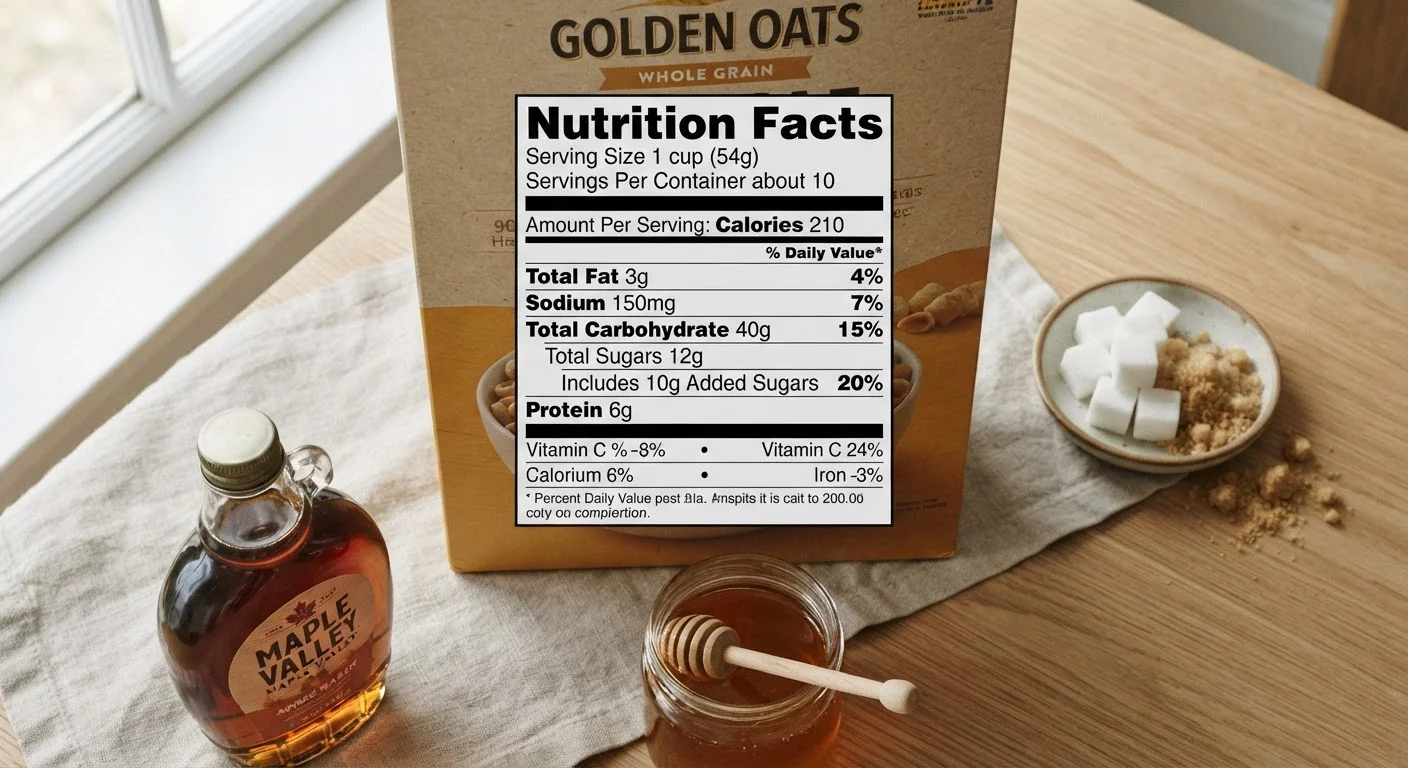
This isn't necessarily a deceptive practice, but it does mean a working knowledge of sugar's many aliases is genuinely useful when you're trying to understand what's in your food. The FDA's updated Nutrition Facts panel now includes a separate line for added sugars, expressed in grams and as a percentage of the Daily Value — which makes the panel itself your first stop. But the ingredient list tells you which sugars were added and in what forms. See our full guide to reading nutrition labels for a broader breakdown of what each panel section means.
| Added sugars line on labels | Required since 2020 (FDA Nutrition Facts update) (U.S. Food & Drug Administration) |
| Estimated number of sugar aliases | 60+ names commonly identified (University of California, San Francisco research compilation) |
| Ingredient list ordering rule | By weight, highest to lowest (FDA food labeling regulations) |
| "Natural" sweeteners on labels | Still counted as added sugars under FDA rules (FDA added sugars definition, 2016) |
| Sugars ending in "-ose" | Almost always a form of sugar (e.g., sucrose, dextrose, maltose) |
A Field Guide: Common Sugar Names to Recognize
Sugar shows up in ingredient lists under three broad categories: syrups, crystalline sugars, and concentrated fruit or juice sweeteners. Here's what each group covers.
Syrups
- High-fructose corn syrup (HFCS) — A widely used liquid sweetener derived from corn starch; common in sodas, condiments, and packaged snacks.
- Corn syrup — Similar base to HFCS but with a different fructose-to-glucose ratio; often used in baked goods and candy.
- Agave nectar/syrup — Marketed as a "natural" alternative, but very high in fructose by composition.
- Brown rice syrup — Derived from fermented rice; higher glycemic index than table sugar.
- Malt syrup / barley malt syrup — A grain-derived sweetener common in bread and cereals.
- Maple syrup — Contains trace minerals, but the nutritional impact of those amounts is minimal in typical serving sizes.
- Molasses / blackstrap molasses — A byproduct of sugar refining; contains some iron and calcium, but is still a form of added sugar.
Crystalline and Granulated Sugars
- Sucrose — Standard table sugar; a 50/50 glucose-fructose molecule.
- Dextrose — Another name for glucose; often used in processed foods and sports products.
- Fructose — The sugar found naturally in fruit, but when added in isolated form, it behaves differently metabolically.
- Maltose — A two-glucose sugar produced during starch digestion; found in some breads and fermented foods.
- Turbinado / raw / demerara sugar — Less-refined cane sugars with a light molasses coating; nutritionally similar to white sugar.
- Coconut sugar — Derived from coconut palm sap; contains inulin fiber, but added sugar content is still substantial.
Concentrated Juice and Fruit Sweeteners
- Fruit juice concentrate — When juice is stripped of water and fiber, what remains is essentially a sugar solution.
- Date paste / date sugar — Made from whole or powdered dates; retains some fiber but is still calorie-dense and sweet.
- Evaporated cane juice — A term for minimally processed cane sugar; nutritionally nearly identical to white sugar.
Added sugars
Sugars and syrups added to foods during processing or preparation, as opposed to naturally occurring sugars found in whole fruit or plain dairy. The FDA requires these to be listed separately on the Nutrition Facts panel.
High-fructose corn syrup (HFCS)
A liquid sweetener made from corn starch in which some glucose has been converted to fructose. It is widely used in packaged foods and beverages and is nutritionally classified as an added sugar.
Fructose
A simple sugar naturally found in fruit and honey. When isolated and added to processed foods, it contributes to added sugar totals and is metabolized differently than glucose.
Sucrose
Ordinary table sugar, composed of one glucose molecule and one fructose molecule bonded together. It is the reference point for most sugar comparisons.
Evaporated cane juice
A minimally processed form of cane sugar that retains a slight golden color. Despite its name, it is nutritionally very similar to white granulated sugar and is classified as an added sugar.
Glycemic index (GI)
A scale measuring how quickly a carbohydrate-containing food raises blood glucose levels compared to pure glucose. Different sugars and syrups have varying GI values, though the overall dietary pattern matters more than any single food.
Putting This Knowledge to Practical Use
Recognizing sugar aliases is a tool for awareness, not a reason to avoid entire food categories. Context matters: a small amount of molasses in whole-grain bread contributes negligible added sugar; the same product with five syrup variants near the top of the list tells a different story.
A few practical habits that build on this knowledge:
- Check the added sugars line first. Before scanning the ingredient list, the Nutrition Facts panel gives you the total in grams. The American Heart Association's general guidance suggests limiting added sugars, but individual needs vary — speak with a registered dietitian if you have specific health goals or conditions.
- Count sugar aliases, not just one name. If you see corn syrup, dextrose, and fruit juice concentrate in the same product, that's three separate sugar additions contributing to one total.
- Look at serving size. The grams of added sugar listed always refer to the stated serving — which may be smaller than a typical portion.
- "Natural" doesn't mean low-sugar. Honey, agave, maple syrup, and coconut sugar are still added sugars under FDA rules and are counted on the Nutrition Facts panel accordingly.
Understanding the language around food ingredients is one piece of a broader nutrition literacy picture. For help spotting misleading health claims in marketing, see our companion piece on diet culture language and what it obscures.
60+
Names used for sugar on ingredient lists
Researchers at the University of California, San Francisco identified over 60 names used for added sugars on ingredient labels in packaged foods.
17 tsp
Average daily added sugar intake for U.S. adults
According to CDC data, the average American adult consumes roughly 17 teaspoons of added sugar per day across all food and beverage sources.
This article is for general informational and educational purposes only and does not constitute medical or dietary advice. For personalized nutrition guidance, consult a registered dietitian or qualified healthcare professional.
The content on this site is for informational purposes only and is not a substitute for professional advice. Always consult a qualified professional for guidance specific to your situation.