

Start here
Why Strength Training Matters More After 40
Understand the biology
What Actually Changes in Your Body
Prepare safely
Before You Lift: Getting Ready Safely
Take action
Building Your First Routine
Keep going
Progressing Without Getting Hurt
Why Strength Training Matters More After 40
Strength training often conjures images of gym mirrors and competitive lifting—a world that can feel irrelevant, even intimidating, to someone in midlife who simply wants to stay capable and healthy. But resistance exercise is arguably the most practical fitness tool available to adults over 40, precisely because of what happens to muscle tissue as we age.
Without active intervention, adults typically lose muscle mass at a rate of roughly 1–2% per year beginning in their late thirties or early forties—a process called sarcopenia. Strength, balance, bone density, and metabolic function all follow. The good news, well-supported by research in exercise physiology, is that this trajectory responds strongly to resistance training at virtually any starting age.
For a broader view of how exercise priorities shift across the lifespan, see how exercise needs evolve with age.
What Actually Changes in Your Body
Understanding a few physiological realities helps set realistic expectations—and removes a lot of unnecessary anxiety.
Sarcopenia
The gradual, age-related loss of muscle mass and strength. It begins in midlife and accelerates without regular resistance exercise.
Progressive overload
The principle of gradually increasing the challenge placed on muscles over time—through more weight, reps, or sets—so the body continues to adapt and grow stronger.
Compound movements
Exercises that engage multiple muscle groups and joints at once, such as squats or rows, making them highly efficient for building functional strength.
Muscle protein synthesis
The biological process by which the body repairs and builds muscle tissue after exercise. Adequate protein intake and rest are key inputs.
Connective tissue
Tendons and ligaments that connect muscles to bones and stabilise joints. They adapt more slowly than muscle and benefit from thorough warm-ups.
Recovery takes longer. Muscle protein synthesis—the repair and rebuilding process—is somewhat slower in older adults compared to younger ones. This doesn't mean training is less effective; it means adequate rest between sessions is even more important than it was at 25.
Connective tissue needs more warm-up time. Tendons and ligaments become less pliable with age, which is why a thorough warm-up isn't optional after 40. Five to ten minutes of light movement before any resistance work meaningfully reduces injury risk.
Gains are still real. Research consistently shows that adults in their 40s, 50s, and beyond can increase both muscle size and strength with appropriate training. The ceiling may be lower than at 22, but the improvements in daily function, metabolic health, and resilience are substantial.
Before You Lift: Getting Ready Safely
A little preparation before your first session significantly reduces the chance of early injury or discouragement. Work through a basic readiness check—our exercise readiness checklist walks you through the key questions.
Check With Your Doctor First
Adults with high blood pressure, heart conditions, osteoporosis, or chronic joint pain should obtain medical clearance before starting a resistance training programme. This isn't a formality—it ensures your programme can be appropriately tailored to your individual health picture. Don't skip this step.
Key pre-start considerations include:
- Medical clearance: If you have cardiovascular disease, diabetes, osteoporosis, or any condition affecting joints or bones, speak with your doctor before beginning.
- Movement screening: Identify any existing pain, limited range of motion, or past injuries. A session with a physical therapist or certified personal trainer can identify movement patterns to modify.
- Equipment basics: Supportive, non-slip footwear matters more than any piece of gym equipment. A mat and a single pair of moderate-weight dumbbells or a set of resistance bands is a fully adequate starting kit.
Building Your First Routine
Effective beginner programmes share a few structural features: they train the whole body, they prioritise compound movements that work multiple muscle groups simultaneously, and they build volume gradually over weeks.
A simple two-day-per-week structure might include:
- Squat pattern – bodyweight squat, goblet squat, or split squat
- Hinge pattern – Romanian deadlift with dumbbells or a hip hinge with bodyweight
- Push pattern – wall push-up, incline push-up, or dumbbell press
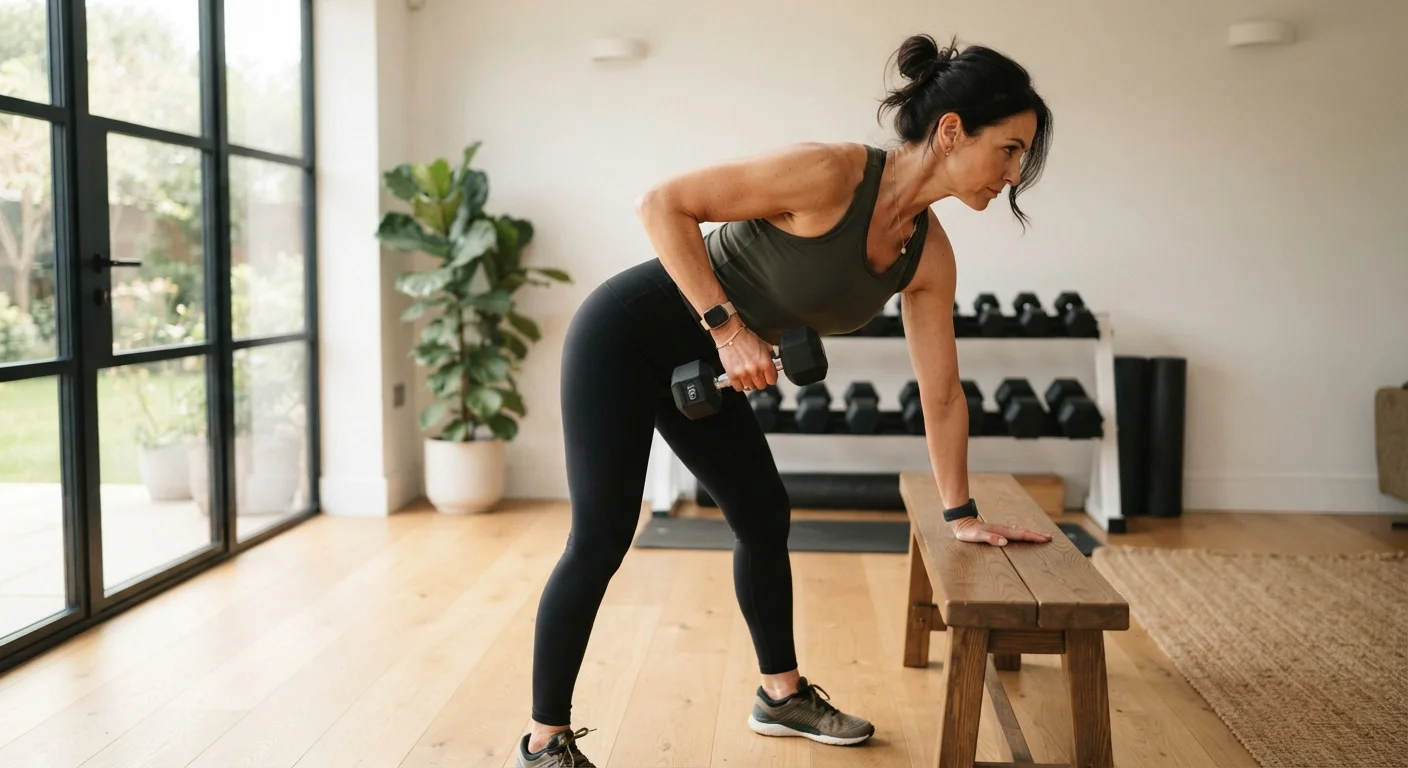
- Pull pattern – resistance band row, table-edge row, or dumbbell row
- Core stability – dead bug, bird dog, or plank hold
If you prefer to stay equipment-free, bodyweight training principles offer a solid foundation with no gear required.
Adopt the Two-Week Rule
Spend the first two weeks focusing entirely on movement quality rather than load. Use lighter resistance than you think you need, nail the form on each exercise, and let your connective tissue adapt. Adding weight too soon is the fastest route to an early setback.
Start with two sets of 10–12 repetitions per exercise at a weight or resistance level that feels manageable but effortful by the last few reps. Rest 60–90 seconds between sets.
Progressing Without Getting Hurt
The single most common mistake beginners make—at any age—is progressing too fast. After 40, the consequences of that mistake (a strained tendon, an aggravated joint) take longer to resolve. Sustainable progress looks deliberate and sometimes feels slow.
A practical rule: increase either the weight, the repetitions, or the number of sets—but only one of those variables at a time, and only when your current level feels genuinely comfortable across multiple sessions. This principle, called progressive overload, is the mechanism behind all strength improvement.
Recovery tools worth building into your routine include: consistent sleep (muscle repair happens primarily during deep sleep), adequate protein intake to support muscle protein synthesis (discuss specifics with a registered dietitian), and light movement on rest days—walking, stretching, or gentle mobility work.
Strength training pairs well with lower-intensity cardiovascular work. Understanding when to train easy and when to push harder helps you balance both without overreaching.
This article provides general health information for educational purposes only and is not a substitute for personalised advice from a qualified healthcare or fitness professional. If you have any medical conditions or concerns, consult your doctor before beginning a new exercise programme.
Frequently Asked Questions
For most people, yes—resistance training is considered safe and beneficial across all adult age groups. However, if you have any chronic health conditions, joint problems, or cardiovascular concerns, consult your doctor before beginning. Start with lighter loads and proper form before increasing intensity.
Two to three sessions per week is a well-supported starting point, with at least one full rest day between sessions to allow muscle repair. As your body adapts over several weeks, you can gradually add sessions if recovery allows.
No. Bodyweight exercises—such as squats, push-ups, and rows using a table edge—provide effective resistance for beginners. A set of adjustable dumbbells or resistance bands can expand your options without a gym membership.
Neuromuscular improvements—meaning your body gets more efficient at recruiting muscle fibers—often appear within the first two to four weeks. Visible muscle changes typically take six to twelve weeks of consistent effort, though individual results vary.
Stop the movement immediately if you feel sharp, stabbing, or joint-centred pain. Mild muscle fatigue is normal; acute pain is a signal to rest and seek guidance from a healthcare or physical therapy professional before continuing.
Resistance training builds lean muscle tissue, which tends to increase resting metabolic rate over time. Combined with balanced nutrition, it can support healthy body composition—though outcomes vary and no exercise guarantees specific weight results.
The content on this site is for informational purposes only and is not a substitute for professional advice. Always consult a qualified professional for guidance specific to your situation.