

What Is Bodyweight Training?
Bodyweight training is a form of resistance exercise that uses your own body mass — rather than barbells, dumbbells, or machines — to create the muscular challenge that drives strength and fitness adaptation. Push-ups, squats, lunges, planks, and pull-ups are all classic examples. The method is as old as physical culture itself, forming the foundation of military fitness, gymnastics, and martial arts conditioning around the world.
Despite its simplicity, bodyweight training is genuinely effective. Research published in exercise physiology literature consistently shows that compound bodyweight movements activate multiple muscle groups simultaneously, improve coordination, and build functional strength relevant to everyday life. It also carries a low barrier to entry: no membership, no commute, minimal space.
If formal gym settings feel intimidating, bodyweight training offers a private, pressure-free alternative. For a broader look at activity without structured workouts, see our guide to everyday fitness.
Start With What You Can Actually Do
Begin every movement at an easier variation than you think you need. Mastering the foundational version of each pattern builds the motor control and tissue resilience that make harder progressions safe. Progress earned over weeks is far more durable than progress forced in days.
Core Movement Patterns to Know
Rather than memorising a long exercise list, it helps to think in movement patterns. Most effective bodyweight programmes are built around six categories:
- Push: Moving weight away from your body. Examples include push-ups and dips, which target the chest, shoulders, and triceps.
- Pull: Drawing weight toward your body. Rows using a low bar or table edge, and pull-ups, train the back and biceps.
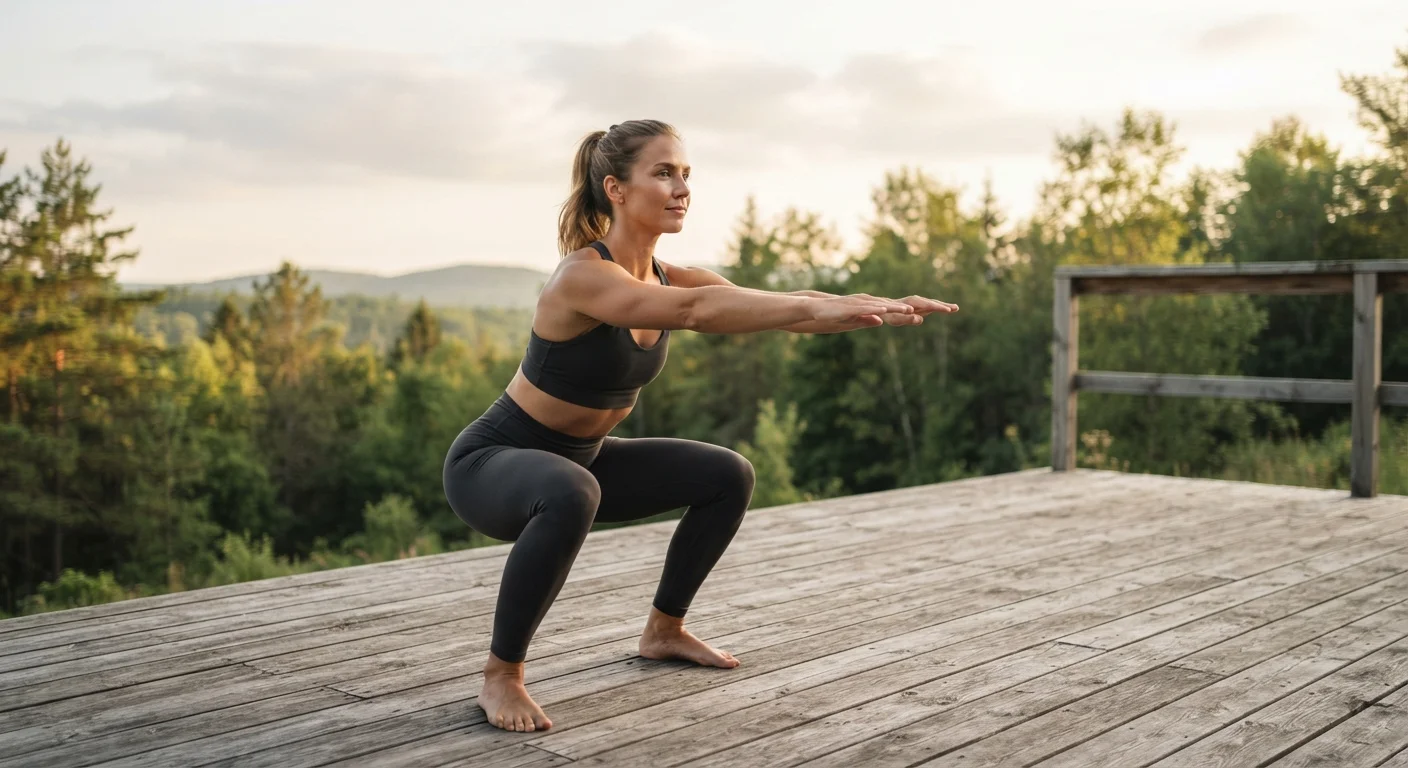
- Squat: Bending at the knee and hip together. Bodyweight squats and split squats develop the quads, glutes, and hamstrings.
- Hinge: Bending primarily at the hip. Single-leg deadlifts and glute bridges isolate the posterior chain — the muscles along the back of the body.
- Core: Stabilising the trunk against force. Planks, dead bugs, and hollow holds build the deep abdominal and spinal muscles that support every other movement.
- Carry / locomotion: Moving your body through space — crawling patterns and bear crawls develop full-body coordination and endurance.
Training at least one exercise from each category across your week ensures balanced development and reduces the risk of overuse patterns.
6
Fundamental movement patterns
Exercise scientists broadly organise human movement into six categories that, when trained together, address the whole body comprehensively.
2–3×
Recommended weekly sessions for beginners
Public health guidelines and exercise physiology research consistently support two to three resistance training sessions per week for novice trainees.
48 hrs
Typical muscle recovery window
Research on resistance training adaptation shows skeletal muscle generally requires approximately 48 hours of recovery between sessions targeting the same muscle groups.
How Progression Works Without Weights
A common misconception is that bodyweight training becomes easy and then stops being useful. In reality, progression is continuous — it simply works through different levers than adding plates to a bar.
Leverage and Angle
Changing your body angle dramatically shifts the load. An incline push-up (hands elevated) is easier than a standard push-up; a decline push-up (feet elevated) or an archer push-up is harder. The same principle applies across every movement pattern.
Tempo and Time Under Tension
Slowing the lowering (eccentric) phase of a squat or push-up — taking three to five seconds rather than one — substantially increases muscular demand without changing the movement at all.
Range of Motion
Deeper squats, fuller hip extensions, and greater shoulder range engage more muscle fibre and build mobility simultaneously.
Volume and Density
Doing more total repetitions over time, or the same work in less time, is a valid and measurable form of progress. Keep a simple log.
Film yourself performing a new movement from a side angle — even briefly on a phone. Self-video catches form errors like forward knee collapse or back rounding that are almost impossible to notice while exercising.
Visual feedback accelerates motor learning and is used routinely by coaches working with athletes at all levels, not just beginners.
When a movement becomes comfortable for three sets at your current difficulty, make one small change — slightly slower tempo or a marginally deeper range — before jumping to a harder variation.
Incremental overload applied conservatively is the principle behind long-term strength development; large jumps in difficulty are the primary driver of overuse injuries.
For adults in midlife considering resistance training, our article on strength training after 40 covers how the body responds differently — and how bodyweight methods translate directly.
Structuring a Beginner Routine
Consistency beats complexity at every level of fitness. A well-structured beginner routine prioritises recovery, full-body stimulus, and gradual volume increases.
Frequency
Two to three sessions per week, with at least one rest or light-activity day between sessions, allows muscle repair and adaptation. Daily training of the same muscle groups is counterproductive for beginners.
Session Structure
- Warm-up (5 minutes): Light movement — leg swings, arm circles, bodyweight hip circles — to raise core temperature and lubricate joints.
- Main work (20–30 minutes): Select one or two exercises from three or four movement categories. Perform 2–3 sets of each at a moderate effort level, resting 60–90 seconds between sets.
- Cool-down (5 minutes): Gentle static stretches held for 20–30 seconds, focusing on the areas worked.
Sample Week
| Day | Focus | Exercises (examples) |
|---|---|---|
| Monday | Full body | Push-up, bodyweight squat, plank, glute bridge |
| Wednesday | Full body | Incline row, reverse lunge, dead bug, bear crawl |
| Friday | Full body | Pike push-up, split squat, side plank, single-leg hinge |
Good nutrition supports every training adaptation. Our Nutrition & Diet hub offers evidence-based guidance on fuelling an active lifestyle.
Tracking Progress Keeps You Honest
A simple notebook or phone note recording your exercises, sets, reps, and how the session felt is one of the most evidence-supported tools for long-term adherence. You do not need an app — consistency of tracking matters more than the format.
Safety, Form, and When to Seek Guidance
Bodyweight training carries a lower injury risk than many other forms of exercise, but poor form, skipped warm-ups, and overly aggressive progression are still common causes of strain.
Key Form Principles
- Neutral spine: Avoid excessive arching or rounding of the lower back during squats, hinges, and planks.
- Controlled range: Only move as far as you can maintain stable, pain-free form — range will grow with practice.
- Breathing: Exhale on the effort phase (the push-up press, the squat stand); inhale on the return. Never hold your breath.
- Joint alignment: In squats and lunges, keep knees tracking over — not collapsing inward past — your toes.
Pain Is Not the Same as Effort
Muscle fatigue and mild discomfort during exercise are normal; sharp, pinching, or joint pain is not. Stop any exercise that produces localised joint pain immediately. Continuing through that kind of signal is a leading cause of avoidable injury among beginners.
If you are new to exercise or returning after a period of inactivity, working through a readiness assessment is worthwhile. Our exercise readiness checklist walks you through the key questions before you begin. Pain that is sharp, joint-specific, or persists after a session should always be evaluated by a qualified healthcare professional — it is not a normal part of the adaptation process.
This article is for general informational and educational purposes only and does not constitute medical advice. Consult a qualified healthcare professional before beginning any new exercise programme, particularly if you have a health condition, injury, or are in a special population group such as pregnancy.
The content on this site is for informational purposes only and is not a substitute for professional advice. Always consult a qualified professional for guidance specific to your situation.