

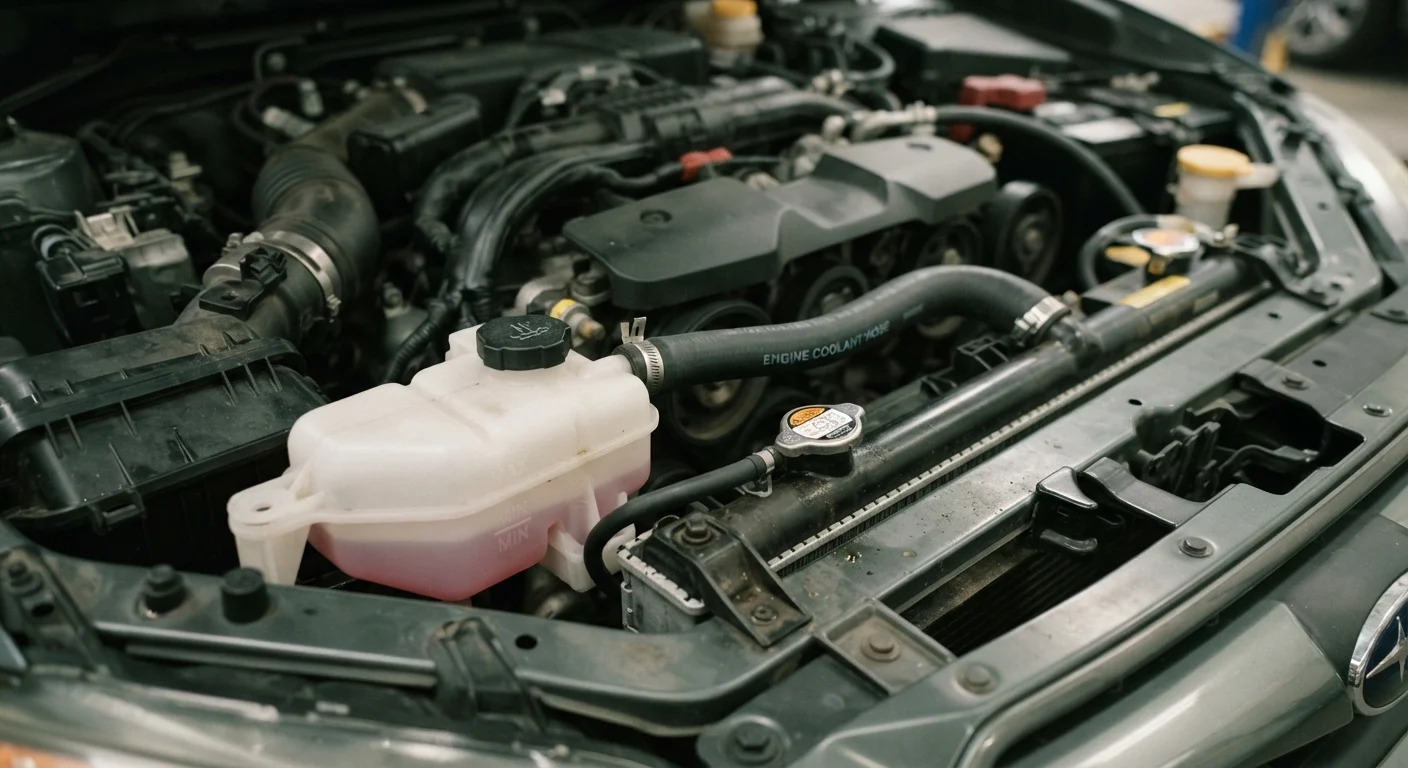
How the Cooling System Actually Works
Every time you drive, your engine generates enormous heat through combustion — enough to destroy internal components without a dedicated system to manage it. The cooling system handles that job continuously and quietly.
Here is the basic circuit: the water pump pushes coolant from the radiator into the engine block, where it absorbs heat. The hot coolant travels back to the radiator, where airflow — aided by the cooling fan — draws that heat away from the fluid. The cooled liquid then recirculates. A thermostat acts as a gatekeeper, holding coolant in the engine until it reaches operating temperature before allowing it to flow to the radiator. This prevents the engine from running too cold, which causes its own wear problems.
The system also includes a coolant reservoir (sometimes called an overflow or expansion tank), pressure-rated hoses, and a radiator cap that maintains system pressure. Raising pressure raises the boiling point of the coolant, buying more margin before the fluid vaporises.
265°F
Boiling point of a 50/50 coolant mix
A standard antifreeze-water mixture raises the boiling point well above the 212°F threshold for pure water, providing critical overheating margin.
-34°F
Freeze protection of a 50/50 mix
A 50/50 ratio of ethylene glycol antifreeze and distilled water provides freeze protection adequate for most US climates.
30k–50k mi
Typical coolant flush interval
Most vehicle manufacturers recommend a full coolant flush within this mileage range, though long-life formulas may extend the interval significantly.
What Antifreeze Actually Does — and Why Concentration Matters
The concentrated ethylene glycol sold as antifreeze does two primary jobs: it lowers the freezing point of water and raises its boiling point. Straight water would boil at 212°F and freeze at 32°F — both thresholds a vehicle regularly approaches or exceeds in daily driving. Adding antifreeze pushes those limits dramatically in both directions.
The standard 50/50 mixture (half antifreeze, half distilled water) is appropriate for the majority of US climates and offers freeze protection to roughly -34°F. In extreme northern climates, a 70/30 antifreeze-to-water ratio offers lower freeze protection, but going beyond 70% antifreeze can actually reduce performance — pure antifreeze has a higher freezing point than the mixture.
Coolant also contains corrosion inhibitors that protect the metal and rubber components throughout the system. Those inhibitors deplete over time, which is why coolant must be periodically flushed rather than simply topped off.
Always Use Distilled Water, Not Tap Water
When mixing coolant or topping off in an emergency, use distilled water rather than tap water. Tap water contains minerals that can deposit inside the cooling system and accelerate corrosion. Distilled water is widely available and inexpensive — worth keeping a jug in your garage alongside your coolant.
Warning Signs the Cooling System Needs Attention
The cooling system rarely fails all at once. Warning signs tend to appear gradually, which means attentive drivers can act before a breakdown occurs. Key signals to watch for include:
- Temperature gauge rising toward the red — This is the most direct alert. If it climbs above the normal range, pull over safely and turn off the engine.
- Sweet, syrupy smell — Ethylene glycol has a distinctive sweet odour. If you detect it inside or outside the car, there is likely a coolant leak.
- White steam from the hood — Steam is coolant vaporising from a leak or an overheating engine. Do not open the radiator cap until the engine has cooled completely.
- Low coolant reservoir level — A level that keeps dropping despite topping off points to a leak rather than normal consumption.
- Heater blowing cool air — The cabin heater uses engine coolant as its heat source. Weak heat output can indicate low coolant or a failing thermostat.
For broader vehicle maintenance context — especially heading into seasonal changes — see our guide on seasonal car maintenance.
Never Open a Hot Radiator Cap
The cooling system operates under pressure, which means coolant temperature can exceed 212°F without boiling. Opening the radiator cap on a hot engine releases that pressure suddenly, causing superheated coolant to spray outward and potentially cause serious burns. Always wait until the engine has fully cooled — typically at least 30 minutes — before removing the cap.
Routine Coolant Maintenance: What Drivers Should Do
Coolant maintenance is straightforward but often neglected. Here are the core habits that keep the system healthy:
- Check coolant level regularly — Look at the reservoir (not the radiator) when the engine is cold. The level should sit between the MIN and MAX marks.
- Inspect hoses and connections — Squeeze hoses periodically. They should feel firm but pliable, not cracked, spongy, or brittle. Look for wet spots or dried residue around clamps.
- Follow the flush schedule — Consult your owner's manual for the manufacturer's recommended interval. Degraded coolant becomes acidic and corrodes metal components.
- Use the correct coolant type — Coolants are not universal. Different vehicles require different formulations (IAT, OAT, HOAT). Mixing types can compromise the corrosion inhibitors. Your owner's manual specifies which to use.
- Leave pressurised work to a mechanic — Pressure-testing the system, flushing the radiator, or diagnosing internal leaks (such as a failing head gasket) should be handled by a qualified technician.
If you are just building your maintenance knowledge, our car maintenance guide for new drivers covers the fundamental habits worth establishing early.
Frequently Asked Questions
Antifreeze refers to the concentrated ethylene glycol fluid that prevents freezing. Coolant is the ready-to-use mixture of antifreeze and water that actually circulates through the engine. The terms are often used interchangeably, but technically they are different forms of the same product.
Most manufacturers recommend a coolant flush every 30,000 to 50,000 miles, though some long-life formulas extend that interval significantly. Check your owner's manual for the interval specific to your vehicle, since ignoring it allows acidic degraded fluid to corrode the system.
In a genuine emergency — if the engine is overheating and you have no coolant — adding distilled water can get you to a repair shop. However, plain water raises the freezing point and lowers the boiling point of the mixture, and should be corrected with a proper coolant flush promptly.
A temperature gauge in the red zone means the engine is overheating. Pull over safely and turn off the engine immediately. Do not open the radiator cap while the engine is hot. Have the vehicle inspected by a qualified mechanic before driving further.
Some small variation in coolant level is normal as the system heats and cools. A consistently dropping level, however, signals a leak somewhere in the system — hoses, the radiator, water pump, or head gasket. A mechanic should inspect it to identify and fix the source.
The content on this site is for informational purposes only and is not a substitute for professional advice. Always consult a qualified professional for guidance specific to your situation.