

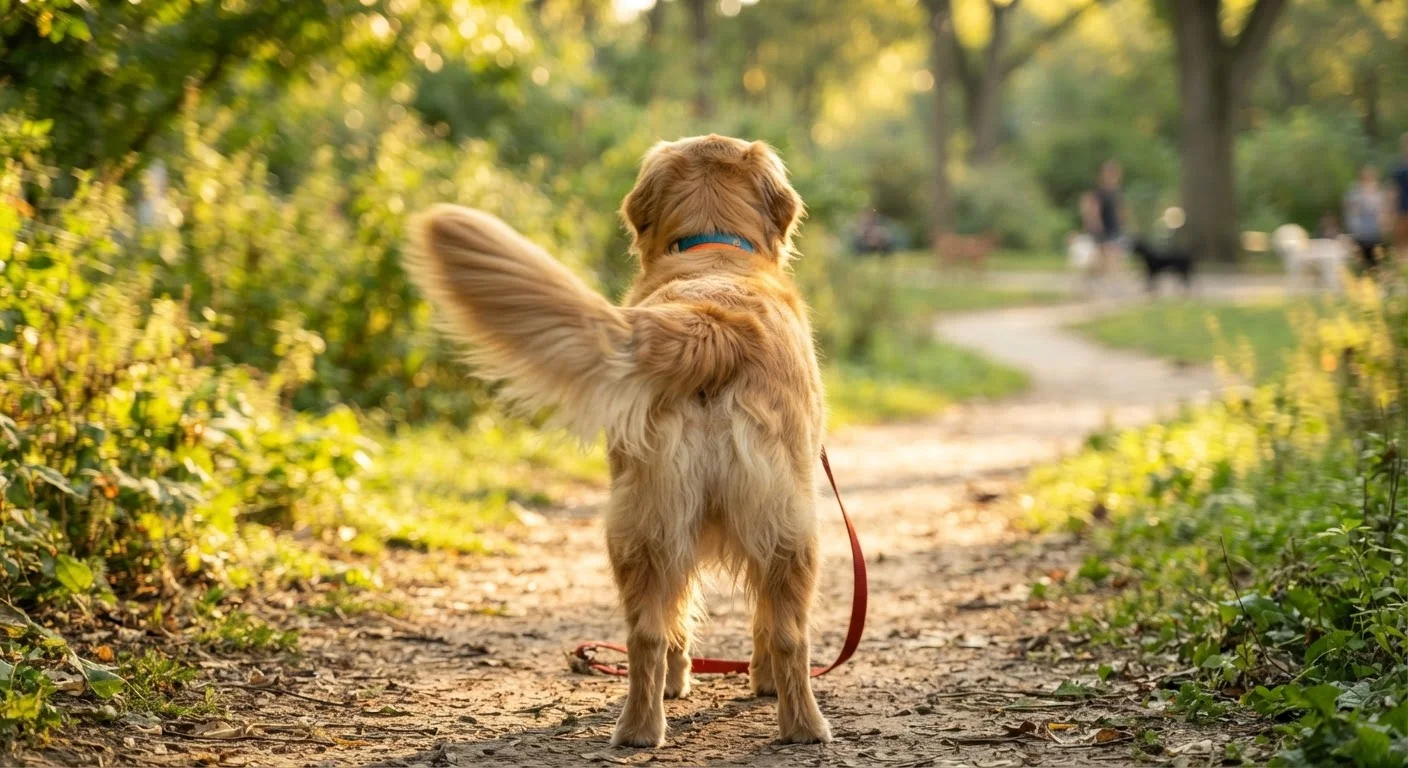
Why the Tail Is More Than a Mood Meter
Most people learn early that a wagging tail means a happy dog. It is one of the most widespread assumptions about canine behavior — and one of the most incomplete. Dogs wag their tails when excited, anxious, conflicted, or even when signaling a potential threat. The wag itself simply means the dog is emotionally activated.
To decode what that activation actually means, owners need to consider three distinct variables simultaneously: height, speed, and direction. Each dimension carries independent information. Together, they form a nuanced signal system that dogs use constantly — and that humans are largely undertrained to read. See our guide to pet body language for a broader breakdown of signals across posture, ears, and eyes.
~250°
Estimated arc of visibility for dog tail signals
Dogs can detect tail movement in their peripheral vision across a wide field, making tail signals effective for at-distance communication within a social group.
2
Distinct brain hemispheres driving wag direction
Research published in the journal Current Biology demonstrated that rightward and leftward tail wags correspond to different emotional processing centers in the canine brain.
4–5
Key body regions to assess alongside tail
Behavioral scientists recommend simultaneously reading tail, ears, eyes, mouth tension, and overall body posture for reliable emotional assessment.
Height, Speed, and Direction: Breaking Down the Wag
Tail height maps roughly to arousal and social confidence. A tail carried high — above the level of the spine — signals alertness, high arousal, or social dominance. A neutral mid-level position typically accompanies a relaxed, comfortable dog. A tail carried low or tucked between the hind legs indicates fear, stress, or submission. Breeds with naturally curled or erect tails (such as Akitas or Basenjis) require some adjustment for baseline anatomy.
Wag speed reflects emotional intensity. A slow, tentative wag communicates uncertainty — the dog is assessing its situation. A wide, fast, full-body sweep tends to accompany genuine positive engagement. A rapid, short, stiff wag at a high position is not a friendly greeting; it is a high-arousal state that can precede aggression.
Wag direction is the subtlest cue. Peer-reviewed research in canine cognition has demonstrated a measurable leftward or rightward bias in tail movement depending on emotional valence. Rightward-dominant wags appear linked to positive states; leftward-dominant wags correlate with negative or avoidant states. While the difference is difficult to detect with the naked eye, it reflects genuine neurological asymmetry in how dogs process emotional experience.
Practice Observing All Three Wag Variables
The next time your dog interacts with a person or another animal, consciously note tail height, wag speed, and whether the motion seems to favor one side. Over time, cross-referencing these cues with context — who the dog is meeting, what's in the environment — builds reliable reading ability. Video recordings can help slow down fast interactions for later analysis.
Reading Tail Signals in Context
No tail signal should be interpreted in isolation. Dogs communicate through a full-body system that includes ear position, facial muscle tension, weight distribution, and eye contact. A tail wagging loosely while a dog's shoulders are dropped, mouth is soft, and ears are relaxed is almost certainly a genuinely happy dog. The same wag speed on a stiff-bodied dog with a closed mouth and hard, direct stare tells a very different story.
This context-dependence is especially important when meeting unfamiliar dogs. A tail in motion is not a green light for approach. Observe the whole animal before assuming friendly intent, and always allow the dog to initiate contact. Dogs that are stressed in ways owners often miss may wag while simultaneously showing subtle avoidance cues like lip-licking, yawning, or turning away.
When Tail Behavior Signals Something Worth Addressing
Persistent changes in how a dog carries its tail can sometimes indicate physical discomfort rather than — or in addition to — emotional state. A dog that suddenly carries its tail lower than usual, holds it rigidly, or guards the base of the tail when touched may be experiencing pain. Conditions affecting the spine, anal glands, or surrounding musculature can all manifest in changed tail posture or movement.
If a behavioral change appears alongside other signs — reduced activity, changes in appetite, sensitivity to touch, or shifts in social interaction — a veterinary evaluation is appropriate. Our article on recognising signs of stress, pain, and illness in pets offers a structured framework for identifying when a vet visit is warranted. Behavioral changes alone, without physical cause, may also benefit from consultation with a certified applied animal behaviorist.
Tail Docking Complicates Communication
Dogs with docked or naturally bobbed tails have a reduced range of expressiveness, which can make their signals harder for other dogs and humans to read accurately. Research suggests this may increase social friction between dogs in group settings. If your dog has a docked tail, pay extra attention to the remaining body language cues to compensate for the reduced signal.
Frequently Asked Questions
No. A wag signals emotional arousal, which can be positive or negative. A stiff, high wag with a tense body may indicate aggression or threat, while a loose, sweeping wag paired with a relaxed posture is more reliably friendly.
A tucked tail — held between the hind legs — signals fear, stress, or submission. It is a dog's way of making itself appear smaller and non-threatening. Persistent tail tucking warrants attention to the dog's environment and overall well-being.
Studies suggest that rightward-biased wags correlate with positive emotional states, while leftward-biased wags reflect negative or uncertain ones. This reflects how each brain hemisphere controls opposite-side body movements and processes different emotions.
Yes. A tail held stiffly upright and moving in short, rapid arcs — especially combined with a rigid body — is a recognized warning signal. It indicates high arousal and a potential threat response, not friendliness.
A slow, low wag generally signals uncertainty or mild apprehension. The dog is processing its environment and has not yet decided how to respond. Give the dog space and avoid sudden movements.
No. Tail signals are one component of a broader communication system. Always read tail position alongside ear placement, body posture, facial tension, and eye contact for an accurate picture of what a dog is communicating.
The content on this site is for informational purposes only and is not a substitute for professional advice. Always consult a qualified professional for guidance specific to your situation.