

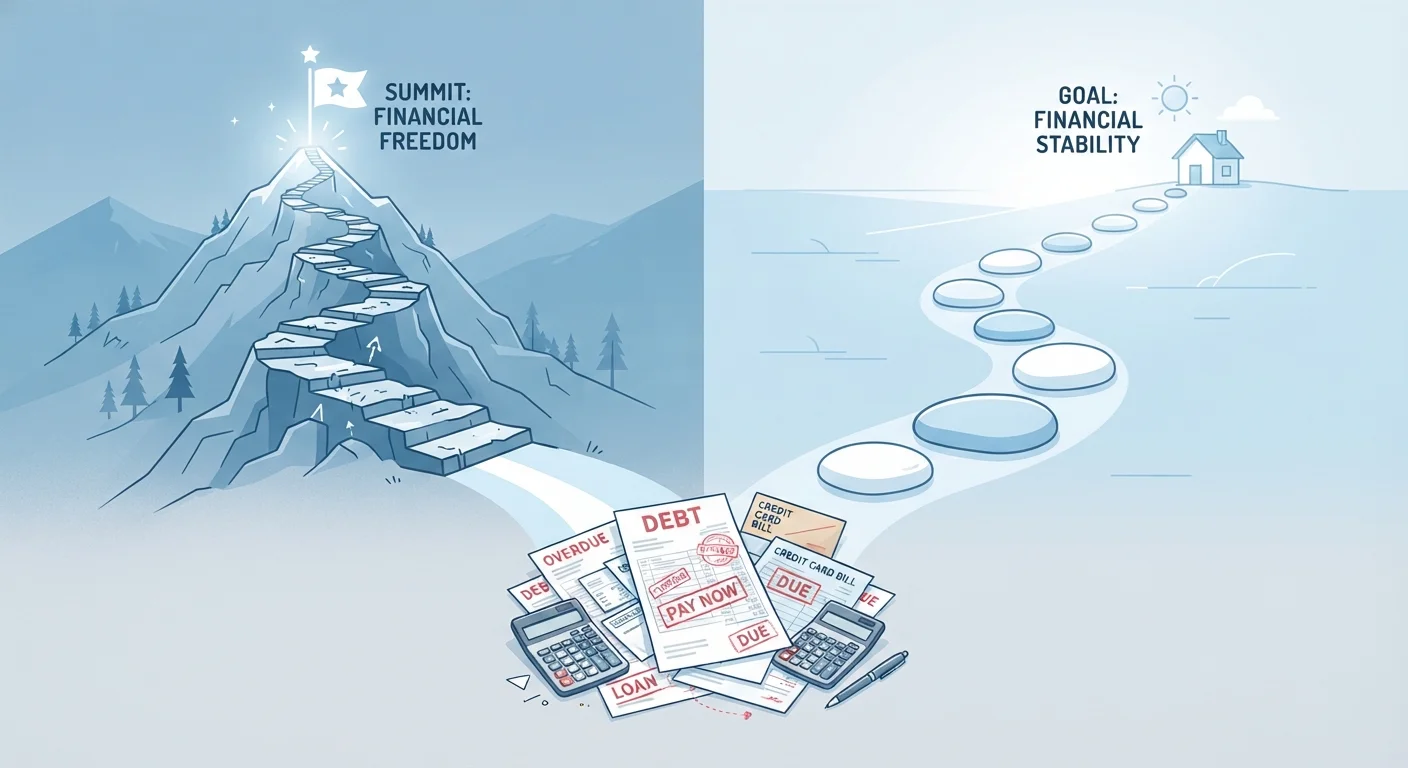
Option A
Avalanche Method
The mathematically optimal, interest-minimising strategy.
Best for: Borrowers who are motivated by long-term savings and comfortable with slower early progress.
Option B
Snowball Method
The psychologically rewarding, momentum-building approach.
Best for: Borrowers who need early wins to stay motivated and have multiple smaller debts to eliminate.
How Each Method Works
Both strategies share the same foundation: you make minimum payments on all your debts, then direct any extra money toward one specific target account. The difference lies entirely in which debt you target first.
With the Avalanche Method, you rank all your debts by APR — the true annual cost of borrowing — and attack the highest-rate balance first. Once that account is paid off, you redirect what you were paying toward the next highest-rate debt, and so on. For a clear definition of APR and related terms, see our plain-language glossary of saving and debt terms.
With the Snowball Method, you rank debts by balance size from smallest to largest, regardless of interest rate. You clear the smallest balance first, then roll that freed-up payment into the next smallest, building momentum as accounts are eliminated one by one.
Neither method requires a specific income level or a minimum number of debts. Both work with any extra amount you can free up — even a modest additional payment each month accelerates progress meaningfully compared to paying minimums alone.
| Criterion | Avalanche Method | Snowball Method |
|---|---|---|
| Repayment order | Highest APR first | Smallest balance first |
| Total interest paid | Lower (mathematically optimal) | Higher (rate ignored initially) |
| Speed of first payoff | Slower if top debt is large | Faster — smallest balance cleared first |
| Psychological reward | Delayed — tied to interest savings | Early — accounts eliminated quickly |
| Best suited for | Disciplined, numbers-motivated borrowers | Borrowers needing momentum and wins |
| Risk of dropout | Higher if progress feels slow | Lower due to regular milestones |
The Case for the Avalanche: Pure Math
From a purely financial standpoint, the avalanche method wins. Interest accrues daily on most revolving debts, so the longer a high-rate balance sits unpaid, the more it costs. By eliminating your most expensive debt first, you reduce the total interest that accumulates across all your accounts throughout the repayment period.
Consider a simplified scenario: two debts — one at 22% APR with a $4,000 balance and one at 9% APR with a $1,500 balance. The avalanche approach directs extra payments to the 22% debt. The snowball approach clears the $1,500 balance first. The difference in total interest paid can be hundreds of dollars, depending on payment amounts and timelines.
~22%
Average credit card APR in the US
According to Federal Reserve consumer credit data, average credit card interest rates have risen significantly in recent years, making high-rate debt especially costly to carry.
3–5 yrs
Typical credit card debt payoff timeline
Financial planning estimates suggest most household credit card debt, paid with consistent extra contributions, takes between three and five years to eliminate fully.
The trade-off is patience. If your highest-rate debt also carries a large balance, early progress feels slow — no account disappears for months or longer. For borrowers who are strongly driven by numbers and have stable financial habits, this is manageable. For others, the lack of visible wins can erode commitment.
The Case for the Snowball: Behavioral Reality
The snowball method accepts a mathematical inefficiency in exchange for a psychological advantage. Eliminating a debt account entirely — even a small one — produces a concrete sense of progress. Researchers studying consumer debt behavior have found evidence that reducing the number of accounts can be more motivating for some people than reducing the total balance or interest owed.
A study published in the Journal of Marketing Research suggested that focusing on individual account payoff, rather than overall debt reduction, may improve repayment rates for certain borrowers. The mechanism appears to be goal completion: finishing something feels rewarding, which encourages continued effort.
Behavioral Economics and Debt Payoff
Behavioral economics research consistently shows that people respond to perceived progress, not just objective outcomes. This is sometimes called the 'goal gradient effect' — motivation tends to increase as people feel closer to completing a goal. The snowball method is deliberately structured around this principle. Understanding your own motivational patterns can be as important as understanding the math when choosing a repayment strategy.
In practice, this means that if the snowball method keeps you making consistent extra payments for three years while the avalanche method causes you to abandon the plan after eight months, the snowball approach may deliver a better real-world outcome — even though it's the costlier method on paper.
If you find your current plan losing steam, our article on signs your debt repayment plan needs a rethink outlines warning signals to watch for.
Choosing Your Strategy — and What Else to Consider
There is no universally correct choice. Your decision should weigh your interest rate spread, the number and size of your debts, your income stability, and — honestly — your own behavioral track record with financial plans.
A few practical considerations worth keeping in mind:
- Hybrid approach: Some people start with the snowball to build momentum, then switch to the avalanche once smaller accounts are cleared. This is a legitimate strategy if it maintains consistency.
- Minimum payments matter: Skipping or reducing minimums on non-target debts damages your credit and triggers fees. Both methods assume all minimums are met first.
- Other options exist: Debt repayment strategies aren't the only tools available. Debt consolidation can restructure what you owe, though it comes with its own trade-offs. Separately, you may not have to choose between debt repayment and saving — see our guide on doing both at the same time.
- Creditor negotiation: If interest rates are a core obstacle, it may be worth understanding what negotiating with creditors actually looks like before committing to a long repayment timeline at a high rate.
This article is for general informational and educational purposes only. It does not constitute personalised financial or legal advice. Please consult a qualified financial professional before making decisions about debt repayment in your specific circumstances.
The content on this site is for informational purposes only and is not a substitute for professional advice. Always consult a qualified professional for guidance specific to your situation.