

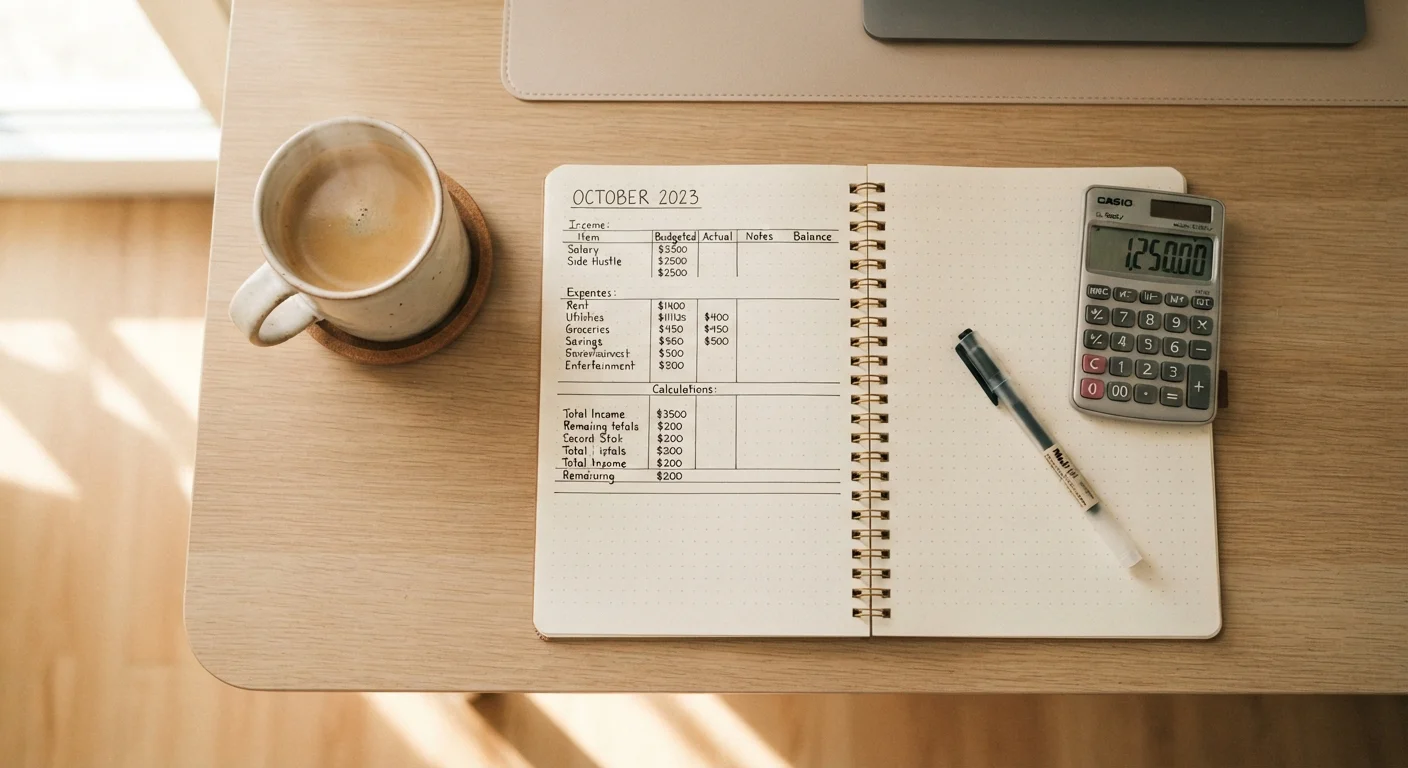
Why Budgeting Matters
A budget is simply a written plan for how you intend to use your money over a set period — most commonly a month. It is not a punishment or a sign of financial struggle. It is the tool that tells your money where to go rather than leaving you to wonder where it went.
Research consistently shows that people who track their spending and follow a plan accumulate more savings, carry less high-interest debt, and report lower financial stress than those who manage money informally. Without a budget, it is easy to under-save, overspend in invisible categories, and feel perpetually behind — even on a reasonable income.
Budgeting also acts as the entry point to broader financial health. Once you know what you spend, you can identify room to build an emergency fund, accelerate debt repayment through the Saving & Debt hub, and eventually redirect surplus toward investing.
~32%
Americans with a written monthly budget
Surveys by NFCC (National Foundation for Credit Counseling) consistently find fewer than one in three U.S. adults maintains a formal budget.
3–6 months
Recommended emergency fund coverage
Financial planning guidance broadly recommends holding three to six months of essential expenses in liquid savings before pursuing other investment goals.
$6,000+
Average U.S. household credit card debt
Federal Reserve data indicates the average indebted U.S. household carries several thousand dollars in revolving credit card balances, underscoring the cost of unplanned spending.
Setting Clear Financial Goals First
A budget without goals is just arithmetic. Before you categorize a single dollar, take time to articulate what you are working toward. Financial goals generally fall into three time horizons:
- Short-term (under 12 months): Building a starter emergency fund, paying off a small credit card balance, or saving for a specific purchase.
- Medium-term (1–5 years): Saving for a home down payment, eliminating student loans, or funding a career change.
- Long-term (5+ years): Retirement savings, children's education funding, or financial independence.
Writing your goals down and attaching dollar amounts and target dates transforms vague intentions into actionable line items in your budget. A goal of "save more" becomes "set aside $300 per month toward a $3,600 emergency fund by next December."
Write your goals as if they are already funded line items in your budget — giving each goal a monthly dollar amount before you start spending makes it far harder to skip.
Behavioral finance research shows that pre-committing a specific amount to a goal (rather than saving 'whatever is left') dramatically improves follow-through.
When categorizing irregular expenses, add a 10–15% buffer to your estimated annual total before dividing by 12 — unexpected costs within those categories are predictably unpredictable.
Most people consistently underestimate variable and irregular spending, which is a primary reason budgets feel like they fail in practice even when the math looked right on paper.
Choosing a Budgeting Framework
No single budgeting method works for everyone. The best framework is the one you will actually stick to. Here are three widely used approaches:
The 50/30/20 Rule
This method divides after-tax income into three broad buckets: 50% toward needs (housing, utilities, groceries, minimum debt payments), 30% toward wants (dining, entertainment, subscriptions), and 20% toward savings and extra debt repayment. It is simple and flexible — a strong starting point for budgeting beginners.
Zero-Based Budgeting
Every dollar of income is assigned a job — spending, saving, or investing — so that income minus outgo equals zero. This method offers precise control and is especially useful for anyone prone to spending whatever is left over at month's end. It requires more time to set up but yields detailed insight into spending patterns.
The Envelope (or Bucket) Method
Spending categories are funded with a fixed amount, historically in cash envelopes but now commonly replicated with digital sub-accounts. When an envelope is empty, spending in that category stops. This method is particularly effective for variable categories like groceries or dining out.
For a detailed walkthrough of constructing your first monthly plan, see Building a Monthly Budget.
Mapping Your Income and Expenses
Before any framework can work, you need accurate numbers. Start by calculating your total net income — the take-home pay that actually lands in your account after taxes, benefits deductions, and retirement contributions. Include all income sources: primary employment, freelance work, rental income, or regular side income.
Next, list every expense. Expenses fall into two types:
- Fixed expenses
- Costs that stay the same each month — rent or mortgage, loan payments, insurance premiums. These are relatively easy to predict.
- Variable expenses
- Costs that fluctuate — groceries, gas, utilities, entertainment. Review 2–3 months of bank and card statements to find realistic averages.
Do not overlook irregular expenses — annual subscriptions, car registration, holiday gifts, or periodic home maintenance. Divide each annual irregular cost by 12 and add that monthly portion to your budget as a sinking fund contribution.
For a comprehensive reference on how to organize these categories, see Common Budget Categories.
Start With Three Months of Statements
Rather than estimating from memory, pull three months of bank and credit card statements to calculate true spending averages by category. Memory consistently underestimates how much goes toward dining, entertainment, and small recurring charges. Accurate baseline data makes your budget realistic from day one.
Building and Maintaining Your Budget
Once you have your income total and a complete expense picture, subtract total expenses from net income. If the result is positive, allocate the surplus to your stated goals. If it is negative, you have a gap to close — either by reducing discretionary spending, increasing income, or both.
A budget is not a set-and-forget document. Plan a brief monthly review — 20 to 30 minutes — to compare actual spending against your plan, adjust for upcoming changes, and recommit to your goals. Many people find a consistent review day (such as the first of each month) helps build the habit.
Tools range from a simple spreadsheet to dedicated budgeting apps. What matters less is the tool and more is the consistency of use. The habit of reviewing where money went — and why — is what produces lasting change.
“A budget is telling your money where to go instead of wondering where it went.”
— Dave Ramsey, Personal finance author and radio host
For evidence-backed strategies on keeping the momentum going past the first few months, see Habits That Keep a Budget Working.
This article is for general informational and educational purposes only and does not constitute personalized financial, tax, or investment advice. Consult a qualified financial professional for guidance specific to your situation.
Adapting Your Budget Through Life Changes
A budget that fit your life last year may not fit today. Major life events — a new job, a pay cut, a move, a growing family, or a health expense — all require a budget reset, not just a small tweak.
When income rises, resist the impulse to expand spending proportionally. Redirect a meaningful share of raises or windfalls toward savings and debt reduction before lifestyle costs absorb them. When income falls, prioritize essential fixed expenses first, then look for temporary reductions in discretionary categories.
As your financial plan matures, the skills you build through consistent budgeting become the foundation for more complex decisions — including exploring concepts in Investing Essentials once your savings base is secure.
A Budget Is a Living Document
Treat your budget as a dynamic plan, not a permanent contract with yourself. Life changes — and your budget must change with it. Reviewing and revising your plan at least once a month is not a sign of failure; it is the core practice that makes budgeting work over the long term. Skipping reviews is the most reliable path to budget drift.
Common Budget Categories Reference
A structured reference covering standard personal budget categories — from housing and transport to subscriptions and irregular costs — to help you build a complete spending map.
Monthly Budget Step-by-Step Walkthrough
A practical, structured walkthrough for constructing your first monthly budget from scratch, including how to tally income and set realistic category limits.
Consumer Financial Protection Bureau (CFPB) Budget Worksheet
The CFPB offers free, printable budget worksheets designed for U.S. consumers to map monthly income and expenses in a straightforward format.
Habits That Keep a Budget Working
Evidence-informed habits for maintaining budget momentum beyond the initial setup phase, especially as life circumstances evolve.
The content on this site is for informational purposes only and is not a substitute for professional advice. Always consult a qualified professional for guidance specific to your situation.