

Summary
22 items · 30–60 minutes
Why These Three Systems Deserve Regular Attention
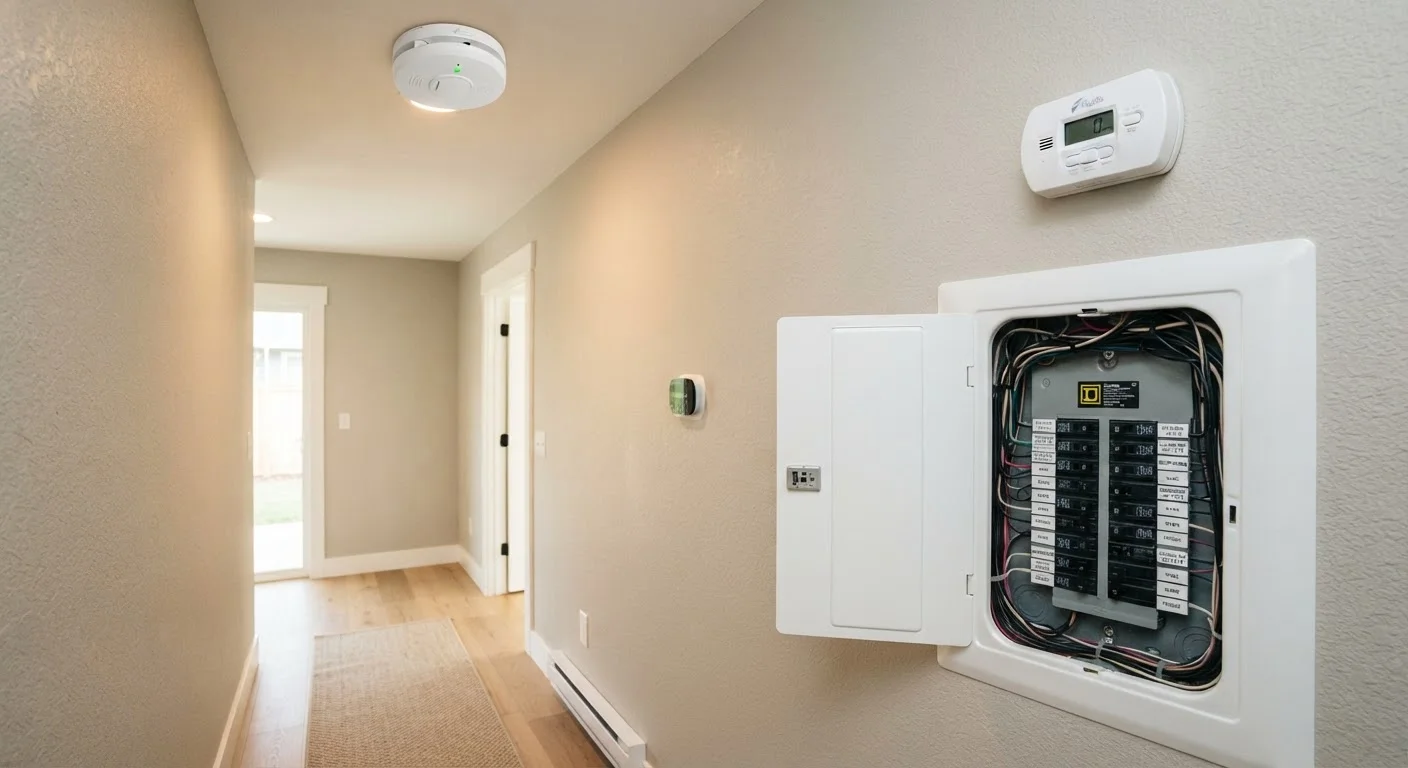
Smoke alarms, carbon monoxide (CO) detectors, and circuit breakers are passive safety systems — they sit quietly until something goes wrong. That invisibility makes it easy to forget they need maintenance. Yet each one can fail silently, providing a false sense of security precisely when you need real protection.
This checklist walks you through a structured audit of all three. It is designed to be completed in a single session, ideally every six months or at the very least once a year. Folding it into your seasonal routine — as covered in our seasonal home maintenance guide — is one of the most effective ways to stay consistent.
Before you begin, gather a stepladder, a fresh set of replacement batteries (AA or 9-volt, depending on your models), a flashlight, and your home's electrical panel diagram if you have one. No special tools or trade knowledge are required for this audit, though any work inside the electrical panel itself should always be left to a licensed electrician.
Stepladder
Provides safe, stable access to ceiling-mounted smoke alarms during testing and cleaning.
Replacement batteries (AA and/or 9-volt)
Used to proactively replace batteries in smoke alarms and CO detectors during the audit.
Flashlight or headlamp
Illuminates the interior of the electrical panel and hard-to-read manufacture date labels inside detector units.
Soft brush or vacuum with brush attachment
Removes dust from alarm vents to maintain sensor accuracy and reduce false alarms.
Home maintenance log or notebook
Records test dates, manufacture dates, and any flagged issues for future reference and scheduling.
Electrical panel directory or diagram
Helps you cross-reference breaker labels against actual circuits during the panel visual inspection.
How to Use This Checklist
Work through each group in order. Mark items as you go — a simple checkmark or a note of the date is enough. If you discover a device that fails a test or is past its replacement date, flag it immediately and prioritize sourcing a replacement rather than leaving the gap open.
For households with multiple floors or sleeping areas, repeat the location-specific checks for each zone. The National Fire Protection Association (NFPA) recommends at minimum one smoke alarm on every level of a home, inside each bedroom, and outside each sleeping area. CO detectors should be placed on every level and near sleeping areas as well.
Never Skip a Failed Test
If any smoke alarm or CO detector does not sound during the test, do not assume it is a battery issue. Replace the unit immediately — do not leave the location unprotected while you wait to source a replacement. A temporary workaround is to relocate a working unit from a lower-priority area until the replacement arrives.
Panel Work Is Not DIY Territory
Visual inspection of the outside of the panel is safe for homeowners. However, any task that requires opening the panel cover to access wiring, replacing a breaker, or adding circuits must be performed by a licensed electrician. Electrical panel work carries a serious risk of electrocution and fire if done incorrectly, and unpermitted work can affect your home insurance coverage.
When your audit is complete, record the test date and the remaining lifespan of each device somewhere accessible — a note inside the panel door, a home maintenance log, or a calendar reminder. This single habit prevents the most common failure mode: forgetting entirely until a low-battery chirp wakes the household at 3 a.m.
Smoke Alarm Audit
Carbon Monoxide Detector Audit
Circuit Breaker Panel Audit
Understanding Replacement Timelines
Even a device that passes every functional test will eventually reach the end of its reliable service life. Sensors degrade over time, and an aging unit may not respond quickly enough in a real emergency even if it still technically chirps when you press the test button.
- Smoke alarms: Replace every 10 years from the manufacture date (printed inside the unit), regardless of apparent function.
- Carbon monoxide detectors: Replace every 5–7 years. Check the manufacturer label — many units print an explicit end-of-life date directly on the device.
- Circuit breakers: Breakers do not have a fixed replacement schedule the way detectors do, but a breaker that trips frequently, feels warm to the touch, or shows visible corrosion or discoloration warrants evaluation by a licensed electrician.
For a broader view of keeping all your home's systems in good shape over time, see our complete home maintenance resource.
A Passing Test Does Not Override Age
A smoke alarm or CO detector that chirps during a test may still be unreliable if it has exceeded its rated service life. Sensor chemistry degrades gradually, and an aging unit may not detect a real emergency at the speed needed to protect your household. Always check the manufacture date — not just the functional response — and replace on schedule.
The content on this site is for informational purposes only and is not a substitute for professional advice. Always consult a qualified professional for guidance specific to your situation.