

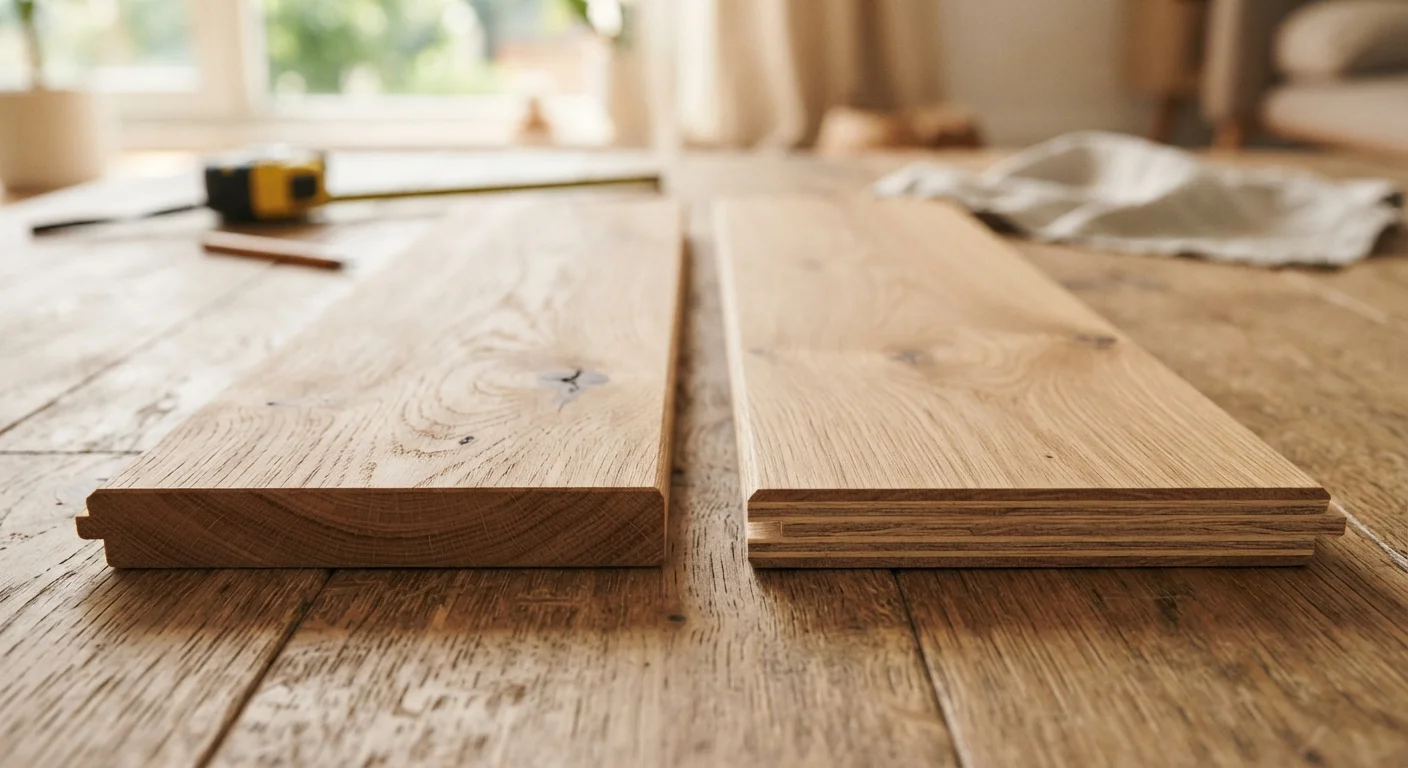
Option A
Engineered Timber Flooring
The moisture-smart, versatile modern option.
Best for: Homeowners installing flooring in basements, kitchens, or over radiant heat systems where dimensional stability matters most.
Option B
Solid Hardwood Flooring
The timeless, refinishable classic for dry spaces.
Best for: Above-grade living rooms and bedrooms in stable humidity environments where long-term refinishing potential is a priority.
How Each Flooring Type Is Constructed
Understanding what's beneath the surface is the fastest way to grasp why these two materials behave so differently in your home.
Solid hardwood is exactly what it sounds like — a plank milled entirely from a single piece of timber, typically between ¾" and ⅝" thick. Because it's one homogeneous material, it expands and contracts as humidity changes, which makes installation location critical.
Engineered timber, by contrast, is built in layers. A real hardwood veneer — often 2mm to 6mm thick — is bonded over a core of cross-stacked plywood or high-density fiberboard (HDF). Those alternating grain directions counteract each other's tendency to move, making the plank far more dimensionally stable. Importantly, the top layer is genuine wood, so the look and feel at surface level is authentic.
| Criterion | Engineered Timber | Solid Hardwood |
|---|---|---|
| Construction | Hardwood veneer over plywood/HDF core | Single solid timber plank |
| Moisture resistance | High — stable in varied humidity | Low — prone to swelling and cupping |
| Installation locations | Above, on, or below grade | Above grade only |
| Radiant heat compatible | Yes (check manufacturer specs) | Generally not recommended |
| Refinishing potential | 1–3 times (veneer-dependent) | 5–10 times over lifespan |
| DIY installation | Accessible (floating method) | More complex; often needs a professional |
| Surface authenticity | Real wood veneer top layer | Solid wood throughout |
Moisture, Climate, and Where Each Can Be Installed
Moisture tolerance is arguably the most important practical difference between these two flooring types, and it directly determines where each can go in your home.
Solid hardwood should only be installed above grade — in rooms at or above the main floor level — and is not recommended over concrete slabs or in areas with high humidity such as bathrooms or unventilated basements. Fluctuating moisture causes solid boards to swell, cup, or gap, and even careful acclimatisation before installation has limits.
Engineered timber can be installed above, on, or below grade, and is generally approved for floating installation over concrete. It also performs well with radiant underfloor heating, provided the manufacturer's temperature guidelines are followed. This flexibility makes it the default choice for renovators working with slab foundations or open-plan layouts that extend into semi-humid zones.
Check Subfloor Flatness Before Installing Either Type
Both engineered timber and solid hardwood require a flat, structurally sound subfloor — typically within 3/16" over a 10-foot span. An uneven subfloor can cause planks to flex, squeak, or loosen over time regardless of which material you choose. Address any high spots or dips before laying your floor.
Always acclimatise either flooring type to your home's humidity and temperature before installation — typically 48–72 hours — to reduce movement after fitting.
Durability, Refinishing, and Long-Term Value
Both materials are durable, but they age differently — and that affects how you should think about long-term cost.
Solid hardwood's greatest advantage is its refinishing potential. Because the board is solid all the way through, it can generally be sanded and refinished anywhere from 5 to 10 times over its lifetime, depending on plank thickness. This means scratches, dents, and dullness can be corrected, potentially extending the floor's life to 80–100 years with proper care.
Engineered timber's refinishing capacity depends entirely on the veneer layer's thickness. A 2mm veneer may tolerate one light sand; a 6mm veneer may allow two or three refinishes. Once that veneer is exhausted, the floor must be replaced. That said, many engineered products carry wear-layer warranties and hold up well to everyday household traffic.
2mm–6mm
Typical engineered veneer thickness range
Veneer thickness directly determines how many times an engineered floor can be sanded and refinished over its life.
80–100 yrs
Potential lifespan of solid hardwood
With repeated refinishing and proper maintenance, solid hardwood floors in stable environments can last for generations.
3x more
Installation location flexibility (engineered vs solid)
Engineered timber is approved for above-, on-, and below-grade use, while solid hardwood is limited to above-grade installations only.
Surface hardness — measured by the Janka scale — is the same for both options when comparing the same timber species. A white oak veneer on an engineered board is just as hard underfoot as a solid white oak plank.
Cost, Installation, and Making the Right Choice
Material pricing for both types varies widely based on species, grade, and veneer thickness, so neither is universally cheaper. Generally speaking, entry-level engineered timber can cost less than premium solid hardwood, but high-end engineered products with thick veneers often approach or exceed mid-range solid hardwood pricing.
Installation is a meaningful differentiator. Engineered timber can be floated (clicked together without adhesive), glued, or nailed, and the floating method in particular is DIY-accessible for a handy homeowner. Solid hardwood almost always requires nail-down or staple-down installation to a wooden subfloor, which is a more involved process typically best left to a professional installer.
When making your decision, weigh these factors together: your subfloor type, the room's humidity level, how long you plan to stay in the home, and your comfort with future refinishing costs. Neither option is universally superior — the right choice depends on the specific conditions of your project.
The content on this site is for informational purposes only and is not a substitute for professional advice. Always consult a qualified professional for guidance specific to your situation.