

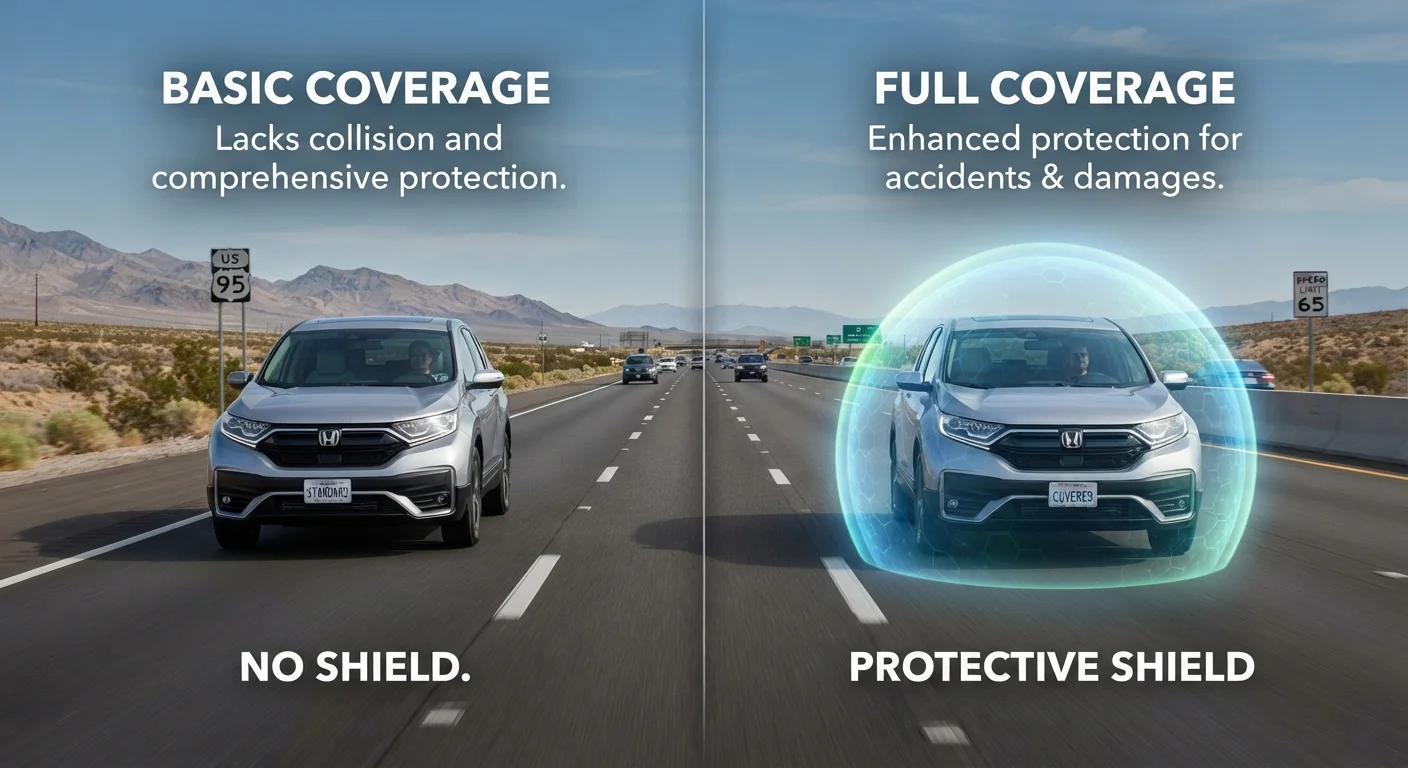
Option A
Liability Coverage
The legally required baseline that protects others.
Best for: Drivers of older, lower-value vehicles who want to meet state minimums at the lowest cost.
Option B
Full Coverage
The broader umbrella that also protects your own vehicle.
Best for: Drivers with newer, financed, or high-value vehicles who need protection beyond third-party damages.
What Liability Coverage Actually Does
Liability coverage is the foundation of any US auto insurance policy and is legally required in nearly every state. Despite being mandatory, it is widely misunderstood — and that misunderstanding can be costly. For a closer look at where state minimums fall short, see what drivers get wrong about auto insurance minimums.
Liability insurance has two distinct components:
- Bodily injury liability: Pays for medical expenses, lost wages, and legal costs if you injure another person in an at-fault accident. It covers the other party — not you or your passengers.
- Property damage liability: Covers repair or replacement of another person's vehicle or property that you damage while at fault.
Liability coverage will not pay for repairs to your own car, your own medical bills (unless a separate medical payments or personal injury protection add-on is in place), or losses unrelated to an at-fault collision. State-mandated minimums are expressed as split limits — for example, 25/50/25 — meaning $25,000 per injured person, $50,000 per accident, and $25,000 for property damage. In a serious accident, these ceilings can be exhausted quickly, leaving you personally liable for the remainder.
Additional Coverages Often Bundled With Liability
Many drivers add optional coverages on top of basic liability: uninsured/underinsured motorist coverage (which steps in when the at-fault driver has insufficient insurance), medical payments (MedPay), or personal injury protection (PIP, required in no-fault states). These are distinct from both standard liability and full coverage, and availability varies by state. Always review your policy declarations to confirm exactly what is and isn't included.
What Full Coverage Adds to the Picture
"Full coverage" is an industry shorthand rather than a formally defined policy type. In practice, it refers to a policy that combines liability with two additional components: collision and comprehensive coverage.
- Collision: Pays to repair or replace your vehicle if it's damaged in a collision with another vehicle or object, regardless of fault.
- Comprehensive: Covers non-collision events — theft, vandalism, weather damage (hail, flooding), fire, and animal strikes.
Both collision and comprehensive come with a deductible — the amount you pay out of pocket before the insurer covers the rest. Choosing a higher deductible lowers your premium but increases your exposure per claim. Neither collision nor comprehensive covers mechanical breakdowns, normal wear, or personal belongings left in the vehicle.
| Criterion | Liability Coverage | Full Coverage |
|---|---|---|
| Covers damage you cause to others | Yes | Yes |
| Covers your own vehicle in a collision | No | Yes (with deductible) |
| Covers theft, weather, or vandalism | No | Yes (comprehensive) |
| Required by state law | Yes (most states) | No (except by lenders) |
| Required by lenders/lessors | No | Yes |
| Typical cost | Lower premium | Higher premium |
| Deductible applies | No | Yes (collision & comprehensive) |
For help interpreting how these coverages appear in your policy documents, reading your auto insurance declarations page walks through every section in plain terms.
How to Decide Which Level Is Right for Your Situation
The right coverage tier depends on three practical factors: your vehicle's current market value, whether you carry a loan or lease, and your personal financial cushion.
~13%
US drivers estimated to be uninsured
The Insurance Research Council has estimated that roughly one in eight US drivers operates without any auto insurance, underscoring the risk exposure even fully insured drivers face from others on the road.
$4,700+
Average collision claim cost
Industry data from the Insurance Information Institute indicates that the average auto collision claim regularly exceeds several thousand dollars, illustrating how quickly out-of-pocket costs accumulate without collision coverage.
A widely cited rule of thumb in the insurance industry suggests that if your annual premium for collision and comprehensive exceeds 10% of your vehicle's current market value, the math may favor dropping to liability only. That said, this is a general heuristic — not a guarantee of the right outcome for everyone's situation.
If you finance or lease, the decision is effectively made for you: lenders require full coverage to protect their collateral. GAP insurance, a separate add-on, covers the difference between your vehicle's depreciated value and the outstanding loan balance if the car is totaled — worth considering on newer vehicles with significant loan balances.
Beyond vehicle value and financing, consider your ability to absorb a sudden loss. If an unexpected $10,000–$15,000 repair or replacement bill would cause serious financial hardship, comprehensive and collision offer meaningful protection. For guidance on keeping your vehicle in good condition and reducing the likelihood of costly incidents, the car maintenance hub covers essential upkeep practices.
This article provides general information about auto insurance coverage types for educational purposes only. Coverage terms, limits, and requirements vary by state and insurer. Consult a licensed insurance professional for advice tailored to your specific circumstances.
The content on this site is for informational purposes only and is not a substitute for professional advice. Always consult a qualified professional for guidance specific to your situation.